
Shopping malls are complex environments where passenger flow directly impacts retail success. Getting visitors from one floor to another — or across long corridors — efficiently and comfortably is a core design challenge. Two of the most common solutions are commercial escalators and moving walkways. While both are powered people-moving systems, they serve fundamentally different purposes. Understanding when to specify each one can save significant costs and improve the overall shopping experience.
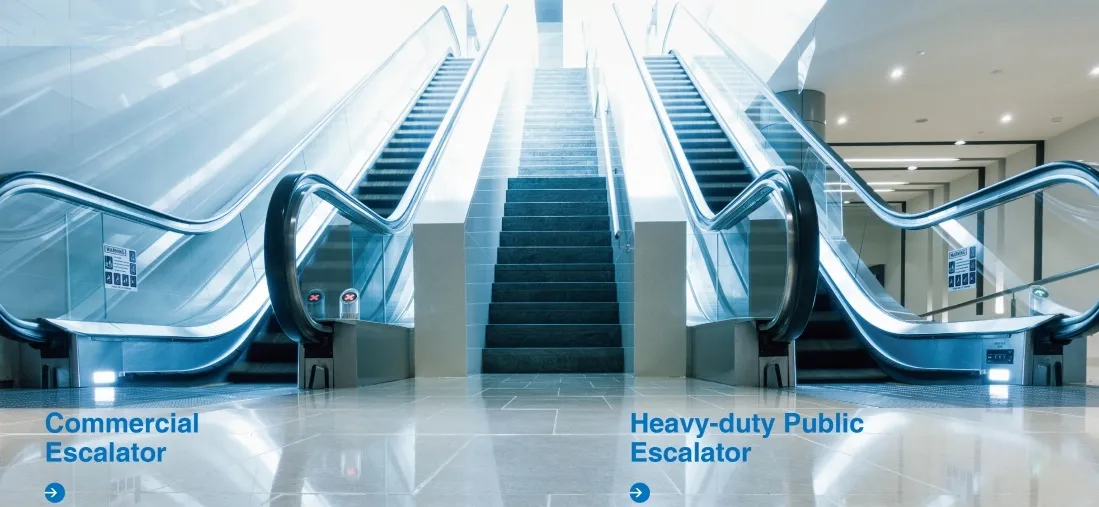
A commercial escalator is a moving staircase designed to transport people between different floor levels. It consists of a continuous loop of steps driven by a motorized chain system, with handrails moving at the same speed on both sides. The standard incline angle for commercial escalators is 30 to 35 degrees, which balances space efficiency with passenger comfort. Each step is typically 600 mm, 800 mm, or 1,000 mm wide, allowing the unit to accommodate different traffic volumes. In a shopping mall, escalators are the backbone of vertical circulation — they connect the ground floor to upper levels, making every retail space accessible and visible to shoppers.
A moving walkway, sometimes called an autowalk or moving sidewalk, is a flat or gently inclined conveyor system that moves people horizontally or at a very shallow angle. Unlike escalators, moving walkways have no steps — the surface is typically a series of metal pallets or a continuous rubber belt. The incline angle is limited to 12 degrees or less, making them unsuitable for floor-to-floor vertical transport. In malls, a moving walk is often found in long entrance corridors, between connected buildings, or in parking garage access tunnels where the main goal is reducing walking fatigue over extended horizontal distances.
The most obvious difference is the step mechanism. Escalators have visible steps that form a staircase — each step rises and then flattens into a platform as it reaches the top or bottom landing. Moving walkways have a completely flat walking surface that remains level throughout the journey. This distinction affects everything from installation requirements to user behavior. Escalators require a structural pit below floor level and upper machine room support, while moving walkways need a longer linear footprint but less vertical structural integration. The handrail systems on both are similar in appearance, but the step-versus-flat surface determines where each can be safely and practically installed.
For mall architects and developers, floor space is always at a premium. Escalators operate at a 30 to 35 degree incline, which means they can bridge a typical floor height of 4 to 6 meters within a relatively compact footprint. A single escalator spanning one floor might occupy roughly 12 to 16 meters of linear space. Moving walkways, by contrast, are limited to a maximum incline of 12 degrees, with most installations operating between 0 and 6 degrees. If you need to move shoppers up one full story, an escalator is the only practical powered option. Moving walkways are best suited for long, nearly flat corridors where the goal is to reduce walking fatigue rather than change elevation.
Standard commercial escalators run at speeds between 0.5 and 0.75 meters per second. Depending on step width, they can handle 6,000 to 9,000 passengers per hour, making them ideal for high-traffic vertical circulation. Moving walkways typically operate at similar speeds — 0.5 to 0.65 meters per second — though some models designed for airports can run faster. One practical difference is that passengers can comfortably walk on a moving walkway to effectively double their travel speed, whereas walking on an escalator is discouraged for safety reasons. For vertical transport in a busy mall, escalators provide higher throughput per unit of floor space. For long horizontal corridors, a moving walkway allows passengers to cover distance with less physical effort.
Both escalators and moving walkways incorporate multiple safety mechanisms. Modern escalators include emergency stop buttons at both ends, handrail entry guards to prevent fingers or clothing from being caught, step demarcation lighting to highlight step edges, skirt brushes to reduce the risk of items being trapped between the step and side panel, and sensors that detect abnormal movement or overloading. Moving walkways feature similar emergency stop systems, handrail inlet guards, and side barriers. Both systems should comply with international safety standards such as EN 115 (European) or ASME A17.1 (North American). Regular maintenance is essential — a poorly maintained escalator or walkway can develop safety issues quickly, so selecting a supplier with reliable after-sales support is critical.
The choice depends on what you need to achieve. If the goal is to move shoppers between floors in a compact, high-traffic environment, commercial escalators are the clear answer. They handle high capacities, fit within tight vertical spaces, and have been the standard in retail environments for decades. For mall operators seeking reliable commercial escalator solutions, it is important to evaluate both the technical specifications and the supplier's track record in delivering and maintaining these systems.
If you have a long, flat corridor — such as a connection between a parking structure and the mall entrance, or a lengthy passage between two wings of the building — a moving walkway reduces walking time and improves the visitor experience. Shoppers carrying bags, families with strollers, and elderly visitors all benefit from the reduced physical strain.
Many large malls use both types of equipment. Escalators handle the vertical circulation between floors, while moving walkways manage extended horizontal passages. Alongside these, elevators are also essential for accessibility, freight movement, and serving visitors who cannot use stairs or escalators. When sourcing these systems, working with a supplier that offers multiple product categories — from escalators and moving walks to passenger and freight elevators — can simplify procurement, streamline installation coordination, and make ongoing maintenance more efficient.
Commercial escalators and moving walkways are complementary rather than competing technologies. Escalators are purpose-built for vertical floor-to-floor transport in compact spaces, operating at 30 to 35 degree inclines and handling thousands of passengers per hour. Moving walkways excel at moving people across long horizontal distances with minimal effort, operating at inclines of 12 degrees or less. For mall developers and operators, the right choice comes down to the specific layout and traffic pattern of the space. By understanding the strengths and limitations of each system, you can design a circulation strategy that keeps shoppers moving comfortably, reduces congestion, and ultimately encourages longer visits and higher retail spending.
Recommend Products












