
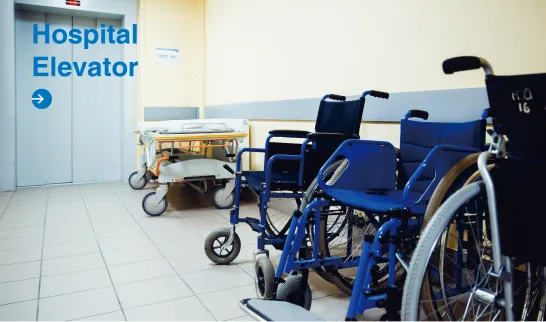
In the heart of every hospital, there's an unsung hero working around the clock—quietly ensuring that the rhythm of care never skips a beat. It's not the surgeons in the OR or the nurses at the bedside, though their roles are irreplaceable. It's the elevators: the silent workhorses that move stretchers through corridors, carry medical equipment to operating rooms, and transport families to visit loved ones. In a setting where every second counts, a hospital's elevator system isn't just a convenience—it's a lifeline. For busy medical facilities, especially those in growing regions like the Middle East, high-capacity elevators aren't a luxury; they're a necessity. And that's where specialized providers step in, turning the challenge of "moving more, faster, safer" into a reality.
Walk through any major hospital, and you'll quickly understand the scale of the task at hand. A typical day might see hundreds of patients being transported for tests, dozens of emergency cases rushing to surgery, and teams of staff moving between floors with bulky equipment—from MRI machines to medication carts. Standard elevators, designed for office buildings or residential towers, simply can't keep up.
Consider this: A standard passenger elevator might carry 8-10 people. But in a hospital, you need to fit a stretcher (2 meters long), a patient, two, and maybe a monitor—all at once. Add in peak hours, like morning check-in times or shift changes, and the strain on under-equipped elevators becomes a bottleneck. Delays here don't just inconvenience people; they risk delaying care, increasing wait times, and adding stress to an already high-pressure environment.
Then there are the safety stakes. Hospitals demand elevators that can handle not just weight, but also specialized conditions: fire-resistant materials to protect against emergencies, antimicrobial surfaces to prevent infection spread, and backup power systems to keep running during outages. For regions like Saudi Arabia, where healthcare infrastructure is expanding rapidly to meet the goals of Vision 2030, these needs are even more critical.
When a hospital sets out to upgrade or install elevators, it's not just shopping for a piece of machinery. It's looking for a partner—one that understands the unique demands of healthcare environments. As a saudi arabia building materials supplier with decades of experience in the region, we've learned that the best hospital elevator solutions aren't just about lifting heavy loads. They're about integrating seamlessly into the entire building ecosystem.
That's why being a one-stop architectural solution provider matters. Hospitals don't need to coordinate with five different vendors for elevators, electrical systems, and fire-resistant materials. They need a single point of contact that can deliver everything from the elevator cab to the wiring, ensuring compatibility, reducing delays, and simplifying maintenance. It's a approach that saves time, cuts costs, and gives hospital administrators peace of mind—knowing their project is in hands that see the bigger picture.
So, what sets a hospital-grade high-capacity elevator apart? Let's break it down:
These elevators aren't just "bigger"—they're engineered for specific hospital needs. A typical high-capacity model offers a payload of 1,600 kg to 3,000 kg (that's 20-35 people, or two stretchers plus medical staff). The cab size is equally important: widths of 2.4 meters and depths of 3 meters ensure stretchers can turn easily, while extra height (up to 2.7 meters) accommodates tall equipment like ventilators.
Hospitals can't afford to cut corners on safety. That's why these elevators come with features like:
It's not enough to carry more—elevators need to move smarter. Modern models use destination dispatch systems that analyze traffic patterns, grouping passengers by floor to reduce stops. For example, during morning rush, elevators might prioritize the ER and maternity ward, while afternoon shifts see more focus on outpatient clinics. This cuts wait times by up to 40%, a game-changer for hospitals where every minute matters.
Today's hospitals aren't just about healing people—they're about healing the planet, too. As part of sustainable building solutions , high-capacity elevators now include energy-saving features like regenerative drives (which feed energy back into the grid when descending) and LED lighting. For facilities aiming to meet Saudi Arabia's Vision 2030 sustainability targets, these details aren't optional—they're essential.
| Feature | Standard Elevator | High-Capacity Hospital Elevator |
|---|---|---|
| Payload | 800-1,000 kg | 1,600-3,000 kg |
| Cab Size (WxDxH) | 1.5m x 1.8m x 2.3m | 2.4m x 3.0m x 2.7m |
| Emergency Power | Optional | Standard (24/7 backup) |
| Fire Rating | 1-hour | 2-hour+ (with fire-resistant materials) |
In 2024, a leading hospital in Riyadh faced a challenge: its existing elevators were causing daily delays, especially during peak hours. With plans to expand its capacity by 50% (adding a new wing for oncology and pediatric care), the hospital needed a solution that could handle increased traffic without compromising safety or efficiency.
As their trusted one-stop architectural solution provider , we worked closely with the hospital's team to design a custom elevator system. We installed four high-capacity elevators (2,000 kg each) with destination dispatch, fire-resistant cabs, and antimicrobial surfaces. But we didn't stop there: as a saudi arabia building materials supplier , we also provided the electrical wiring, emergency lighting, and fire-rated wall panels for the elevator shafts, ensuring every component worked in harmony.
The results? Wait times dropped by 45%, staff reported less stress during shifts, and the hospital's infection control team noted a 20% reduction in surface bacteria on elevator touchpoints. Most importantly, the elevators now support the hospital's mission to deliver care faster—whether it's a critical patient being rushed to surgery or a family visiting a child in the pediatric ward.
The healthcare industry is evolving, and so are the elevators that serve it. Tomorrow's hospital elevators will be smarter, greener, and more connected. Imagine elevators that "talk" to hospital systems: if an emergency is called on the 5th floor, the elevator automatically reserves itself, bypassing other stops to reach the scene faster. Or solar-powered elevators, aligned with sustainable building solutions , that reduce reliance on the grid. For regions like Saudi Arabia, where Vision 2030 emphasizes innovation and sustainability, these advancements aren't just future dreams—they're the standard we're building toward today.
Another trend? Customization. Hospitals have unique needs: a children's hospital might want elevators with calming lighting and playful designs to reduce anxiety, while a trauma center needs maximum speed and durability. As a provider, we're investing in flexible manufacturing to meet these niche demands—because every hospital deserves an elevator system tailored to its mission.
At the end of the day, high-capacity hospital elevators are about more than moving people and equipment. They're about enabling care. They're about ensuring that when a patient needs surgery, the elevator is there. When a nurse needs to reach a Code Blue, the path is clear. When a family needs to be by their loved one's side, the journey is smooth.
As a one-stop architectural solution provider with deep roots in Saudi Arabia and a commitment to sustainable building solutions , we're proud to play a part in that mission. Because in healthcare, every detail matters—and the right elevator isn't just a tool. It's a promise: that no matter how busy the hospital gets, the lifeline keeps moving.
Recommend Products












