
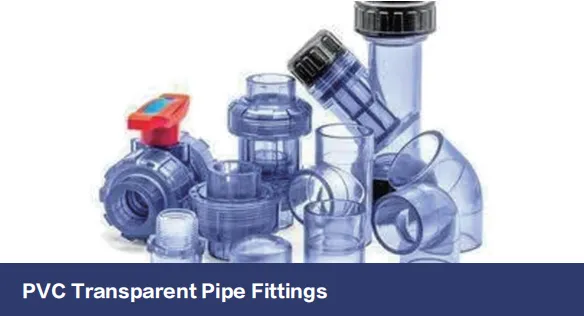
Let's talk about why clear PVC fittings are game-changers. Unlike traditional opaque fittings, transparent variants give you something invaluable: visual feedback. Imagine troubleshooting a clog without disassembling your entire system. That's not just convenient - it's time and money saved. Watching the flow patterns reveals installation errors and performance quirks invisible in standard pipes. Maintenance becomes proactive rather than reactive, preventing small issues from turning into weekend-ruining catastrophes.
But they're not just practical performers. Transparent fittings bring an unexpected aesthetic quality, especially in modern labs or breweries where showcasing processes builds atmosphere. That beautiful cascade of bubbling liquid isn't just functional – it's a conversation starter. The material offers the same chlorine resistance and durability as white PVC, but turns routine plumbing into something visually engaging.
These are the navigators of your piping system. Transparent 90° elbows make crisp turns in tight spaces, while 45° versions create gentler transitions that maintain flow efficiency. You'll notice the difference when pushing thick fluids like brewing wort or liquid fertilizers - the angled approach reduces resistance.
Equal tees divide flow evenly between paths - think laboratory reagent distribution where precise volumes matter. Reducing tees handle the messy reality of connecting different pipe sizes. That visible flow in transparent tees shows something critical: whether both branches get equal flow or if one dominates.
I once saw a hydroponics setup where opaque tees masked an imbalance starving half the plants. Clear versions would've revealed that flaw immediately.
Couplings join twin pipes seamlessly, but reducing couplings are where things get clever. Need to transition from 2-inch main lines to 1-inch feeder lines? This is your tool. The transparent versions offer a bonus: you see sediment patterns where pipe diameters change.
Then there are adapters - the diplomats connecting PVC to other materials like copper or stainless steel. Clear adapters let you monitor these critical transition points where systems most often fail.
These are the unsung heroes when systems need servicing. Threaded unions let you dismantle sections without sawing pipes apart - a lifesaver when replacing sensors or valves. Transparent models offer visible proof of proper sealing before reopening flow.
Consider 3-way unions for distributing supplies to multiple stations, or 4-way versions for complex manifolds. The clear plastic reveals air pockets during priming - invaluable for irrigation setups.
Ball valves deliver instant shut-off while gate valves provide precise flow control. With transparent bodies, you actually see whether gate valves are fully closed or open - no more guessing games. Transparent ball valves show when debris gets trapped in the ball mechanism.
For high-temperature water supply systems, look for CPVC-compatible valves where materials match the piping expansion rates. The see-through quality helps spot scale buildup early.
End caps seal systems permanently against contaminants. Threaded plugs create temporary access points for cleaning or expansion. Clear caps serve as visual indicators when pipelines are charged with fluid.
Crosses manage the complex intersection of four flow paths. Transparent versions are fantastic for spotting vortices where turbulence might damage valves downstream. Reducing bushings gracefully step down pipe sizes within confined fittings. Seeing flow behavior through these junctions reveals whether the transition is laminar or turbulent.
| Application | Why Transparent Wins | Fitting Types |
|---|---|---|
| Lab Setups | Watching flow patterns validates experimental consistency and reveals bubbles compromising results | Valves, Tees, Adapters |
| Brewing/Distilling | Monitoring color changes signals process stages visually while cleaning validation becomes simple | Elbows, Unions, Valves |
| Aquaculture | Spotting sediment or biofoul before it restricts flow prevents catastrophic filter failures | Couplings, Caps, Tees |
| Hydroponics | Nutrient dispersion imbalance becomes visible with root-level clarity across growth zones | Tees, Crosses, Reducers |
Not all clear plastics are created equal. Standard PVC transparent fittings handle 140°F (60°C) - fine for cold water and room-temperature chemicals. CPVC variants push that to 200°F (93°C) for hot water applications. For aggressive chemicals, translucent PVDF offers compatibility charts worth studying.
The schedule thickness tells your pressure story. Schedule 40 (SCH40) handles standard household pressures up to 450 PSI at room temperature. Schedule 80 (SCH80) takes industrial-grade punishment at higher pressure ratings but reduces inner diameter. Seeing that flow difference? That's the beauty of transparent fittings.
Cutting & Cleaning: Always deburr pipe ends thoroughly - those ridges love catching debris you'll later spot through clear fittings. Use dedicated PVC primer even on clear joints; it creates the molecular bond that normal solvent cement relies upon.
Alignment Tricks: Before cementing, dry-fit sections with unions as checkpoints. Seeing potential misalignments through clear fittings avoids pressure-killing kinks down the line.
Cement Techniques: Apply cement to pipe end and fitting socket quickly but thoroughly. The transparency helps immensely: watch the cement wick into the joint gap as you twist. That swirling action creates vital coverage for leak-free bonds.
Clear fittings become your diagnostic partners. That slight discoloration? UV degradation warning. Cloudiness? Either mineral buildup or plasticizer migration telling you to replace soon. Seeing sudden turbulence? Sensor failure or clog approaching.
For cleaning, avoid harsh abrasives that scratch clarity. Simple soap solutions and soft brushes preserve visibility. Chemical deposits sometimes surrender to vinegar soaks - visible confirmation shows when the process completes.
Look for NSF/ANSI 61 certification for drinking water applications or ASTM D1784 ratings matching your chemical needs. Transparent doesn't mean compromise - top manufacturers offer full material traceability.
Beware of cheap imitations. True PVC clarity maintains optical properties for years, while subpar materials yellow quickly. Proper formulations resist cracking and environmental stress like their opaque counterparts.
Transparent PVC fittings transform piping systems from mysterious hidden networks into observable, diagnosable systems. That visual feedback loop improves design efficiency, prevents failures, and simplifies troubleshooting. Whether you're building a precision lab rig, monitoring irrigation flow, or maintaining industrial processes, choosing clear fittings brings functionality and form together in ways that opaque versions never can.
Your piping isn't just transporting fluids anymore - it's communicating with you. All you need to do is watch and learn.
Recommend Products












