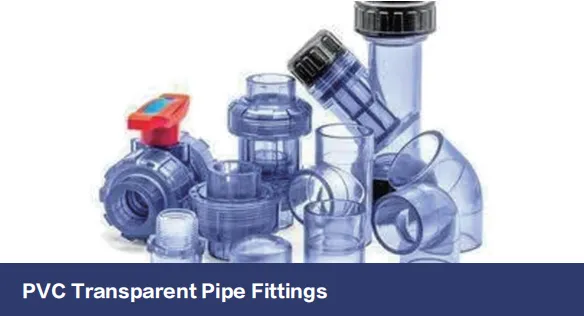
Walk into any modern brewery, biotech lab, or craft distillery, and you'll spot them immediately – those crystal-clear pipelines snaking between tanks and equipment. What was once purely functional industrial tubing has transformed into a canvas for innovation. We're witnessing a quiet revolution where PVC transparent pipe fittings aren't just conveying liquids anymore; they're carrying expectations for customization, specialized performance, and aesthetic integration.
The global plastic pipes and fittings market, valued at $126 billion in 2025, is projected to hit $166 billion by 2030 – a solid 6% annual growth. Within this landscape, transparent PVC fittings are emerging as the unexpected dark horse, evolving from niche specialty items to mainstream solutions as manufacturing flexibility meets designer imaginations.
The Customization Imperative
From Standard to Bespoke
Remember when pipes just connected Point A to Point B? Those days are fading. Today's demand centers on fittings engineered for specific environments – chemical-resistant formulations for semiconductor plants, UV-stabilized variants for greenhouse hydroponics, or anti-microbial versions for pharmaceutical lines. This isn't just product diversification; it's the industrial equivalent of couture tailoring.
The shift shows up clearly in procurement patterns. Five years ago, bulk orders of standard fittings dominated. Now, nearly 40% of industrial buyers request some form of modification – specialized diameters, integrated monitoring ports, or custom-colored polymers. And here's the kicker: manufacturers report these customized orders deliver 25-30% higher profit margins than off-the-shelf products.
Transparency as Functional Advantage
Why transparent? Because seeing really is believing – and trouble-shooting. In food processing plants, supervisors monitor flow without opening systems. Microbrewers track sediment buildup visually. Maintenance teams pinpoint leaks instantly. This functionality fuels adoption beyond visual appeal.
Take aquaculture operations. Over 70% now use transparent PVC in feeding systems to observe food dispersion without disrupting tank environments. Or consider laboratory settings, where researchers need to confirm phase separation in real-time during experiments. In these scenarios, transparency isn't a luxury; it's operational intelligence made physical.
Material Innovation Pace
Bio-based PVC formulations grew >25% annually in 2023-2024 while recycled PVC adoption increased 22%
Profit Premium
Customized pipe fittings deliver 25-30% higher margins than standard industrial equivalents
Design Influence
Architects specify transparent pipe systems 40% more for commercial projects than 5 years ago
Segmentation Unpacked
Material Evolution: Beyond Basic PVC
Not all clear plastics are created equal. The transparent PVC category has splintered into specialized branches, each serving distinct industry needs:
-
Chemically-Inert Formulations:
Used in 65% of laboratory settings with resistance charts matching specific reagents
-
Reinforced Visual Grade:
Polymer blends with
transparent pipe system accessories
preventing optical distortion in monitoring applications
-
Hybrid Composites:
Incorporating glass fiber or carbon nanotubes for pressure handling while maintaining visibility
-
Bio-Attributed PVC:
Plant-based alternatives grabbing 30% market share in eco-sensitive EU markets
Application-First Segmentation
The application defines the fitting. What works for residential water systems fails spectacularly in industrial contexts. Clear segmentation has emerged:
Water Management Systems (28% share)
Municipalities now specify transparent sections at every junction box for rapid leak detection. California's water districts reduced repair response time by 40% using this approach.
Food & Beverage (22% share)
FDA-compliant clear fittings dominate processing lines. Craft beverage boom drives demand - microbreweries average 300+ specialized fittings per facility.
Industrial Process Lines (31% share)
Chemical plants pay premium for corrosion-resistant visibility. Monitoring ports added every 15 feet on average for sampling.
End-User Dimensions
User requirements splinter dramatically across sectors. Residential users want aesthetic consistency and DIY-friendly installation, while industrial buyers prioritize chemical resistance and lifecycle costs.
The healthcare segment presents fascinating evolution. Hospitals deploying advanced liquid medical devices now specify transparent components throughout systems - not just at inspection points - creating "visual verification pathways" that reduce errors.
Asia-Pacific drives nearly 50% of global PVC demand with China commanding 45% share. Construction accounts for over 55% of PVC usage, where transparent elements increasingly substitute traditional materials in dividers, railings, and decorative features. Residential projects alone increased material usage by 35% in 2023 as designers leverage pipe aesthetics.
Regional Hotspots & Design Trends
Asia-Pacific: Customization at Scale
Chinese manufacturers mastered responsive fabrication – changing molds 3x faster than Western counterparts. Shenzhen factories deliver custom orders within 72 hours for regional clients. But beyond speed, Asian producers lead material innovation:
-
Singapore's polymer labs developed self-cleaning nano-coatings
-
Japanese manufacturers pioneered scratch-resistant optical grades
-
Thai firms now offer color-change indicators reacting to temperature shifts
The residential boom shows fascinating adaptation. High-rise developers install transparent drainage systems as design features in lobbies – turning utilities into architectural statements while simplifying maintenance access.
Europe's Sustainability Push
With regulations banning single-use plastics expanding, manufacturers respond with circular solutions. Dutch company Wavin's ReWin initiative recovers PVC from demolition sites, creating premium transparent fittings with 95% recycled content. The kicker? They charge 20% more than virgin material equivalents – and struggle to meet demand.
Meanwhile, Scandinavian architects treat transparent piping as design elements rather than hidden infrastructure. Helsinki's recently opened public library features exposed clear plumbing networks color-coded by function – heating lines glow amber while potable water shines cobalt blue through proprietary pigment techniques.
Emerging Opportunities & Future Outlook
Three seismic shifts will reshape the market landscape:
Smart Integration:
Embedded sensors in fittings will monitor flow rate, temperature and composition without external equipment. Early prototypes from Germany's Fraunhofer Institute pipe surfaces that change opacity when detecting particulate contamination.
Distributed Manufacturing:
On-site fabrication using modular extruders allows engineers to create custom fittings during installations. MIT's mobile units already deploy at pharmaceutical plants needing urgent line modifications.
Bio-Accelerated Decomposition:
New catalyst additives promise PVC that maintains integrity during use but degrades rapidly when landfilled. While early stage, patents filed by chemical giants suggest commitment to solving PVC's environmental paradox.
Investment Priorities (2025-2027)
- Bio-based PVC development: 35% increase
- Customization technology: 30% increase
- Smart material R&D: 28% increase
- Recycling infrastructure: 22% increase
Material Adoption Projections
- Standard PVC: 4.51% CAGR
- Transparent/Recycled PVC: 9.8% CAGR
- Bio-Attributed Formulations: 18% CAGR
The democratization of manufacturing continues driving change. Where only Fortune 500 companies could justify custom tooling five years ago, today's cloud-connected micro-factories allow craft breweries and university labs to order specialized transparent fittings in batches under 50 units. This accessibility fuels experimentation – artisanal cheese makers design transparent cheese brine circulators, while boutique distilleries create glass-like spirit pathways.
Transparent PVC fittings demonstrate the core truth of modern materials – functionality merges with form, engineering dances with aesthetics, and industrial components transform into design statements. What flows through these pipes isn't just liquids, but the future of adaptive infrastructure.