


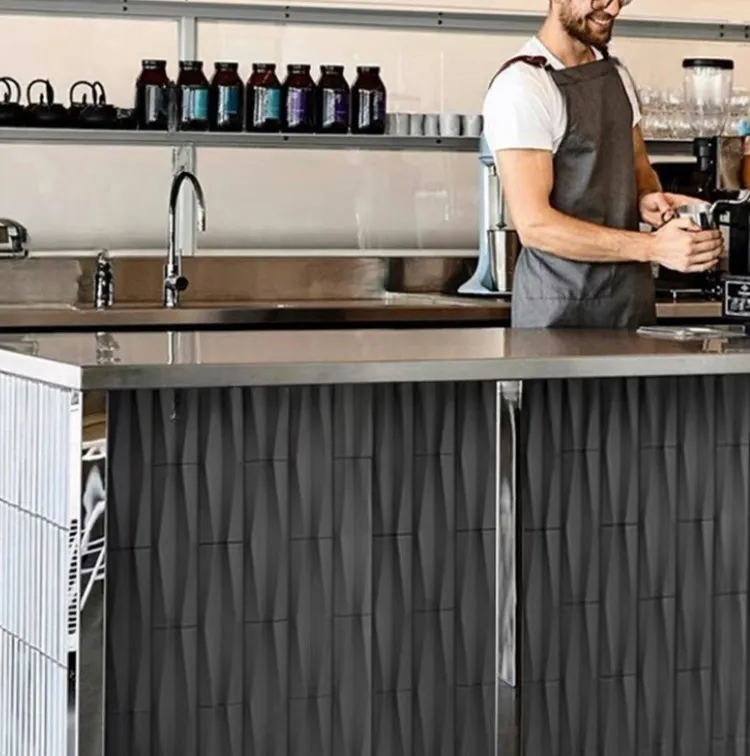
Stone isn't just rock anymore – it's becoming tech. Forget those chunky slabs you're used to; we're entering the era where stone gets supermodel-thin and high-tech, marrying nature's beauty with human ingenuity. Let's peel back the layers on these paper-thin marvels transforming buildings worldwide.
The Tech Revolution in Stone Design
Stone's journey from mountain to monument used to mean brute force – huge saws, heavy equipment, and limitations on what we could create. Today? We're operating at the molecular level, crafting stone surfaces thinner than your phone. These ultra-thin films unlock possibilities architects only dreamed about a decade ago.
What's Driving This Change?
Sustainability: These new approaches use less raw stone – up to 90% less than traditional slabs. That means fewer quarries, less energy in transport, and way less waste ending up in landfills.
Design Freedom: Stone's finally bending to our will – literally. We're wrapping it around curved surfaces, embedding it in complex geometries, even making it transparent for windows.
Cost Effectiveness: Imagine stone performance without stone weight. Buildings need less structural support, installation gets quicker, and maintenance becomes simpler.
Science Behind the Thin Magic
How do you take something as solid as granite and make it whisper-thin? It's all about physics and chemistry playing nice together. These nano-engineered layers transform stone surfaces while preserving their soul:
The Sandwich Effect
These films create a multi-layered protection system. The base adheres like glue to the stone, intermediate layers boost durability, and top layers provide stain resistance – all while maintaining the stone's natural pores.
Invisible Shield
The best treatments are ghost-like – protecting without changing appearance. You get preservation, not plastic-looking fakery. Natural color intensity actually improves as treatments enhance light reflection within the stone.
Water behavior changes dramatically too. Instead of soaking in, it beads up and rolls off like mercury. But vapor? That still passes through. This intelligent moisture management prevents weather damage while avoiding the 'plastic bag' effect of old sealers.
Fabrication Showdown: The Major Players
Three techniques dominate this space, each with their strengths for different applications. Here's how they compare:
Physical Vapor Deposition (PVD)
Think of this as molecular spray painting. We vaporize metals in a vacuum chamber and let them condense onto stone surfaces. The result? Crazy-thin layers – we're talking nanometer-thin – that bond at an atomic level.
Perfect for: Creating metallic finishes on stone (brushed gold on marble anyone?), decorative pieces needing precise detailing, exterior applications demanding weather resistance.
Chemical Vapor Deposition (CVD)
This approach uses gas reactions that create solid deposits – like frost forming on a window, but controlled precisely. It grows protective films molecule by molecule onto stone surfaces.
Where it shines: High-performance architectural applications demanding durable optical effects (think anti-reflective stone windows), extreme weather protection, or chemical resistance.
The Rising Star: Sol-Gel Processing
This liquid-based approach starts as a solution that transforms into a gel, then bonds to stone surfaces. It's simpler equipment-wise and offers insane versatility. Architects love it because:
- Works on complex shapes that wouldn't fit in vacuum chambers
- Adjusts properties easily by tweaking the chemical cocktail
- Creates self-cleaning surfaces using photocatalytic reactions
We're seeing incredible architectural facade solutions emerge from this tech – like stone that sheds dirt when sunlight hits it.
Real-World Magic: Where These Stones Live
Forget theoretical potential – here's where these thin stone technologies are making waves today:
Louvre Abu Dhabi Dome
That breathtaking "rain of light" effect? It comes from multi-layer thin films on the dome structure – manipulating sunlight while protecting the underlying materials. It creates that magical dappled light effect museum-goers love.
Shanghai Tower's Skin
The world's second tallest building wears double-skin façades with smart thin films. They reject solar heat while letting daylight through, slashing AC costs dramatically. Engineers estimated energy savings equivalent to powering hundreds of homes.
Residential projects are embracing these technologies too. Picture kitchen backsplashes with marble veining that are actually heat-resistant enough for cooking zones. Or shower walls that look like natural travertine but laugh at moisture and soap scum.
Building Smarter, Not Harder
The evolution continues as these technologies mature:
Intelligent Surfaces
Next-gen films will adjust properties based on conditions – darkening when the sun blazes for heat control, then clearing in cooler weather for solar gain.
Bio-Inspired Tech
Researchers are mimicking nature's nanostructures (think lotus leaves or butterfly wings) to create surfaces that are easier to clean and maintain.
Installation processes are evolving too. We're moving toward robotic precision application that ensures perfectly uniform coverage regardless of stone shape. Quality testing has advanced to molecular-level inspection guaranteeing every installation meets specifications.
The Bottom Line: Why This Matters
Ultra-thin stone finishes represent more than just technical novelty – they're changing how we build and conserve architecture. By combining natural beauty with high-tech performance, we're creating materials that:
- Preserve heritage structures with minimally invasive methods
- Enable designs previously impossible with natural stone
- Reduce environmental impact throughout the building lifecycle
The future of stone lies not in thicker slabs, but in smarter applications. These ultra-thin technologies deliver stone's timeless beauty where we couldn't use it before. It's like putting stone in places it doesn't belong – elegantly, efficiently and sustainably.










