


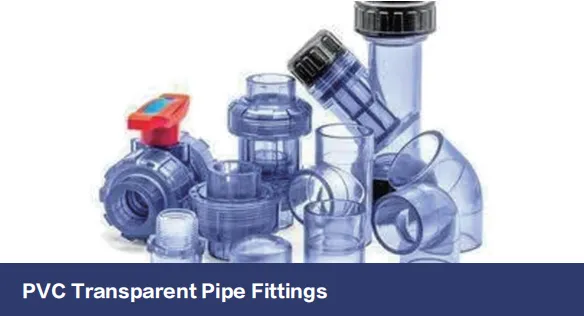
Let's talk about something that often doesn't get the spotlight it deserves - the silent guardians in our fire safety systems. You've probably walked past them thousands of times without noticing: those clear plastic pipes weaving through ceilings and walls. What makes these unsung heroes so special? Their unique ability to resist flames while letting us literally see through them. Today we're pulling back the curtain on how PVC transparent fittings have become indispensable in critical applications where safety can't be compromised.
The Science Behind the Safety
When you think "fire safety," plastic might not be your first thought. But transparent PVC pipes play a crucial role thanks to their engineered molecular structure. Unplasticized Polyvinyl Chloride (UPVC) contains high chlorine content (around 56-57%), creating a natural flame resistance that's hard to find in other materials.
How exactly does this work? When exposed to flame, PVC forms a protective char layer that acts like a firefighter's shield. This char insulates the material underneath while releasing hydrogen chloride gas that dilutes oxygen near the flame - essentially choking the fire before it can spread.
But here's where transparent PVC fittings stand apart: manufacturers have perfected the chemistry to maintain optical clarity without sacrificing fire resistance. Achieving this requires meticulous attention to additives and stabilizers during production.
Practical Applications Where Transparency Saves Lives
The "see-through" factor isn't just for show - it transforms how we manage critical systems:
- Chemical Processing Monitoring: In pharmaceutical plants and labs, engineers can spot flow irregularities, sediment buildup, or contamination without opening systems - a safety game-changer when handling volatile compounds.
- Biotech Fluids Management: Maintaining sterility is non-negotiable. Transparent fittings allow technicians to verify purity levels visually, reducing invasive testing that risks contamination.
- Fire Suppression Systems: Here's where it gets critical. Transparent pipes act as the eyes in sprinkler systems , letting maintenance teams inspect for blockages or water quality issues without disassembly. This visibility directly translates to reliability in emergencies.
- Food Production Lines: Compliance officers can conduct hygiene audits by simply walking production lines, spotting any residue or microbial growth before it becomes a health hazard.
Putting Materials to the Test
How does transparent PVC measure up? These industry-standard tests tell the real story:
| Test Standard | What It Measures | PVC Performance | Critical Requirement |
|---|---|---|---|
| UL94 V-0 | Vertical burn resistance | Self-extinguishes in <5 seconds | Prevents flame propagation |
| LOI (Oxygen Index) | Minimum oxygen concentration to sustain fire | ≥45% (needs high oxygen to burn) | Natural flame resistance |
| ASTM E84 | Flame spread & smoke density | Class A rating (best possible) | Minimizes toxic smoke |
| ISO 4589-2 | Limiting oxygen concentration | 40-49% (difficult to ignite) | Fire containment |
These certifications aren't just paperwork - they're proof that transparent PVC won't be the weak link in your safety chain. The material naturally resists ignition and contains fires rather than feeding them.
Why Choose Transparent PVC Over Alternatives?
Other materials come with compromises that PVC avoids:
- Glass: While visually clear, it's fragile and dangerous when ruptured. PVC maintains visibility without shattering risks.
- Standard Plastics: Polypropylene or polyethylene may be cheaper, but they melt rapidly in fires and drip flaming material.
- Metal Piping: Opaque by nature, requiring invasive inspection ports. Metal also conducts heat rapidly, potentially spreading fire.
During a facility upgrade at a German chemical plant, switching to transparent PVC fittings resulted in a 75% reduction in system inspection time. Maintenance crews could identify sedimentation issues immediately instead of shutting down lines for internal inspections.
The Installation Advantage
Transparent PVC doesn't just perform well - it installs smartly too:
Chemical Welding: Unlike threaded metal connections prone to leaks, solvent cement creates seamless joints. The transparency lets installers verify proper cement distribution for perfect seals.
Thermal Expansion Handling: Engineers design routing paths that account for PVC's natural expansion/contraction. Proper bracing prevents stresses that could cause failures during temperature fluctuations.
Lightweight Advantage: At roughly 1/5 the weight of steel, PVC reduces structural support requirements significantly. Entire systems in pharmaceutical facilities have been relocated without building modifications.
Sustainable Safety
Modern PVC solutions bring eco-advantages that might surprise you:
- Many manufacturers now use calcium-based stabilizers instead of heavy metals
- Production energy requirements are 30-50% lower than metal alternatives
- New recycling methods break down PVC into reusable components with zero landfill impact
A lifecycle analysis revealed that transparent PVC piping systems generate 44% lower greenhouse gas emissions compared to stainless steel alternatives across manufacturing, transport, and installation.
Evolving With New Safety Challenges
Innovation continues with two exciting frontiers:
Nano-composite Reinforcements: Incorporating materials like layered silicates at molecular levels boosts heat deflection temperature without compromising clarity or flame retardancy.
Intelligent Sensing: Embedding micro-optic sensors in pipe walls can detect temperature spikes, pressure changes, or chemical permeation while maintaining visibility - creating truly smart piping networks.
The Life-Saving Transparency Takeaway
From pharmaceutical clean rooms to industrial fire suppression systems, transparent PVC has proven itself as more than just convenient plumbing. Its unique combination of optical clarity and flame resistance transforms piping from hidden infrastructure into a visible safety asset.
The next time you see those clear pipes running along a ceiling or wall, remember you're looking at a sophisticated safety technology working 24/7 to protect people and processes - giving us the power to see potential problems before they become emergencies.










