
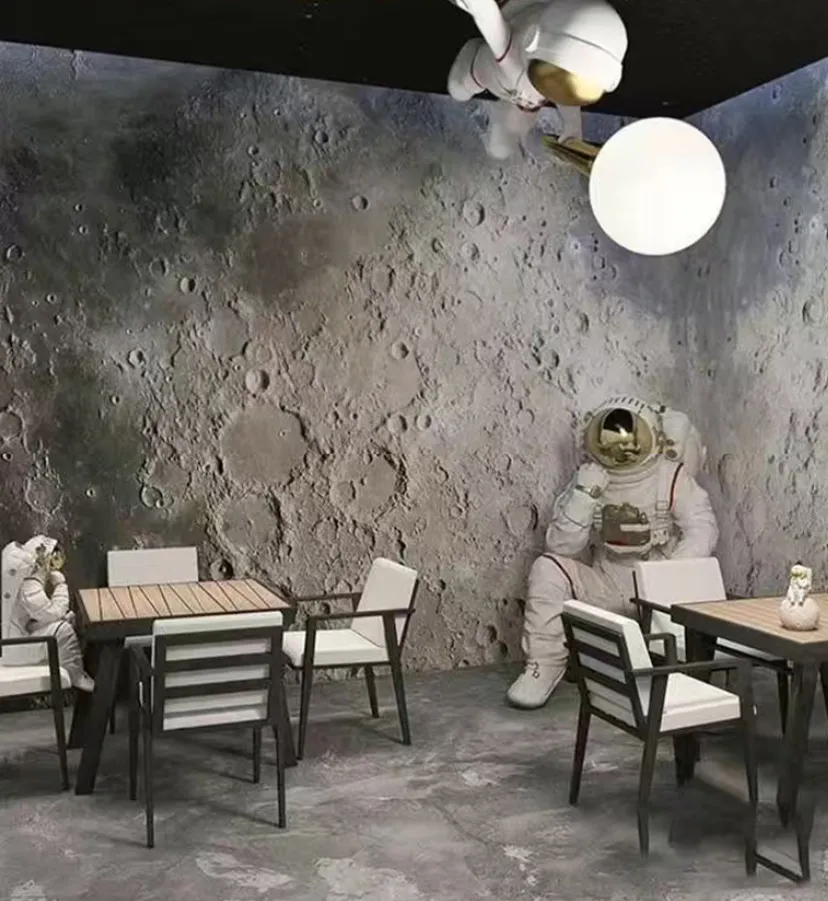
Picture walking into a hotel where the lobby doesn't just welcome you—it transports you. Where every surface seems carved from celestial bodies, where lighting mimics distant galaxies, and where the very air feels charged with cosmic wonder. That's the magic of space-themed hotel lobbies inspired by moon rocks, and today we're exploring five exceptional examples that have truly mastered this otherworldly aesthetic.
The Lunar Citadel isn't shy about its interstellar ambitions. Walking in feels like stepping into Armstrong's footprint. Architects used actual pulverized moon rock composites—lightweight yet textured—to create the central reception desk that glows with soft bioluminescence. The walls? They're layered with recycled spacecraft aluminum and 3D-printed basalt tiles resembling lunar craters.
But what truly makes you catch your breath is the celestial dome above. Nearly 10,000 fiber-optic points recreate the exact star constellation visible from Mare Tranquillitatis. Guests often linger just to spot familiar formations. As hotel manager Sabine Renault puts it: "We're not just designing space—we're bottling moon dust magic."
Japan's answer to cosmic luxury hides beneath Tokyo's bustling streets. Stellaris Station plunges visitors 15 meters underground into a pressurized chamber reminiscent of moon bases. The genius lies in its decorative profiles —minimalist chromium lines tracing constellations across obsidian walls. Like following Orion's belt through a void.
Furniture floats on magnetic fields, bartenders serve "crater cocktails" in zero-g tumblers, and the floor replicates the moon's Sea of Serenity through backlit resin. Acoustic panels absorb sound so completely you hear your own heartbeat—an intentional design choice evoking space's profound silence. The owners collaborated with JAXA to ensure scientific accuracy down to the regolith samples displayed like religious relics.
Emerging from Arizona's red rocks like a crashed spacecraft, the Apollo Atrium uses local geology to stunning effect. Architects sourced over 40 tons of crushed quartz mimicking lunar dust which they sealed into glow-in-the-dark pathways. The effect? You tread on moonlight.
The centerpiece is a genuine Apollo-era heat shield suspended above the lounge. Backlit panels surrounding it radiate warmth gradients representing re-entry temperatures. Meanwhile, sustainably harvested meteoritic iron forms the bar counter—cool to touch but visually fiery. General Manager Eli Vasquez beams: "We've turned guests into astronauts. First-timers whisper; repeat visitors bring telescopes."
At 4,000 meters elevation, Mare Respite practically touches the stars it celebrates. The lobby mirrors the moon's South Pole-Aitken basin through concave terrazzo flooring containing actual asteroid fragments. NASA scientists consult on the dynamic lightscapes simulating lunar day cycles—brighter and more frequent than Earth's.
Cleverly integrated thermal panels heat seating during cold Andean nights while preserving energy-efficiency. The textured ceiling uses nanomaterials changing opacity to simulate Earthrise views. But the emotional core might be the "Wish Wall" where guests embed messages in synthetic moon rock—a collective time capsule destined for future lunar museums.
Iceland's geothermal energy meets cosmic inspiration at Selenite Dreams. Basalt columns frame the entrance like natural rocket exhaust plumes, while inside, geothermal pipes double as sculptural elements recalling lunar lava tubes. The architects brilliantly used Iceland's volcanic grit to create acoustics resembling the moon's sonic emptiness.
Hydrothermal veins in the polished floor mimic lunar mineral deposits visible only under UV night lighting. The concierge desk floats on nearly invisible tension cables—a gravity-defying trick that delights physics enthusiasts. As head designer Björk Stefánsdóttir admits: "We didn't build this lobby. We coaxed it from volcanic dreams and NASA topography scans."
These five lobbies prove space-inspired design isn't about cold futurism—it's tactile, emotional, and profoundly human. From Tokyo's precise astronomical detailing to Arizona's geological poetry, each space invites not just admiration, but childlike wonder. As commercial space travel looms, these sanctuaries offer something vital: earthly places where we can touch the cosmos with both hands.
Next time you enter one, pause. Run your hand along cratered walls, watch artificial constellations shift, and feel that leap in your chest. That's not just good design—that's the eternal pull of the cosmos rendered in stone, light, and stardust-infused imagination.
Recommend Products












