
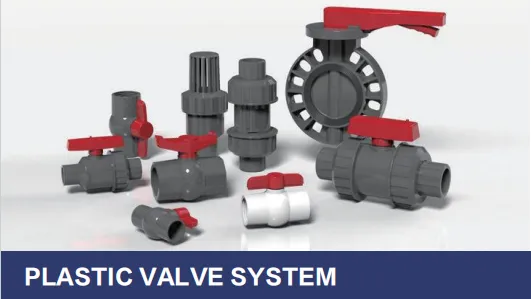
Your comprehensive guide to navigating the world of industrial plastic valves
Imagine walking through a state-of-the-art water treatment facility or a cutting-edge pharmaceutical plant. What you might not notice are the unsung heroes quietly ensuring everything runs smoothly - plastic valves. These engineering marvels have transformed fluid management across industries, replacing traditional metal valves with solutions that offer superior corrosion resistance, lighter weight, and better cost-efficiency.
Unlike their metallic counterparts that rust and decay when exposed to harsh chemicals, plastic valves laugh in the face of corrosive substances. That's why they've become the go-to choice for industries ranging from chemical processing to municipal water systems. Whether it's PVC valves handling your drinking water or CPVC valves regulating industrial chemicals, these polymer-based solutions offer reliability where it matters most.
Modern plastic valves aren't created equal - manufacturers now use advanced polymers like PVC, CPVC, PP, PVDF, and PTFE that each bring unique strengths. Picture PVDF valves handling high-purity applications in semiconductor manufacturing, while rugged PP valves manage abrasive slurries in mining operations. It's this material diversity that allows engineers to precisely match valve specifications to application demands.
Cost efficiency isn't just about the sticker price either. Consider the total lifecycle: plastic valves require less maintenance, don't corrode, and typically outlast metal alternatives in corrosive environments. Maintenance teams everywhere are breathing easier thanks to reduced downtime and repair costs. And let's not forget the weight advantage - plastic valves weigh up to 70% less than metal equivalents, making installation and handling dramatically easier.
The plastic valve manufacturing landscape is filled with specialists and innovators. Let's meet some key players redefining industry standards:
These industry pioneers have tackled the toughest challenges in corrosive liquid control. Their specialty? Handling nasty stuff like sodium hypochlorite and hydrochloric acid that would eat through lesser valves. With custom solutions available, they're the emergency responders of the valve world.
Imagine a one-stop valve shop with everything from industrial butterfly valves to sediment strainers. That's TVI's playground. Their thermoplastic valves work up to 235 PSI across water treatment and food processing. Simple, reliable, and maintenance-friendly – the trifecta of good engineering.
Hailing from Spain, these specialists craft corrosion-resistant valves specifically for chemical and pharmaceutical applications. Their secret? Flexible production that tailors valves to your exact specifications. When standard valves won't cut it, PureValve steps up.
For automated precision, Uflow's plastic solenoid valves offer sophisticated control in compact packages. Available in sizes from 1/8" to 2", they handle everything from air to fuel at various temperatures. Direct-operated or pilot-controlled – they've got your automation covered.
This company brings serious engineering muscle to plastic valves. Their products undergo seven-step quality inspections and hold ISO certifications. With diaphragm, ball and butterfly valves designed for demanding applications, KOSCN means business in all the right ways.
Choosing the right plastic valve manufacturer feels daunting with so many options. But approach it systematically:
Match the valve material to your fluid's chemistry. CPVC handles hot water beautifully, while PVDF shrugs off aggressive chemicals. Think about temperature ranges too – some polymers soften under heat where others maintain integrity.
Don't guess – calculate. Know your system's maximum pressure and flow rates before selecting. Underestimating leads to failures, while oversizing wastes money.
Threaded, socket weld, flanged – your piping system likely dictates the connection style. Manufacturers offer various options, so specify your requirements clearly.
For critical applications, insist on certifications like NSF/ANSI 61 for potable water or FDA compliance for food processing. Reputable manufacturers gladly provide documentation.
Look beyond purchase price. Factor in installation labor, maintenance costs, and expected service life. A slightly more expensive valve often pays for itself through reduced downtime.
| Manufacturer | Specialty | Pressure Rating | Key Industries | Unique Advantage |
|---|---|---|---|---|
| Plast-O-Matic | Corrosive fluids | Custom solutions | Chemical, Ultra-pure | Handles extreme chemistry |
| TVI Valves | Comprehensive range | Up to 235 PSI | Water, Food, Pharma | One-stop valve solutions |
| Asahi/America | High purity systems | ISO certified | Semiconductor, Pharma | Minimal contamination design |
| IP Valves | Solenoid valves | High-flow options | Industrial automation | Precise flow control |
| PureValve | Custom engineering | Chemical resistance | Chemical processing | Tailored solutions |
| GEMÜ Group | Diaphragm valves | Industrial strength | Water treatment, Chemical | Ultra-pure options |
As you review manufacturers, consider the specific scenarios where each excels. For standardized applications requiring reliable performance, companies like TVI offer proven solutions. When facing unique chemical challenges, specialists like Plast-O-Matic provide custom engineering expertise. Water treatment facilities implementing sustainable solutions particularly benefit from plastic valve technology.
The plastic valve world extends far beyond simple ball valves. Innovative solutions continue emerging:
These electronically-controlled valves deliver precision fluid management. From irrigation systems to industrial automation, they enable remote operation and fine-tuned control unavailable with manual valves.
Pharmaceutical and food industries depend on these for uncontaminated flow. The sealed design prevents fluid contact with mechanical parts - crucial for sterile processes.
When large flow capacity matters, butterfly valves deliver. Their compact design handles larger pipe diameters than comparable ball valves while maintaining excellent shutoff capability.
These unsung heroes prevent backflow, protecting pumps and sensitive equipment. Modern plastic check valves feature designs that minimize pressure drop while preventing reverse flow.
Absolutely. Modern engineering-grade plastics withstand pressures exceeding 200 PSI while maintaining corrosion resistance. Manufacturers design valves specifically for industrial environments - they're not your typical hardware store fittings.
Consider three key factors: chemical compatibility, temperature range, and pressure requirements. PVC suits water applications below 140°F, CPVC handles hotter water, while PVDF excels with aggressive chemicals. Reputable manufacturers provide detailed chemical resistance charts.
Yes, and effectively so. Plastic valves work well with electric, pneumatic, and hydraulic actuators. Manufacturers offer pre-configured automated assemblies or components to integrate into existing systems.
Critical applications demand validation. Look for NSF/ANSI 61 for potable water, FDA compliance for food processing, and various industrial certifications like ISO 9001. Reputable manufacturers readily provide documentation.
Properly specified valves last for decades. Unlike metal valves that corrode and fail, plastic valves maintain integrity as long as they're within their chemical and temperature limits. Regular inspections will help maximize their service life.
Successfully integrating plastic valves requires more than just good products:
Follow manufacturer instructions precisely – overtightening plastic threads causes cracks. Use compatible pipe dope, not Teflon tape that can shred. Allow for thermal expansion in hot applications.
Schedule annual inspections checking for: visible cracks, stiffness in operation, seal integrity. Keep stems lubricated and actuators calibrated according to manufacturer schedules.
Stock critical spares like seals and diaphragms. Note that plastic valve repair kits typically cost less than metal equivalents. Identify long-lead components before problems occur.
Educate staff about specific differences from metal valves – no pipe wrenches! Teach proper operation methods, torque specifications, and leak troubleshooting.
The plastic valve evolution continues accelerating:
Valves with embedded sensors now monitor flow rates, pressure differentials, and even detect leakage. This IoT connectivity enables predictive maintenance - replacing valves before they fail.
Materials science keeps pushing boundaries. New polymer formulations now withstand higher pressures and temperatures while improving chemical resistance. Future valves will operate reliably in currently impossible conditions.
Additive manufacturing allows complex geometries previously unattainable with molding techniques. This enables hyper-specialized valves for unique applications.
Manufacturers increasingly adopt renewable energy and recycled materials. Bio-based polymers now enter valve production, reducing environmental impact.
Leading manufacturers continue developing new product options to serve evolving markets. Their ongoing commitment to manufacturing excellence ensures the availability of increasingly sophisticated solutions.
Choosing the right plastic valve partner deserves careful consideration. Evaluate potential suppliers based on:
Technical Expertise: Can they discuss your specific application knowledgeably? The best manufacturers act as consultants, not just parts suppliers.
Customization Capabilities: When standard products won't work, can they engineer solutions? Look for manufacturers that offer custom molding and machining.
Quality Assurance: What certifications do they hold? How extensive is their testing? Reputable manufacturers provide detailed documentation.
Logistical Reliability: On-time delivery matters. Inquire about lead times and stocking programs for critical components.
Post-Sale Support: What happens after installation? Technical support, training resources, and spare parts availability separate the best from the rest.
When you finally select a partner, start with a small order. Validate their claims about quality, performance and service before committing to large volumes. The right plastic valve manufacturer becomes a long-term strategic partner contributing to your operational success.
Recommend Products












