
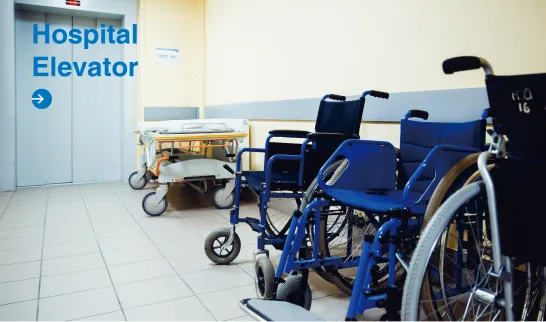
Walking through a hospital's bustling corridors, you'll notice a silent hero working behind the scenes - the hospital elevator. These aren't your average building lifts; they're specialized systems engineered for critical moments when seconds count. Whether transporting a newborn to the NICU or rushing a trauma patient to surgery, hospital elevators serve as vital lifelines that impact outcomes in unspoken ways.
Consider this: during the 2013 Boston Marathon bombing response, hospital elevators moved over 150 critical patients between floors in just two hours. That's one life-changing trip every 48 seconds. This isn't just machinery – it's a heartbeat monitoring a facility's circulatory system.
You can't just plug a standard office building elevator into a hospital and call it done. Medical facilities demand specialized vertical transport solutions designed around three non-negotiable requirements:
Size Matters: Unlike residential elevators, hospital lifts need generous dimensions. We're talking minimum 6'x8' cabins to accommodate stretchers, medical equipment, and care teams – with some ICU models reaching van-sized capacities for full surgical teams to work during transport.
Life-Saving Responsiveness: Average commercial elevators take 15-30 seconds to respond. Hospital-grade systems cut this to 5-10 seconds, with trauma bypass modes that preempt all other calls when activated by emergency codes.
Sanitary Armor: Antimicrobial copper alloys embedded in control panels, seamless non-porous cabin surfaces, and UV-C sterilization systems combat superbugs that could linger for weeks on standard elevator surfaces.
The workhorses of patient transport. Unlike standard stretcher elevators found in other buildings, these feature specialized gurney locking systems that stabilize patients during movement. Standard dimensions run 6.5'x9' to accommodate complex equipment like ECMO machines traveling with patients. What truly sets them apart? Dual-layer soundproofing to minimize patient distress and a trauma-mode override that clears decks for emergency runs.
These heavy-duty transporters handle everything from meal carts to MRI components. They feature reinforced floors supporting up to 10,000 lbs, oversized doors reaching 6' wide, and damage-resistant interiors that can withstand gurney impacts. Smart systems alert staff about elevator locations when transporting time-sensitive blood products or organs to minimize transplant wait times.
While not specialized medical equipment, these systems have hidden intelligence. Traffic management algorithms separate visitor and staff flows during shift changes. Tactile interfaces with braille and voice guidance assist visually impaired users. Most importantly, they feature panic sensors that detect distress and immediately contact security while halting movement.
Meeting codes is the bare minimum. Truly exceptional hospital elevators incorporate redundant safety systems like triple-braided steel cables with individual load sensors, seismic stabilizers that maintain functionality during earthquakes, and fire-rated shaft construction. The most advanced models feature AI-assisted door monitoring that prevents trapping IV poles or wheelchair components – addressing the #1 source of elevator accidents in medical facilities.
A major Boston hospital reduced elevator-related incident reports by 73% after implementing smart obstacle detection systems. The technology paid for itself in avoided liability costs within 18 months.
| Feature | Standard Elevator | Hospital-Grade Performance |
|---|---|---|
| Door Open/Close Cycle | 4-8 seconds | ≤2.5 seconds |
| Average Wait Time | 25-40 seconds | 8-15 seconds |
| Travel Speed | 200-400 ft/min | 500-700 ft/min |
| Dispatch Accuracy | 75-85% | ≥95% |
| 24/7 Uptime | 97-99% | 99.99%+ |
Post-pandemic, elevator microbiology became serious science. Leading models now incorporate:
Hepa filtration with UVGI purification cycling air 8-12 times hourly
Photocatalytic nano-titanium coatings that break down pathogens under light
Copper-infused handrails eliminating 99.9% of bacteria within 90 minutes
Foot-operated call buttons and voice command systems minimizing touchpoints
Self-disinfecting cabins using pulsed xenon UV between transports
Understanding why hospital elevators cost anywhere from $150,000 to over $500,000 requires breaking down five key cost drivers:
Capacity Tiers: Basic patient transport units start at $120K but ICU-capable models with full medical team accommodation hit $350K+
Speed Engineering: Each additional 100 ft/min of speed adds 15-20% to drive system costs
Intelligent Systems: AI traffic management adds $25-75K but reduces wait times by 40%
Infection Control: Antimicrobial systems range from $10K (basic copper) to $100K+ (full UV sterilization)
Installation Complexity: Retrofitting shafts in existing buildings costs 30-70% more than new construction
True value engineering focuses on strategic optimizations, not corner-cutting:
Phased Implementation: Install base functionality immediately while pre-wiring for future infection control tech that can be added during scheduled upgrades.
Maintenance Contracts: Extended service agreements (5-7 years) typically offer 18-25% savings versus annual renewals while guaranteeing parts availability.
Energy Recovery Systems: Regenerative drives feeding braking energy back into the building grid can shave $800-$1,500 yearly off operational costs per elevator.
Remote Diagnostics: Investing in IoT-connected monitoring prevents 60% of emergency repairs through predictive maintenance.
Use this decision framework when comparing systems:
Clinical Validation: Request case studies demonstrating performance in actual emergency scenarios – don't settle for factory test data
Durability Testing: Ask for accelerated lifecycle reports simulating 10+ years of hospital-level usage patterns
Emergency Protocols: Verify tiered response modes (Code Blue priority, fire service override, mass casualty protocols)
Infection Control Reporting: Demand third-party validated microbiology reports rather than marketing claims
Service Network Depth: Ensure the provider stocks mission-critical parts locally rather than relying on overseas shipments
Even excellent elevators underperform if installed incorrectly:
St. Vincent's Medical Center avoided a projected $1.2M renovation by discovering existing shafts could handle 90% of their new elevator requirements after specialized structural scanning.
Always validate these hidden variables:
Structural Integrity: Existing shafts may need reinforcement – get exploratory opening reports before finalizing plans
Power Infrastructure: High-speed models may require dedicated transformers not reflected in base quotes
Network Integration: Smart elevators need HIPAA-compliant data pathways and cybersecurity protocols
Vibration Control: Sensitive imaging equipment below elevator paths requires advanced harmonic dampeners
Tomorrow's hospital elevators already exist in prototype:
Emergency Transport Pods: Self-contained mobile ICU units that dock with elevators to maintain critical care during vertical transit
Predictive Logistics AI: Systems anticipating patient flows based on OR schedules and census patterns
Multidirectional Movement: Ropeless elevators navigating shafts horizontally and vertically, connecting departments like vascular and IR through direct routes
Touchless Biometrics: Facial recognition security paired with gesture control interfaces eliminating all touchpoints
Position purchases for upcoming innovations:
Modular Architecture: Specify systems allowing component upgrades without full replacement
Data Infrastructure: Install Cat 6A cabling and 10Gb fiber pathways even if current systems don't require them
Structural Forward-Engineering: Build shafts sized for future ropeless systems that require larger dimensions
API Integration: Demand open-architecture controllers that can interface with emerging hospital IoT platforms
Riverside Hospital achieved 103% ROI on their elevator investment not through equipment savings, but by reducing average patient transfer times by 9 minutes daily. Those accumulated minutes created capacity for 24 additional outpatient visits daily.
The right hospital elevator goes beyond steel cables and control panels – it becomes an invisible extension of care teams. By selecting systems that blend clinical functionality, safety engineering, and intelligent operation, hospitals create seamless vertical workflows that support faster recoveries and improved outcomes. And with a thoughtful approach that balances innovation with budget realities, this mission-critical investment yields returns measured in lives improved as much as dollars saved.
Recommend Products












