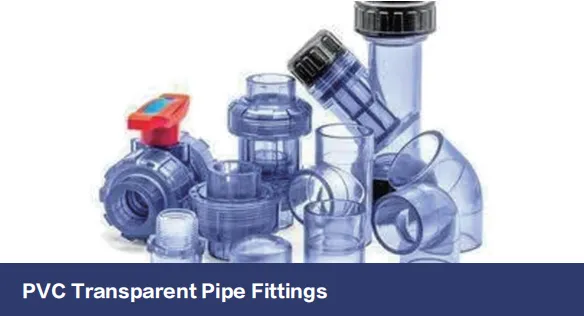
You know those moments when you're watching a chemical process flow through a pipeline and think "I wish I could actually see what's happening inside"? That's where PVC transparent pipes really shine. Unlike traditional opaque systems, these clear solutions literally put your processes on display, bringing that extra layer of control and safety we all appreciate. Whether you're in a pharmaceutical lab monitoring sensitive compounds or a food processing plant keeping an eye on quality control, transparent pipework delivers that visual confirmation you simply can't get from standard piping.
Now, let's get real about customization – because off-the-shelf solutions often leave gaps in industrial applications. Working with custom-sized fittings means not just solving problems, but preventing them entirely. A well-executed custom PVC installation transforms workflow hurdles into smooth operational pipelines, literally and figuratively. It's about creating that perfect visual flow pipeline where components align with precision, eliminating weak points and maintenance surprises.
Where You'll Actually See the Difference
Industry-Specific Applications
Picture this: You're walking through a pharmaceutical lab where technicians glance at clear pipelines every few minutes, visually verifying flows without disrupting sterility. That's the transparency advantage in action. From verifying absence of air bubbles in critical processes to spotting contamination before it spreads, these pipes act as both functional infrastructure and real-time monitoring tools. And let's not overlook training facilities – where future engineers learn fluid dynamics by watching actual flow patterns instead of just reading about them in manuals.
Chemical Processing Insights
Ever noticed how chemical reactions often have visible tells – color changes, precipitation development, or phase separations?
Clear PVC fittings make those transformations trackable without sampling. A plant manager shared how shifting to transparent pipework helped them spot crystallization buildup before it caused blockage downtime. Simple visual monitoring transformed what used to be scheduled maintenance into predictive adjustments – saving days of production time over just one quarter.
Food Safety Applications
For food processors, seeing is definitely believing. Visual confirmation goes beyond efficiency – it's about brand protection. There's nothing more unsettling for a consumer than discovering particulates in what should be a clear liquid. Transparent pipes allow technicians to monitor filtration efficacy during production runs, catching potential issues before products leave the facility. One dairy equipment installer told us it became their "most requested quality control upgrade" after initial trials.
Beyond Basic Sizing Charts
When engineers mention "custom sizes," they're rarely talking about just scaling dimensions. Properly designed transparent PVC systems integrate several critical technical considerations:
Pressure Balance Science
Many don't realize how dramatically wall thickness impacts pressure handling. For instance, a 110mm PN 10 pipe handles 10 bar pressure at 20°C while maintaining critical visibility. But extend that to 60°C in certain environments and safety margins start eroding. That's why truly custom fittings don't just scale dimensionally – they engineer wall compositions that maintain both structural integrity and essential transparency under specific thermal profiles.
Material Science Nuances
The "U" in PVC-U isn't just alphabet soup – it signifies unplasticized material critical for maintaining clarity while resisting chemical degradation. Standard PVC can haze over time when exposed to solvents, but specialized formulations preserve optical properties even in tough environments. One German manufacturer shared how adding UV inhibitors into their polymer matrix extended outdoor piping life from 3 years to over 10 without compromising that essential see-through quality.
Temperature Stability
Remember those 0-60°C specs aren't arbitrary. Above 60°C, molecular chains in standard PVC-U start behaving unpredictably – you might see warping, cloudiness, or pressure resistance failures. But here's what's exciting: modern compounding techniques now push this boundary to 80°C for specialty transparent formulations. A chemical plant engineer reported halving their cooling system costs simply by implementing pipes that could handle hotter process streams without sacrificing visual access.
Making Customization Practical
From Design to Function
Customization isn't about being difficult – it's about precision fitting to your needs. We've seen brilliant examples like pharmaceutical plants that eliminated particle traps with carefully contoured elbows. Or the German brewery that commissioned bespoke viewports at critical fermentation junctions. The trick lies in partnering with manufacturers who understand not just PVC molding, but fluid dynamics and inspection requirements. A good supplier won't just ask "what size?" but "what are you monitoring?"
Fitting Design Applications
While most focus on pipes, fittings matter just as much. Flow disturbance at connection points can lead to inspection blind spots. That's why custom socket-spigot configurations exist – minimizing turbulence zones where visual clarity suffers most. We watched installation teams implement tapered transitions at a biotech plant, eliminating air pocket formations technicians had been battling for months. Sometimes the smartest design isn't the most complex – just properly fitted to the physics.
Segment-Bent Elbows:
For systems requiring precise angles beyond standard 45° or 90° increments
Molded Couplers:
Maintaining consistent wall thickness at critical connection points
Vision Patch Fittings:
Strategic reinforced viewing zones for high-wear inspection areas
Inline Sampling Ports:
Integrated without creating turbulence points
Getting the Most From Your Installation
Beyond Basic Gluing
Ever noticed how poorly sealed joints seem to attract inspection? There's science behind that. Traditional solvent welding can create visual distortion zones around joints, essentially creating inspection blind spots. Specialized acrylic adhesives solve this by matching refractive indices almost perfectly. A chemical plant reduced false positive contamination reports by 30% simply by switching their bonding technique – proving installation quality matters as much as material specs.
Thermal Stress Management
Here's something field crews overlook: temperature changes cause PVC to expand and contract more than metal piping. That beautiful straight run you installed on a cool morning might develop stress cracks after a hot afternoon of process flow. Smart installers build in subtle compensation bends or expansion loops from the start. One facilities manager shared how eliminating seasonal pipe alignment issues saved them $25,000/year in adjustment labor alone.
The real value of clear pipework unfolds over time through smarter maintenance. Inspection routes go from "check for leaks" to "document flow characteristics." Predictive maintenance programs use clarity trends as performance indicators – noticing gradual haziness can signal chemical incompatibility before failures occur. It transforms pipeline management from reactive troubleshooting to proactive optimization. As one plant supervisor put it: "Our transparent lines became the dashboard for our entire fluid handling process."
Material Evolution and Future Directions
Today's PVC transparency would astonish engineers from just twenty years ago. Where early attempts yielded cloudy, brittle pipes, modern formulations achieve near-optical clarity while maintaining impressive structural integrity. Nano-additives now combat UV degradation that plagued earlier generations. Co-extruded layers create self-sanitizing surfaces for pharmaceutical use. We're even seeing integrated micro-optics that magnify flow patterns at critical junctures. As material science progresses, the applications continue to expand.
Technical Frontier Innovations
What's next? Three frontiers excite us: smart sensor integration, advanced self-monitoring, and hyper-durable formulations. Imagine transparent pipe with embedded micro-lasers detecting particulate concentration changes. Or materials that change tint when chemical incompatibility occurs. Or formulations maintaining clarity in applications up to 120°C. These aren't science fiction – working prototypes already exist in cutting-edge facilities. The industry is moving toward systems that provide not just visibility, but actionable intelligence.
As technologies evolve, standardization efforts must keep pace. Organizations like ISO and ASTM now have dedicated teams developing benchmarks for clear polymer systems. These aren't just about measurements – they define acceptable clarity degradation over time, chemical resistance verification protocols, and pressure testing methods optimized for visual pipework. One positive outcome: leading manufacturers are now publishing detailed performance projections beyond basic pressure-temperature charts.
Making Custom Work for You
Navigating Spec Considerations
Specifying custom fittings shouldn't feel intimidating. Start with three fundamentals: application environment, critical viewing zones, and operational tolerances. Document thermal peaks that standard ratings might miss. Map where optical perfection matters most versus where moderate clarity suffices. And never overlook fluid compatibility – what flows through a pipe chemically interacts with the material at a molecular level. Missing this can turn a transparent asset into an opaque liability within months.
Finding the right manufacturing partner transforms potential into results. Seek suppliers comfortable discussing application context, not just diameters and angles. Ask for material traceability documentation – knowing resin origin matters for consistency. Request installation procedure outlines – if they're vague about jointing techniques, that's a warning sign. And don't hesitate to request samples under simulated operating conditions. A quality manufacturer welcomes these tests as proof points.
"After switching to custom clear fittings, our batch inspection time decreased by 40% while defect catch rates increased. But what really surprised us? Training new technicians became significantly easier when they could visually trace system flows."
- Pharmaceutical Production Manager
Beyond the Specification Sheet
When evaluating PVC transparent systems, the untrained eye might focus on basic metrics – wall thickness, pressure rating, nominal size. But the engineers seeing the best results dig deeper into material pedigree, thermal behavior curves beyond standard ratings, and installation methodology details. They request accelerated aging studies showing clarity retention. They examine microsurface finishes that affect both optical properties and cleanability. Because they understand that in critical applications, what's not specified often becomes what's regretted later.
Successful projects balance short-term practicality with long-term performance. Don't just ask "can you make this?" but "how will this perform in 5 years?" Document post-installation performance baselines with calibrated imaging for future comparison. Set periodic optical clarity assessments as part of your maintenance routines. And perhaps most importantly, train technicians to leverage what they're now able to see – because the best equipment only delivers when teams understand how to utilize it.
Ultimately, custom PVC transparent
pipe fittings transcend utilitarian fluid transfer. They become integral components of operational intelligence systems, quality control protocols, and process improvement initiatives. The clearest indicator of success? When teams start requesting additional installations not because they need replacements, but because they've demonstrated measurable ROI through optimized operations, reduced downtime, and enhanced quality assurance. That's when visibility transitions from optional to indispensable.