
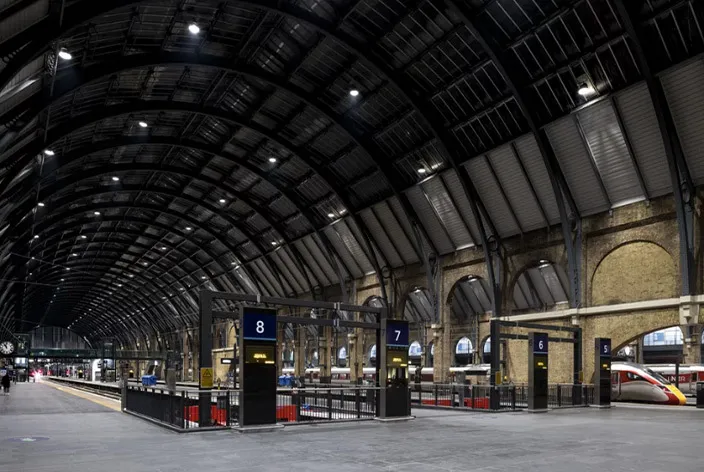
Walk into any factory or warehouse, and you'll immediately notice the sea of lights overhead – those powerful fixtures illuminating every corner of these vast industrial spaces. But what most people don't realize? These lighting setups are guzzling electricity like thirsty machines, driving operational costs through the roof.
Industrial facilities typically allocate 15-30% of their total energy budget just to keep the lights on. That's more than just a line item on the electricity bill – it's a drain on profitability. But what if we told you there's a straightforward solution hanging right above assembly lines and storage racks?
LED high-bay lighting has quietly revolutionized industrial illumination, turning energy conservation from theoretical potential into concrete savings. But how exactly do these modern fixtures slash costs while actually improving lighting quality? Let's explore the mechanics and economics behind this lighting transformation.
For decades, factories relied on traditional lighting technologies that were notoriously inefficient:
The former industry standard converts over 60% of electricity into heat rather than light. These require significant cooling systems that compound energy waste.
While more efficient than metal halide, they produce poor color rendering that reduces visual clarity and worker productivity.
Better efficiency than predecessors but plagued with rapid lumen depreciation and frequent ballast failures.
Beyond technology limitations, three critical issues plague conventional industrial lighting:
1. Phantom maintenance costs: Traditional lamps typically last 10,000-20,000 hours before requiring replacement. Considering most facilities operate 24/7, that means bulb replacements every 8-16 months. Add lift rentals, labor hours, and production downtime during replacements.
2. Directional inefficiencies: Standard lamps emit light omnidirectionally, forcing reflectors to redirect photons downward. This imperfect redirection causes significant lumen loss before light even reaches work areas.
3. Thermal management: All that wasted energy manifests as heat. Industrial facilities then spend additional electricity cooling these hot light sources – essentially paying twice for the same wasted energy.
LEDs achieve superior efficiency through fundamental design differences:
Unlike omnidirectional lighting, LEDs focus photons directionally. Top-tier high-bay fixtures achieve >90% downward light distribution. More photons reach work surfaces with less wattage.
Traditional technologies lose significant energy converting electrons to heat rather than light. LED chips operate cooler, converting up to 200 lumens per watt versus metal halide's maximum 125.
When we examine industrial spaces requiring 50+ foot candle illumination (typical for manufacturing precision work), the efficiency gap becomes staggering:
500,000 sq ft facility: Metal halide system requires ≈500kW versus LED solution at ≈170kW
Annual savings: $180,000+ at $0.10/kWh (24/7 operation)
"It's not just about swapping bulbs – it's about reimagining light delivery. LED technology fundamentally changes how photons travel from source to surface, eliminating decades of optical inefficiency."
While energy bills show the clearest impact, additional savings come from unexpected areas:
With 100,000-150,000 hour lifespans, high-quality LEDs outlast traditional lamps 4-6 times over. Facilities eliminate:
Traditional 400W metal halide fixtures expel ≈200W of thermal energy each. replace 500 fixtures? You've eliminated 100kW of heat generation – equivalent to 28 tons of cooling capacity.
Superior color rendering (80+ CRI) and adjustable color temperatures create optimal visual environments, reducing:
A 2024 manufacturing study found assembly line defect rates dropped 1.2-1.8% after upgrading to high-CRI LEDs – a savings that often exceeds the energy reductions alone in high-value production environments.
Transitioning requires more than swapping fixtures. Here's how industry leaders approach upgrades:
Professional photometric analysis ensures:
Smart facilities rarely flip the switch all at once. Pilot zones allow:
Maximize savings by adding:
Studies show such controls can capture an additional 30-50% energy savings beyond the basic LED conversion.
The transition to LED high-bays creates ripple effects across sustainability initiatives:
Industrial plants leveraging commercial and industrial solar energy solutions find LED conversions effectively extend their solar investments. A 30% lighting load reduction creates solar capacity to power other operations.
More significantly, energy-focused certifications like LEED and ISO 50001 award substantial points for lighting upgrades, accelerating progress toward environmental targets. Companies routinely bundle LED projects with compressed air optimizations and high-efficiency motor retrofits.
Financial analysis consistently reveals compelling returns:
Typical project cost: $150,000 (for 500-fixture replacement)
Annual energy savings: $85,000
Maintenance savings: $20,000
Simple payback: ≈22 months
Utility incentive programs often accelerate returns dramatically. The Midwest manufacturer recently secured a $45,000 rebate through their local power company, reducing their effective payback period to under 15 months.
"Think beyond wattage – the true value compounds through maintenance reductions, productivity gains, HVAC synergy, and sustainability positioning. LED conversions routinely deliver 150-200% total ROI when accounting for all impacts."
Not all LED solutions deliver equal results. Common implementation mistakes include:
High-bay LEDs demand sophisticated heat dissipation. Poor designs experience:
Retrofit kits promising "drop-in" simplicity often conflict with:
Ensure quality by demanding:
The efficiency revolution continues as emerging technologies push boundaries:
Experimental facilities already transmit data via lighting systems, creating dual-purpose illumination/infrastructure.
Next-generation fixtures incorporating:
Integration of photovoltaic skins turns fixtures into net energy producers rather than consumers.
Companies that installed early-generation LED high-bays now report second-wave savings by upgrading to current hyper-efficient models – proving that in industrial lighting, efficiency improvements continue compounding over time.
The transformation of industrial lighting from energy liability to profit center demonstrates how thoughtful technology adoption creates triple-win outcomes: financial savings, operational improvements, and environmental responsibility. For facility managers fighting rising energy costs, the solution quite literally hangs overhead.
Recommend Products












