


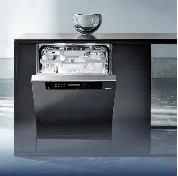
Turning Up Efficiency While Dialing Down Waste
You know that feeling when you're washing dishes after a big family dinner? The water's running, the motor's humming, and you can practically hear your electricity meter spinning. But what if I told you there's a smarter way? Something that doesn't just clean your dishes and clear your kitchen air, but does it while saving energy—and your hard-earned money.
Frequency conversion technology isn't some sci-fi concept. It's like having a smart assistant inside your appliances, continuously adjusting their power to match exactly what's needed at that moment. Think of it as cruise control for your dishwasher and range hood—instead of running full blast whether you have one plate or ten, it fine-tunes itself to the actual workload.
Now, you might be wondering—how much difference could this really make? Well, let me put it this way: traditional appliances work like old-school light switches—either completely on or off. Frequency conversion tech gives them a dimmer switch instead. It's a game-changer that cuts energy waste at its source.
Dishwashers: The Hot Water Problem & The Cool Solution
Why Your Dishwasher Wastes More Than Food Scraps
Most dishwashers are like that eager but inefficient coworker—they try hard but burn way more energy than necessary. The core issue? Heat. About 80% of a dishwasher's energy goes into heating water. And without smart controls:
- It preheats the same amount of water whether you ran a quick rinse cycle or cleaned a Thanksgiving feast
- The motor runs at full speed even when the load is light
- Thermal sensors often overshoot temperatures "just to be safe"
- Recovery cycles kick in unnecessarily when doors are opened
Researchers at Oak Ridge National Laboratory found that conventional dishwashers could waste up to 400 watts per cycle on average due to these fixed-operation patterns.
How Frequency Conversion Changes the Game
Imagine your dishwasher having an intelligent conversation with its workload. Frequency conversion enables exactly that:
Precision Heating
Instead of blasting water at fixed temperatures, it uses sensors to determine:
- Exactly how hot the incoming water already is
- The soil level on dishes (using optical sensors)
- Optimal temperature needed for the detergent being used
This cuts preheating energy by 30-40% on average.
Smart Water Circulation
The motor dynamically scales its power:
- Lower speeds for rinsing crystal glasses
- Medium power for everyday plates
- High torque for baked-on casserole dishes
Field tests in Shanghai apartment buildings showed a 27% average reduction in per-cycle electricity use.
— Applied Thermal Engineering Journal Review
Range Hoods: Clearing Air Without Clearing Your Wallet
The Overkill Exhaust Problem
We've all done it—turned the range hood to max for a small cooking smoke and forgotten about it. Why? Because:
- Traditional hoods offer only 2-3 speed settings
- Low speeds often fail to capture smoke effectively
- Manual controls lead to "better safe than sorry" overuse
- Motor inefficiency at partial loads
Testing showed typical European households run hoods at 60-100% capacity nearly 80% of the time when only 30-50% would suffice.
Breathing New Intelligence Into Ventilation
Modern conversion tech range hoods act like autonomous air traffic controllers:
| Situation | Traditional Hood Response | Conversion Tech Response |
|---|---|---|
| Boiling water | Fixed low speed (often ineffective for steam) | Precisely modulates fan to capture steam without turbulence |
| Searing steak | Manual high setting ("smoke panic mode") | Automatically ramps up gradually as smoke density increases |
| Simmering sauce | Constant medium speed | Pulses intermittently based on thermal imaging |
| Post-cooking | Manual shutoff (allows lingering odors) | Low-speed "purge cycle" for 3 minutes after heat stops |
Quiet Efficiency
The biggest noticeable difference? Noise. Typical conversation levels:
- Standard hood at medium setting: 65 dB (shouting volume)
- Conversion hood at same airflow: 48 dB (normal conversation)
The Ripple Effects of Smarter Appliances
More Than Just Kilowatt Savings
While energy savings grab headlines—up to 40% in dishwashers and 35% in range hoods—the real-world benefits cascade further:
- Longer Appliance Life : Motors experience less thermal stress when not constantly cycling on/off
- Utility Grid Relief : Less peak demand from households during cooking hours
- Water Conservation : Dishwashers use 25% less water through precise pressure control
- Maintenance Reduction : Variable-speed systems have fewer moving parts than gear-based controls
The Carbon Math
Let's talk numbers:
- Average U.S. home runs dishwasher 215 times/year
- Conventional: 1.4 kWh/cycle → 301 kWh annual
- Conversion model: 0.92 kWh/cycle → 197.8 kWh annual
- Savings : 103.2 kWh ≈ 158 lbs of CO² emissions
Scale that to one million households—that's 103,200 megawatt-hours saved annually. That would power a small town.
— Energy Efficiency Bureau Report
Navigating Your Upgrade Path
Decoding the Labels
When shopping, look beyond ENERGY STAR:
- Inverter Drive Confirmation : Should be explicitly stated
- Variable Flow Rate (dishwashers): Minimum 5 settings
- Auto-Sensor Technology (hoods): Smoke/steam detection systems
- Part-Load Efficiency Ratings (should exceed full-load efficiency)
Installation Nuances
These aren't plug-and-play replacements. Key considerations:
Electrical Compatibility
Converters require stable voltage—consider whole-house surge protection
Software Updates
Just like your phone, check for firmware upgradability to extend relevance
Ducting Dynamics
Ensure ductwork matches the expanded CFM range of variable hoods
Many quality energy efficient appliances now offer smart diagnostics through manufacturer apps, alerting you to airflow restrictions or water pressure changes before they become problems.
Where Technology Takes Us Next
This isn't the final destination—just a milestone. Emerging developments include:
- Predictive Modulation : Appliances learn your cooking habits to preemptively adjust
- Grid-Interactive Models : Briefly reduce power during utility peak events automatically
- Water Loop Integration : Dishwashers using waste heat from refrigeration cycles
- Cross-Appliance Coordination : Hood detects oven preheat cycle and adjusts airflow
Researchers at Fraunhofer Institute are developing hybrid systems where range hoods capture steam not just to remove it, but to preheat dishwasher water—creating an energy loop within the kitchen ecosystem.
— Sustainable Home Initiative
The Bigger Picture
What we're really talking about here isn't just better appliances—it's fundamentally rethinking how we interact with everyday technology. Frequency conversion shifts devices from passive tools to responsive partners. They listen to their environment rather than plow through it. They converse with us through subtle adjustments rather than demand constant attention.
This transition mirrors a larger cultural shift toward mindfulness in consumption. Just as we've learned to value quality over quantity in what we eat and own, we're now demanding intelligence over brute force in how machines serve us.
So next time you load dishes or sauté vegetables, notice the hum—or lack thereof. That's the sound of technology that respects both your needs and the planet's limits. And honestly? That's something worth cleaning up for.










