


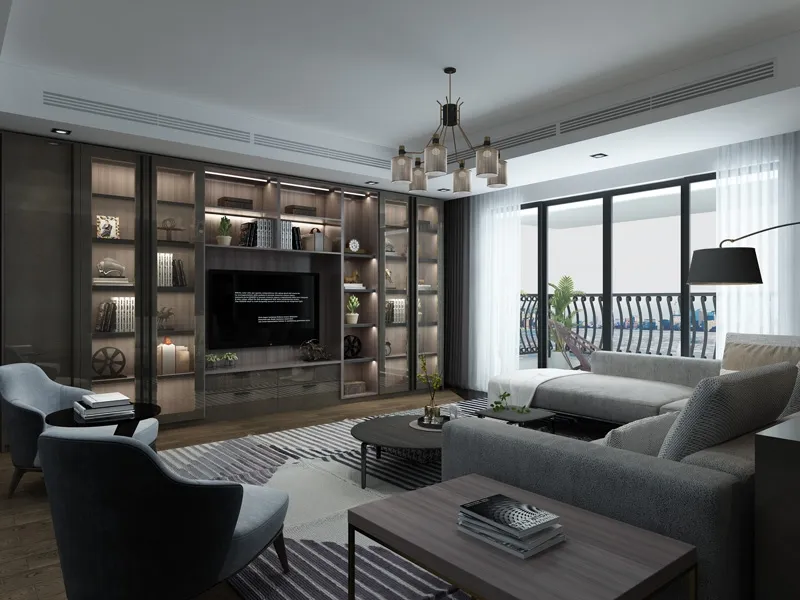
Let's talk about something that matters in your everyday life – those TV cabinets we all have at home. Have you ever wondered why prices vary so much? Well, it all comes down to how factories manage their energy and resources. Manufacturers who embrace smart efficiency strategies don't just cut costs; they shape how affordable quality furniture is for people like us.
Picture this: a factory humming not just with activity, but with intelligence. Machines calibrated to use minimal power, recycled materials transformed into elegant designs, and solar panels soaking up energy for production. This isn't futuristic stuff – it's happening now, and it's reshaping what we pay for home essentials. Companies leveraging automation and cloud stone technology for sustainable finishes are setting new benchmarks.
The Energy Equation in Furniture Manufacturing
Energy consumption makes up roughly 15-30% of manufacturing costs for TV cabinets. When factories optimize this, they're saving money that directly impacts your wallet.
Smart Machinery for Smart Savings
- Precision Cutting Tech – Reduces wasted wood by up to 60% while trimming electricity use
- LED Lighting Systems – Slash power bills by 75% compared to traditional setups
- AI Efficiency Controllers – Analyze energy peaks to optimize machine usage schedules
One factory in North Carolina switched to motion-activated lighting and saw their monthly bills drop by 45% – equivalent to producing an extra 250 premium solid wood TV cabinets annually. That's why companies investing in bamboo charcoal wallboard technology are seeing both eco and economic wins.
☀️ Harnessing Nature's Power
Forward-thinking manufacturers are flipping conventional energy models upside-down. By installing rooftop solar panels, they're converting sunlight into tangible cost reductions:
60-80%
Energy cost reduction in assembly zones
3-5 Years
Average ROI for solar installations
"Our transition to solar wasn't just about being green," shares Maria Rodriguez, production manager at Crestwood Furnishings. "Within three years, we lowered production costs by 18%. That savings let us upgrade our finishing department without raising prices." This kind of innovation is what makes truly modern manufacturing tick.
The Resource Revolution
Material waste is the silent killer of profitability. Modern factories treat every scrap as potential, not trash.
Circular Material Flows
- Closed-Loop Dust Collection – Wood particles get repurposed into decorative wall panels
- Water Recycling Systems – Treat and reuse 90% of staining/coating liquids
- Pre-Order Precision – Custom tv cabinet operations cut only what's needed, eliminating surplus
Consider oak dust – what used to get swept into dumpsters now becomes pressed fiber accents. Factories embracing this circular approach can trim material expenses by 25-40%, meaning they aren't forced to pad margins to cover waste. That's smart business that benefits everyone.
Lightweight, Heavy-Duty Design
Innovation in materials science has brought game-changers to furniture manufacturing:
Traditional MDF
Heavy, high transport costs
Requires toxic binders
Recycled Bamboo Composite
35% lighter weight
Naturally antimicrobial
Lower carbon footprint
This shift isn't just about trends – it's physics and finance. Lighter TV cabinets mean shipping 30% more units per truck, slashing logistics costs that once trickled down to consumers. Plus, customers get easier-to-move furniture that's kinder to their floors.
The Price Connection
Every efficiency gain has a domino effect on pricing:
Energy Savings → Machinery Innovation
Reduced power bills free up capital for state-of-the-art joinery systems that create longer-lasting dovetail joints without labor markup.
Waste Reduction → Material Stability
Factories saving $X tons of wood waste can lock in bulk material contracts, insulating against market volatility that causes price hikes.
Breaking Down TV Cabinet Costs
Material: 45%
Labor: 25%
Energy: 10%
Profit Margin: 20%
Stable pricing despite inflation
Material: 50% (+ waste)
Labor: 30%
Energy: 15%
Profit Margin: 5%
Sensitive to energy/material spikes
When factories sweat the small stuff – kilowatt-hours, wood chips, water droplets – they build resilience. This efficiency translates to predictable pricing even when supply chains wobble. Shoppers feel it too – stable prices instead of sticker shock.
The Road Ahead
What does all this mean for your next living room upgrade? The frontier keeps evolving:
Localized Micro-Factories
Emerging facilities near urban centers use regional materials and renewable micro-grids, eliminating cross-country shipping fees. A walnut TV cabinet made within 50 miles of you? That future's happening today.
Smart Grid Integration
Factories are becoming energy traders – using cloud computing to generate, store, and sell surplus power during expensive peak hours. This creates revenue streams that offset manufacturing costs.
The beauty of efficient manufacturing? It's win-win. Factories build stronger businesses, workers enjoy better-equipped facilities, and shoppers get more value. That TV cabinet you've been eyeing? It could carry a smarter backstory than you imagined – one where sustainability and affordability weren't competing ideas, but interconnected realities.
Next time you browse for a new entertainment unit, ask about its efficiency heritage. The factory that powers its machinery with sunlight and transforms scraps into art? That's where your money stretches farthest – creating value for you today and a cleaner industry tomorrow.










