
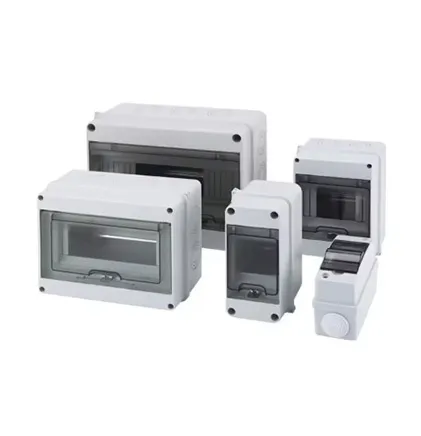
Every building 鈥?whether a cozy apartment, a busy office tower, or a sprawling industrial plant 鈥?relies on a hidden hero to keep the lights on and appliances running safely: the distribution box. Often tucked away in utility rooms or basement corners, these unassuming cabinets are the nerve center of any electrical installation. Understanding how they work, what to look for, and where to source them can save you from costly downtime, safety hazards, and compliance headaches.
A distribution box 鈥?also called a distribution board, breaker panel, or consumer unit 鈥?is a centralized enclosure that receives incoming electrical power and divides it into multiple outgoing circuits. Think of it as a traffic roundabout for electricity: power arrives from the grid or main supply, then gets routed through individual breakers to lighting, outlets, HVAC systems, and heavy machinery. Each circuit is independently protected so that a fault in one area does not bring down the entire system.
A well-designed distribution box supplier will offer enclosures made from durable materials such as metal or high-grade ABS plastic, with proper insulation, busbars, and clearly labeled circuits. The quality of the enclosure matters as much as the components inside, especially in humid, dusty, or outdoor environments where IP-rated protection becomes essential.
Key Takeaway
The distribution box is the single most important safety component in a building's electrical system. It controls, protects, and organizes power flow 鈥?and choosing the right one is non-negotiable.
Opening a distribution box for the first time can be intimidating. Inside, you'll find a carefully arranged set of components, each with a specific job. Here are the essentials:
The main switch is the gateway to the entire electrical supply. Flipping it cuts all power to the building 鈥?a critical feature during maintenance work or emergencies. Every distribution box should have a clearly marked, easily accessible main switch with adequate amperage rating for the total load.
Miniature Circuit Breakers (MCBs) are the workhorses of protection. Each breaker corresponds to one circuit 鈥?say, the kitchen outlets or the third-floor lighting 鈥?and automatically trips when it detects an overload or short circuit. This prevents overheating, wiring damage, and potential fires. Working with a reliable electrical fixtures & cables supplier ensures you get breakers matched to your wiring gauge and load profile.
Busbars are thick conductive strips 鈥?usually copper or aluminum 鈥?that distribute power horizontally across all the breakers. They must be sized correctly to handle the full incoming current without excessive heat buildup.
Residual Current Devices (RCDs) and Residual Current Breakers with Overcurrent (RCBOs) add a layer of protection against electric shock. They detect tiny leakages of current to earth and shut off power within milliseconds 鈥?a life-saving feature, especially in wet areas like bathrooms, kitchens, and outdoor circuits.
The neutral busbar provides a return path for current, while the earth (ground) busbar offers a safe route for fault currents to dissipate into the ground. Both are essential for a properly functioning and code-compliant installation.
The DIN rail is a standardized mounting strip that holds breakers, contactors, and other modular components securely in place. The enclosure itself must be robust, properly rated for the environment (indoor vs. outdoor), and lockable to prevent unauthorized access.
Not all distribution boxes are created equal. The right type depends on the building's size, function, and electrical demand. Here's a quick guide:
| Type | Best For | Typical Use Case |
|---|---|---|
| Main Distribution Board (MDB) | Whole-building power entry | Commercial towers, factories, large residential complexes |
| Sub-Distribution Board (SDB) | Floor-by-floor or zone-based distribution | Office floors, hotel wings, hospital wards |
| Consumer Unit | Residential single-family homes | Apartments, villas, small shops |
| Lighting Distribution Board | Dedicated lighting circuits | Malls, theaters, exhibition halls |
| Power Distribution Board (PDB) | High-power industrial loads | Manufacturing plants, data centers |
| Motor Control Center (MCC) | Motor-driven machinery | Factories, pumping stations, elevators |
For building projects that involve multiple systems 鈥?from lights to HVAC to elevators 鈥?choosing a coordinated set of distribution boards is much easier when working with a one-stop architectural solution provider that can supply matched components across all categories.
Cutting corners on electrical equipment is one of the riskiest decisions in any construction project. A substandard distribution box can lead to:
Investing in certified, high-quality distribution boxes from a trusted distribution box solutions provider pays for itself many times over in safety, reliability, and peace of mind.
Place distribution boxes in dry, well-ventilated areas with easy access for maintenance. Avoid locations exposed to water, extreme temperatures, or physical damage. For outdoor or industrial settings, always specify weatherproof enclosures with appropriate IP ratings.
Distribution box installation and wiring should only be performed by qualified electricians. Proper sizing of breakers, correct wire gauges, and compliance with local electrical codes are not areas for guesswork.
Every circuit should be clearly labeled on the inside of the box door 鈥?"Master Bedroom Lights," "Kitchen Outlets," "HVAC Unit 2," and so on. Clear labeling saves hours of troubleshooting and reduces risk during emergency shutoffs.
A distribution box should be inspected at least once a year 鈥?more often in harsh environments. Check for:
When sizing a distribution box for a new build, always leave spare breaker slots. Electrical demand tends to grow over time 鈥?with new appliances, EV chargers, smart home devices, and office equipment. A box sized for today's load may be undersized in just a few years.
For construction professionals, facility managers, and developers, the question is not whether you need distribution boxes 鈥?it's where to source them reliably, at scale, and with the right specifications.
Working with a specialized building material supplier that carries a full range of electrical products offers several advantages:
For projects in the Middle East, partnering with a Saudi Arabia building materials supplier that understands local electrical codes, climate conditions, and project timelines can make the difference between on-time delivery and costly delays.
Even the best systems occasionally develop problems. Here are three common issues and what they usually mean:
If a specific breaker trips regularly, the circuit is likely overloaded 鈥?too many devices drawing power at once. Try redistributing the load across multiple circuits. If the problem persists, a short circuit or ground fault may be the cause and requires professional diagnosis.
A faint hum from the box can be normal, but loud buzzing, crackling, or arcing sounds are warning signs. They may indicate loose wiring, a failing breaker, or a faulty component. Turn off the main switch and call an electrician immediately.
Distribution boxes generate some heat under normal operation, but the enclosure should never be too hot to touch. Excessive heat usually points to overloaded circuits, loose connections causing resistance, or undersized busbars. This is a fire hazard and needs immediate attention.
It's easy to think of distribution boxes in isolation 鈥?just another item on the electrical materials list. But in reality, they are part of a much larger building ecosystem. The distribution system must work seamlessly with lighting solutions, elevator systems, HVAC controls, security systems, and smart building technologies.
This is why many forward-thinking developers and contractors prefer to work with a comprehensive commercial building materials supplier that can provide not just electrical components, but also walls, flooring, sanitary fixtures, customized furniture, windows & doors, and more 鈥?all from a single source. When every system is sourced coherently, compatibility issues melt away, project timelines shrink, and the end result is a building that functions beautifully as a unified whole.
Pro Tip
For large-scale projects, request a full electrical package from your supplier 鈥?distribution boxes, breakers, cables, switches, outlets, and lighting 鈥?rather than sourcing each item separately. You'll save time on procurement and ensure all components are rated to work together.
Ready to Source Reliable Distribution Boxes for Your Next Project?
Whether you're building a single-family home, a commercial tower, or an industrial facility, choosing the right distribution boxes is a decision that impacts safety, compliance, and long-term reliability. COLORIA GROUP offers a comprehensive range of electrical fixtures and building materials 鈥?from distribution boxes and cables to lighting, switches, and everything in between. As a trusted one-stop architectural solution provider with a local agent in Saudi Arabia and global reach, they serve residential and commercial projects across the world with quality products and dedicated support.
Visit https://www.coloriagroup.net to explore their full product catalog or contact their team for personalized project support.
Recommend Products












