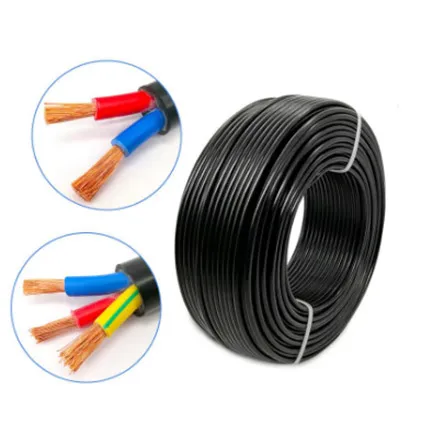
Government projects vary widely—from a rural school to a metropolitan metro system—each with unique cable needs. Below are the most critical types, tailored to specific applications:
1. Power Cables: The Lifeline of Electrical Distribution
Power cables are the workhorses of any project, transmitting electricity from grids to buildings and machinery. For government projects, we prioritize
low-voltage (LV)
and
medium-voltage (MV)
power cables, designed to handle high current loads safely.
Applications
: Hospitals (MRI machines, life support systems), stadiums (lighting, HVAC), and industrial zones (water treatment plants). In Saudi Arabia's NEOM project, Coloria supplied MV power cables for the city's renewable energy grid, ensuring stable power for 40,000+ residents.
Technical Highlights
: Insulated with cross-linked polyethylene (XLPE) for heat resistance, armored with aluminum or steel for mechanical protection, and rated for 0.6/1kV (LV) to 33kV (MV). Our cables meet IEC 60502, the global benchmark for power cable safety.
2. Fire-Resistant Cables: Protecting Lives in Critical Spaces
When fire strikes, standard cables melt, releasing toxic smoke and cutting off power—disastrous for hospitals, stations, or high-rise government buildings. Fire-resistant cables are engineered to maintain functionality during fires, ensuring emergency systems (alarms, sprinklers, exit lights) stay operational.
Applications
: Intensive Care Units (ICUs), school auditoriums, and tunnel systems. For Riyadh's King Abdullah Financial District (KAFD), Coloria provided
LSZH (Low Smoke Zero Halogen)
fire-resistant cables, which emit minimal smoke and no toxic halogen gases, crucial for evacuations.
Technical Highlights
: Constructed with mica tape insulation and copper conductors, these cables withstand temperatures up to 950°C for 3 hours (per BS 6387 CWZ standards). They're also halogen-free, aligning with Saudi's strict fire safety codes.
3. Control Cables: The "Nervous System" of Automation
Modern government projects rely on automation—from traffic lights to building management systems (BMS). Control cables transmit low-voltage signals between devices, ensuring precise operation of everything from elevator controls to water pumps.
Applications
: Smart city projects (e.g., Dubai's IoT-enabled streetlights), airport baggage systems, and wastewater treatment plants. Coloria's control cables powered Jeddah's new international airport, enabling real-time monitoring of runway lighting and baggage handling.
Technical Highlights
: Twisted-pair conductors reduce electromagnetic interference (EMI), while PVC or XLPE insulation ensures flexibility for tight installations. Rated for 450/750V, they comply with IEC 60227, ensuring signal integrity in noisy electrical environments.
4. Communication Cables: Enabling Smart Infrastructure
Government projects today are "smart"—they require high-speed data transmission for CCTV, Wi-Fi, and intercom systems. Communication cables, including fiber optic and Cat6/Cat7 Ethernet cables, are the backbone of this connectivity.
Applications
: Police stations (surveillance networks), universities (campus Wi-Fi), and municipal offices (cloud-based governance systems). In Abu Dhabi's Smart City initiative, Coloria supplied fiber optic cables that support 10Gbps data transfer, connecting 50+ government buildings into a unified network.
Technical Highlights
: Fiber optic cables use glass strands for low signal loss over long distances (up to 100km), while Cat7 cables offer 600MHz bandwidth for high-definition video and IoT devices. Both meet ISO/IEC 11801 for global compatibility.
5. Eco-Friendly Cables: Aligning with "Green Government" Goals
With global focus on sustainability, governments are prioritizing eco-friendly materials. Coloria's
sustainable cables
reduce carbon footprints without compromising performance—perfect for LEED-certified projects or Saudi Arabia's "2030 Vision" for green infrastructure.
Applications
: Solar-powered schools, eco-friendly public housing, and waste management facilities. For Riyadh's Green Building Initiative, we supplied cables made from recycled copper and halogen-free insulation, cutting embodied carbon by 25%.
Technical Highlights
: Recyclable materials, low energy consumption during production, and compliance with EU's RoHS directive (restricting hazardous substances). These cables also support renewable energy systems, like solar panels, by efficiently transmitting clean power.