


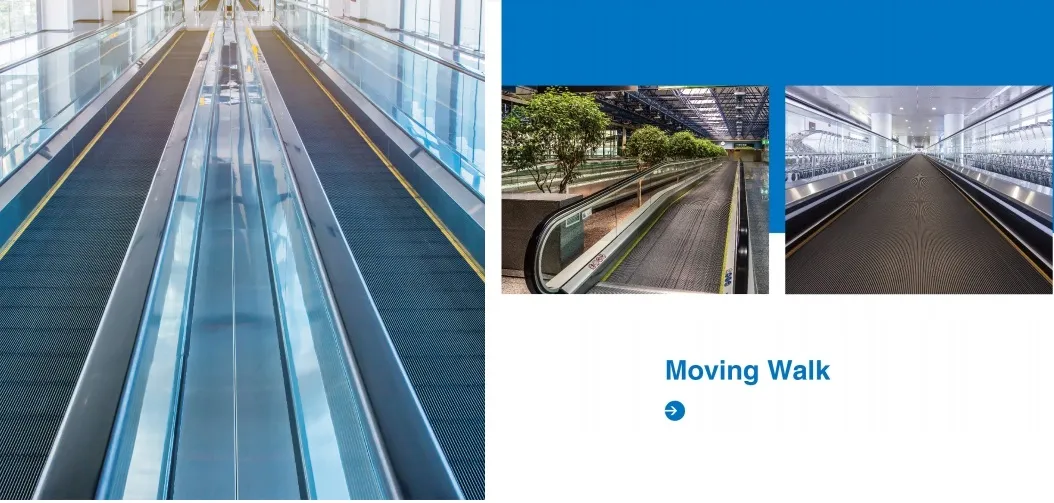
Why your daily commute could become faster, smoother, and less frustrating
You know that exhausted feeling when you finally drag your luggage through a crowded station after a long flight? Or that anxious darting glance at your watch when your train connection leaves in three minutes but the gate's a quarter-mile away? Modern transit hubs can feel like obstacle courses where time evaporates faster than your coffee cools.
But what if the solution to these daily frustrations isn't adding more trains or expanding terminals (often impossible in dense urban areas), but reinventing how we move through the spaces in between? Enter moving walkways – not just those sluggish airport treadmills you stand on half-asleep, but intelligent systems that adapt to human flow like water finding its path.
More Than Just Convenience: Walkways as Urban Lifelines
Transportation isn't just about vehicles – it's about people. As cities grow denser and stations become destinations themselves (with shops, services, and experiences), traditional infrastructure strains under the weight. Think of Tokyo's Shinjuku Station handling over 3.5 million passengers daily, or London Waterloo during peak hours. Human movement becomes fluid dynamics.
Early walkways were simple novelties. Today? They're strategic tools combating three silent enemies of urban mobility:
- Time thieves stealing minutes from our days in accumulated footsteps
- Energy vampires draining commuters before they reach their destinations
- Space bandits squeezing humanity into increasingly tight corridors
The Crucial Balancing Act: Walking the Walk(way) Design Tightrope
Installing moving walkways isn't as simple as rolling out carpets. Engineers and urban planners face decisions more complex than holiday traffic:
How Long is Long Enough? The Length Dilemma
Too short? They become pointless decorations. Too long? They become reliability nightmares.
Research shows the sweet spot lies in segmenting walkways rather than creating marathon paths. Think 30-60 meter sections allowing for:
- Natural acceleration/deceleration zones
- Emergency access points every 50 meters
- Strategic breaks preventing bottleneck panic
The Lausanne Station case study revealed segmented designs reduced average travel time by 28% during rush hours compared to single continuous belts.
Finding the Flow: Walking the Speed Tightrope
Safety screams "slow down!" while efficiency shouts "faster!" Modern solutions are learning to listen to both.
Imagine adaptive systems where speed intelligently responds to crowd density like a responsive dance partner:
- 0.75 m/s in boarding zones (safer with luggage and kids)
- 1.5 m/s in straight-line transfer corridors
- Variable acceleration zones merging traffic flows gently
Next-gen prototypes now test zones that gradually increase from walking speed to jogging pace, cutting transfer times nearly in half.
Built to Last: The Unsung Hero of Durability
There's nothing romantic about moving walkway mechanics – until they break during your sprint to Gate 47.
Durability isn't just about heavy-duty motors; it's about choosing materials that withstand the equivalent of a medium-sized earthquake every single day . Modern designs incorporate:
- Carbon-fiber reinforced belts resisting 30+ years of abrasion
- Weather-resistant stainless steel frameworks preventing corrosion in underground stations
- Modular components enabling overnight part swaps without disruption
Tomorrow's Moving Sidewalks: More Than Just Faster Conveyor Belts
Forget those airport relics – the next wave looks like something from sci-fi novels:
The Chameleon Walkways
Imagine paths sensing your approach and gently speeding up to meet your pace. Early Singapore prototypes use lidar arrays creating "speed bubbles" around passengers – no handrails needed!
Vertical Ascenders
Why stop at horizontal? Copenhagen's experimenting with 12-degree inclined walkways transporting passengers up station levels. Feels like strolling uphill minus the sweat.
The Invisible Infrastructure
Future hubs might embed walkways seamlessly under anti-slip tiling, only activating when sensors detect congestion. Discreet when quiet, superheroes during rushes.
Most radically, variable-speed systems could let urban residents treat moving walkways like bus lines. Picture hopping on a 27 km/h "speed street" from your downtown office to transit hub – your personal horizontal subway.
Beyond Station Walls: Walkways as City Connectors
Forward-thinking cities now see walkways not just as internal circulation tools but as connective tissue solving the frustrating "last half-mile":

Hong Kong's elevated "Central Walkway" system demonstrates this beautifully:
- Seamlessly connects ferry terminals with financial district offices
- Reduced street-level pedestrian traffic by 41% post-implementation
- Integrated solar canopy provides shade while powering the system
"We stopped asking 'how do we move people through our station?' and started asking 'how do we move people through our city?' That changed everything." – Li Wei, HK Transport Authority
What This Means for Your Daily Grind
Let's translate technical specs into real life. These innovations could mean:
| Current Reality | Near Future | Your Gain |
|---|---|---|
| 10 min station transfer | 4 min adaptive transfer | ⏱️ 6 extra minutes/day |
| Exhausting walk from bus stop | Covering distance in moving comfort | Less fatigue, more energy |
| "Will I miss my connection?" anxiety | Predictable movement flow | Reduced commute stress |
The best part? Unlike adding subway lines costing billions, modular walkway networks can evolve incrementally, delivering benefits within budget cycles rather than decades.
The Walkway Renaissance: Where We're Headed
We're witnessing a quiet revolution in how we engineer human movement. No longer just metal platforms moving at fixed speeds, modern walkways are becoming:
- Intelligent – Sensing crowds like rivers sense rainfall
- Adaptive – Changing speed like thoughtful tour guides
- Durable – Engineered with robust materials
- Integrated – Flowing into cityscapes like urban streams
Of course, challenges remain. Engineers still wrestle with:
- Rainwater's sneaky ability to cause belt slippage
- Finding ethical balance between efficiency and accessibility
- Making maintenance routines invisible to passengers
But the destination? Transportation hubs that feel less like crowded tunnels and more like smoothly choreographed dances of urban life.
Perhaps tomorrow's grandchildren will marvel we ever walked entirely on our own feet through transit hubs - like we marvel at hand-cranked car windows today. Because sometimes, progress isn't about reinventing the car. It's about reimagining the sidewalk beneath us.










