


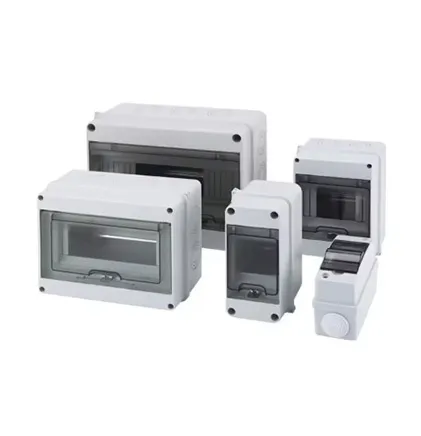
You walk into a modern data center, and what strikes you first? That low hum of computing power, flashing server lights – but more importantly, how everything connects . Behind every rack of servers lies a critical nervous system: distribution boxes. As our world increasingly relies on cloud services, AI, and real-time data, getting these connectivity solutions right becomes mission-critical.
Think of distribution boxes as the unsung heroes that ensure your Netflix streams without buffer, your cloud documents save instantly, and your financial transactions process securely. We’re diving deep into the evolving landscape of high-density power and data frameworks where reliability isn’t just a buzzword – it's the core requirement.
Power Distribution: Why Your Box Matters More Than You Realize
Imagine this: you're mid-deployment when the cooling units trip. Without robust electrical equipment in your distribution chain, you're staring at a catastrophic outage. The distribution box forms the critical bridge between utility feeds and server racks – handling hundreds of kilowatts while maintaining millimeter-perfect connections.
Real-World Problem Solving
Northern Finland's O3 Data Centers faced Arctic temperatures causing standard hardware brittleness. Their solution? Distribution boxes with industrial-grade polymers and heated busbars – now operational at -40°C with zero failures.
The Cable Density Conundrum: Untangling Tomorrow’s Needs
When Joe, a senior network architect at Equinix, opened a retrofit cabinet in 2025, he found spaghetti junction: cables so dense technicians avoided maintenance. The lesson? Future-proofing requires designing beyond today’s needs.
- Vertical vs. Horizontal : The shift to overhead power runs creates cleaner racks
- Flex Channels : Retrofittable guides that compress cable paths by 40%
- AI Monitoring : Smart tension sensors detecting abnormal stress patterns
"Distro boxes are becoming living systems, not passive containers. Our latest boxes monitor thermal behavior and predict failures weeks in advance." - Dr. Samantha Rhee, Lead Engineer, Eaton Power Solutions
When Heat Becomes the Silent Killer
Remember that viral video of a data center fire caused by overheated terminals? Distribution boxes at 80kW+ loads generate serious heat. Passive cooling doesn't cut it anymore.
| Cooling Type | Capacity Range | Reliability Gain | Cost Factor |
|---|---|---|---|
| Passive Convection | ≤8kW/rack | ★★☆☆☆ | 1x |
| Phase-Change Materials | 15-30kW | ★★★★☆ | 2.3x |
| Direct Liquid Cooling | 30-100kW+ | ★★★★★ | 3.7x |
Google's Project Chimera showcases what's next: mineral-oil immersed boxes handling 80kW/sq.ft without active cooling – a 92% energy reduction over traditional systems.
Beyond Physical: Cybersecurity’s Hardware Frontier
The 2024 Meta outage taught us hard lessons. When distribution points become intelligent, they become hackable. New solutions include:
- Air-gapped monitoring systems
- Quantum-secured firmware chips
- Tamper-lock systems triggering physical disconnects
Field Test: Tokyo Financial Hub
A Tier IV facility implemented vibration-sensitive hardware locks after forensic analysis revealed hackers mimicking maintenance crews. Now, any unexpected torque on cabinet screws triggers isolated power-down.
Building Like LEGOs: The Shift to Component-Based Distribution
Distribution boxes are moving away from monolithic designs toward modular systems. AWS's Aurora distribution system allows:
- Live-swappable circuit modules
- Hot-pluggable monitoring pods
- Voltage-agnostic busways accepting 208V-480V inputs
"Our colocation clients demand configuration changes in hours, not weeks. Modular distro systems turned 6-week retrofits into 90-minute operations." - Carlos Mendez, Director of Ops, Digital Realty
Navigating the Compliance Maze
From Singapore's SS670 to EU's EN 50600, global standards differ wildly. Key considerations:
- Seismic bracing requirements (Critical in Pacific Rim)
- Material toxicity standards (EU RoHS 3 vs China GB/T)
- Fire rating harmonization (UL94-V0 vs IEC 60332)
Companies like Rittal and Vertiv now offer configurators pre-loaded with regional compliance profiles – eliminating guesswork during procurement.
Going Green at the Connection Point
Distribution efficiency isn't just about uptime – it's about carbon footprint. Cutting-edge developments:
- Silver-nanowire coatings (30% less resistance than copper)
- Repurposed ocean-plastic enclosures
- Self-healing insulation polymers
Microsoft's Amsterdam campus reduced connection losses by 0.7% across their distribution network. That tiny percentage equals annual power for 1,200 homes.
Your Deployment Checklist: Avoiding Deployment Nightmares
After dozens of installations, patterns emerge for smooth rollouts:
- Thermal modeling before ordering hardware
- Over-provision 20% extra capacity ports
- Color-coded phase identifiers at EVERY tap point
- Mandatory torque calibration for terminal installers
- Baseline dB and vibration metrics at acceptance
Remember that installation near Quebec where vibrating generators loosened connections weekly? Resonance-dampening mounts at distribution points solved it permanently.
What's Next: When Distribution Becomes Intelligent
The frontier? Self-configuring microgrid interfaces. Siemens and Schneider demoed prototypes at MWC 2025 featuring:
- Solid-state circuit breakers (0ms response)
- Edge-AI load forecasting
- Dynamic phase-balancing across racks
"In 5 years, distribution boxes will be active grid participants – selling unused capacity back during peak events. They're evolving from dumb boxes to revenue generators." - Lisa Nguyen, Gartner Infrastructure Lead
Here’s the bottom line: distribution solutions form the critical last-mile in our data ecosystem. By embracing modular designs, proactive thermal management, and security-by-design approaches, we transform these humble boxes from potential failure points to strategic assets. The density challenges won’t lessen, but with smarter distribution architecture, we’ll keep our digital world humming reliably through every megawatt surge.
Ready to upgrade? Remember: your distribution strategy shouldn’t just keep pace with server loads – it needs to be two steps ahead. Because the next groundbreaking app or AI breakthrough might just depend on your power distribution choices today.










