
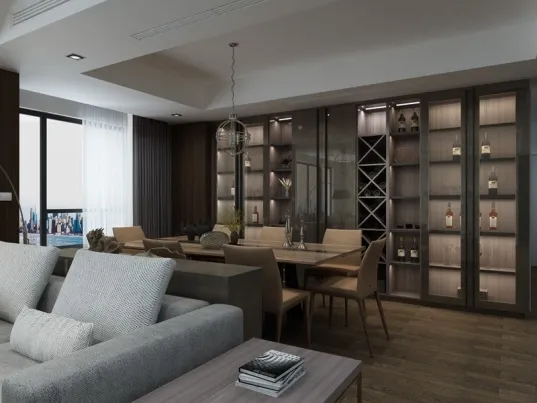
Picture this: You finally uncork that special bottle you've been saving for years, only to discover it's been ruined by fluctuating temperatures. Heartbreaking, isn't it? What if I told you there's an artisan solution emerging from China's workshops that does more than store wine – it celebrates it? Forget cookie-cutter cabinets; we're entering the era of personalized wine sanctuaries designed specifically for your collection, your space, and your lifestyle.
Wine isn't just a beverage; it's liquid history in a bottle. Each vintage tells a story about the soil, the weather, and the winemaker's craft. Doesn't it deserve better than being shoved into a generic cabinet? That's where Chinese manufacturers have stepped up, transforming from mass producers to specialized artisans who understand wine's delicate needs.
Over morning tea in Foshan factories, I watched craftsmen debate wood grains like sommeliers discuss tannins. "Merlot needs different humidity than Cabernet," one explained, sanding a cedar frame. This attention to detail separates true custom manufacturers from assembly lines. They're not just building boxes – they're creating microclimates.
What makes these Chinese workshops stand out? Flexibility. Think of it like ordering a bespoke suit:
In Guangdong province, I met Master Chen, a third-generation woodworker who pivoted from furniture to wine cabinets. "Wine breathes," he told me, running fingers over dovetail joints. "The wood must breathe with it." His team spends weeks selecting timber that balances durability with the right porosity – hardwoods for bold reds, softer woods for delicate whites.
Nearby, at a glass workshop, technicians tempered glass panels using techniques usually reserved for aquarium construction. "Wine cabinets need clarity without UV damage," the foreman explained, showing me prototype blue-tinted glass that filters harmful rays while making your Bordeaux look like liquid jewels.
| Material | Best For | Pro Tip |
|---|---|---|
| Solid Oak | Traditionalists with large collections | Ask for quarter-sawn cuts – less warping over time |
| Stainless Steel | Modern spaces needing thermal efficiency | Request brushed finish to hide fingerprints |
| Decorative Stone Accents | Statement pieces with luxury appeal | select water-resistant varieties like slate or quartzite |
| Glass Hybrids | Compact urban spaces | UV-coated is non-negotiable for wine protection |
Remember that ruined bottle earlier? Here's the science: Wine is alive, slowly evolving through chemical reactions. At 75°F, it ages three times faster than at 55°F. Too dry? Corks shrink. Too humid? Labels mold. Chinese manufacturers now embed precision sensors that regulate conditions better than some commercial cellars.
At Lyson Home's facility, engineers demonstrated cabinets holding Chardonnay at 50°F and Shiraz at 64°F simultaneously – with humidity maintained within 2% of target. The secret? Quadruple-sealed doors and microprocessor-controlled compressors they previously only used for medical equipment.
Built into existing architecture with custom-matched finishes. Features hidden ventilation and sliding access panels.
Minimalist steel framework with dual-paned glass, backlit with color-tunable LEDs that simulate dawn to dusk lighting cycles.
Repurposed barn wood with iron accents, incorporating high-performance decorative stone bases that provide thermal mass for natural temperature stabilization.
It's the thoughtful details that transform cabinets into heirlooms:
In Suzhou, I met designer Mei, who adds subtle scent channels in cabinet bases. "We infuse cedar essence when clients request it," she shared, opening a cabinet that smelled like a forest. "It won't affect the wine but elevates the experience."
Working with Chinese factories requires discernment. After visiting numerous facilities, here's what separates true craftspeople:
Reputable workshops provide forestry certifications and material samples before cutting
They'll demonstrate temperature/humidity consistency across 72-hour tests
Look for teams who ask probing questions about your collection habits and space constraints
As we sipped tea overlooking a Hangzhou workshop, engineer Liu sketched tomorrow's cabinets: "Imagine AI that tracks your consumption patterns, suggesting optimal drinking windows via app alerts." Other prototypes included:
But the real revolution is accessibility. What once cost more than your entire wine collection now starts under $1,000 for custom units, thanks to efficient production and direct-from-factory models.
Standing in warehouses filled with crates bound for Paris penthouses and Napa vineyards, one realization hits: the humble wine cabinet has transformed. Chinese factories haven't just learned to build storage – they've mastered crafting personal wine experiences. Whether it's accommodating your grandmother's Riesling or that trophy Domaine de la Romanée-Conti, the right custom piece doesn't just protect your bottles; it tells your story through every precisely angled rack, every sustainably sourced plank of wood, every consistent degree of temperature.
The best makers speak a universal language: passion for craftsmanship. As Chen told me while adjusting a prototype's hinge: "Good wine makes memories. Our cabinets are just memory-keepers."
Recommend Products












