
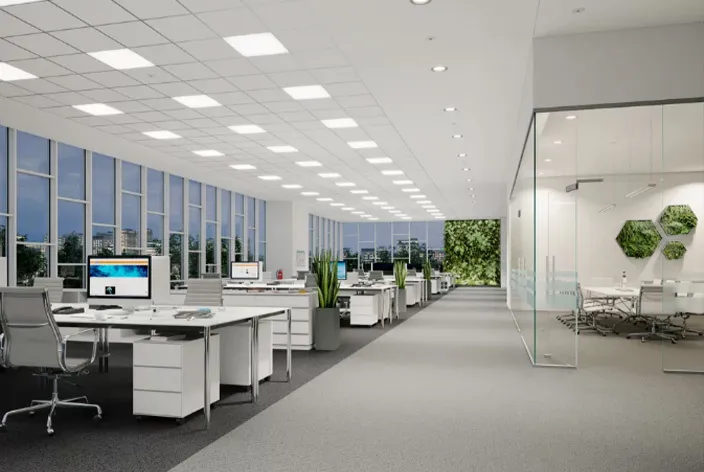
Ever notice how the lighting in your office can either boost your energy or drain it completely? It's not just you—science backs this up. That's why forward-thinking companies are turning to custom office lighting solutions. And guess where the real magic happens? In Chinese factories, where innovation meets scale.
I recently toured several facilities in Guangdong, and what I saw changed my perspective on commercial lighting. These aren't your grandfather's fluorescent tubes. We're talking intelligent, human-centric LED systems that adapt to circadian rhythms and work patterns. You might be surprised how much lighting affects productivity and even employee satisfaction.
There's a common misconception that manufacturing in China means sacrificing quality. But walk through any modern Chinese lighting factory and you'll see robotic arms assembling precision-engineered components beside engineers using spectral analysis tools. The scale is staggering - a single factory might output more fixtures in a month than some countries produce in a year.
What makes these factories special isn't just the technology though. It's the approach to architectural lighting solutions . When a Shenzhen manufacturer designs office lighting, they're not just producing bulbs and wires. They're creating environmental systems that consider everything from glare reduction and color temperature to IoT connectivity and energy consumption patterns.
"The lighting doesn't just illuminate the space—it shapes how people work," explained Li Wei, a design engineer at a leading Dongguan factory. "Our task is creating systems where employees forget about lighting entirely because it just feels... right."
That philosophy translates to tangible benefits beyond aesthetics. Proper lighting can reduce eye strain by up to 40% and decrease errors in detailed tasks—critical in settings like architectural firms or design studios. The data comes from workplace studies conducted by factories themselves, who partner with European ergonomics specialists to validate their designs.
Ten years ago, office lighting meant uniform brightness across floorspace. Today's smart systems use sensors to detect occupancy and daylight penetration, dimming unneeded fixtures automatically. It's fascinating to walk through sections of a factory floor where different zones simulate lighting conditions from Scandinavian offices to Singaporean high-rises.
For many China lighting manufacturer operations, the transition to LED was just the beginning. What excites engineers now is tunable white technology—lights that shift color temperature throughout the day. Morning cool blues enhance alertness; afternoon warm tones reduce fatigue. The sophistication comes not from individual fixtures, but how entire ecosystems communicate.
It's one thing to talk about technology, but how does this translate to actual workplaces? Let's look at how different sectors benefit from custom implementations.
| Office Type | Lighting Challenges | Custom Solutions | Benefits Achieved |
|---|---|---|---|
| Open Plan Tech Offices | Glare on screens, inconsistent brightness | Indirect LED panels with 50% uplight component | 37% reduction in monitor glare complaints |
| Architectural Firms | Color accuracy for materials, task lighting | CRI>95 track lights + tunable desks | True color rendering for material selection |
| Financial Trading Floors | High stress, long hours, visual fatigue | Circadian rhythm system with daylight simulation | 18% decrease in late-day trading errors |
| Healthcare Administration | Document-intensive tasks, eye strain | Task-ambient system with personal controls | 42% reduction in correction errors |
The above data comes from post-installation studies conducted by European firms working with Chinese factories. It's compelling evidence that well-designed commercial lighting does more than look pretty—it creates competitive advantage through human performance optimization.
During my tour, I sat with a facility manager who described the "aha moment" when his operations team realized lighting controls could be integrated with their meeting room booking system. "The lights now automatically brighten 5 minutes before a scheduled meeting," he noted. "It's a small touch that signals readiness and professionalism."
"Many Western buyers focus too much on lumens per watt when they should be asking about experiences per square meter. The best manufacturers engineer human responses, not just photometric performance."
– Dr. Emma Reynolds, Lighting Psychologist
What's next in the pipeline? Factories are buzzing about two innovations: AI-driven personal lighting profiles and true LiFi integration. The personal profiles learn individual preferences through smartphone apps, adjusting nearby fixtures as employees move through spaces. It sounds like sci-fi, but prototypes are already being tested in Shanghai co-working spaces.
LiFi—light-based WiFi alternative—could solve the bandwidth crunch in dense offices while providing illumination. One Guangzhou factory showed me demonstration space where HD video streamed purely through LED fixtures. The potential for integrating lighting infrastructure with data infrastructure could redefine office design fundamentals.
What fascinates me most about visiting these factories isn't just the technology though. It's the design philosophy shift. A decade ago, lighting was considered a building system. Now it's treated as a human performance tool. That psychological shift transforms how factories approach manufacturing.
If you're considering custom office lighting, here's what I've learned from sourcing experts:
As I concluded my factory tours, one manager offered this insight: "The office of the future won't have 'lighting systems'—it will have environmental wellbeing platforms." After seeing what happens when electrical engineering meets human physiology in these factories, I couldn't agree more.
The most successful companies aren't just buying lighting fixtures—they're investing in visual environments that elevate how people feel and perform. And increasingly, they're finding that Chinese factories offer the perfect blend of technological sophistication and human-centered design to make that vision reality.
Recommend Products












