
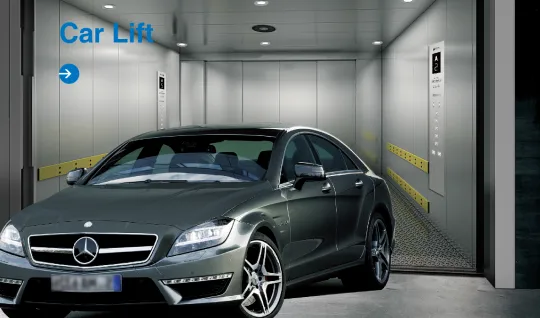
Picture this: You drive into a repair shop, and within minutes, your vehicle is smoothly elevated four feet in the air, granting mechanics full access to its undercarriage. This everyday marvel of engineering isn't magic – it's the result of decades of innovation in car lift technology. Imagine how different auto repair would be without these mechanical workhorses that serve as the backbone of garages worldwide.
In the bustling manufacturing hubs of China, factories have been quietly perfecting these indispensable tools. From Guangzhou's high-tech facilities to Shandong's industrial powerhouses, Chinese engineers have transformed car lifts from simple hydraulic platforms to sophisticated systems that blend raw power with digital precision. These aren't just metal structures; they're carefully calibrated machines that balance vehicles weighing thousands of pounds while ensuring technician safety.
The journey of a car lift begins with sheets of high-tensile steel and ends as a life-saving device in garages across six continents. Chinese manufacturers have mastered this transformation, creating solutions that help mechanics from Detroit to Dubai work smarter, safer, and faster. As we explore this fascinating industry, you'll discover why Chinese factories have become global leaders in providing these essential pieces of garage equipment.
Precision-engineered cylinders that transform hydraulic pressure into smooth vertical motion – Chinese factories use military-grade sealing technology to prevent leaks even after thousands of lift cycles.
Automatic mechanical locking systems engage at every stage of ascent, creating failsafe protection should hydraulic pressure drop. This redundant safety approach has become an industry benchmark.
Modular arm systems with infinitely adjustable pads accommodate vehicles ranging from tiny compact cars to heavy-duty trucks, all secured by vacuum-formed rubber cushions that grip without scratching.
What truly sets Chinese manufacturing apart is the meticulous attention to what mechanics actually need. Take Li Wei, a shop owner in Qingdao who struggled with older scissor lifts. "We needed something with more clearance for suspension work," he explains. "Local engineers didn't just modify their design – they spent three days at my shop observing our workflow before creating the low-profile solution we now use."
This practical engineering mindset extends to the electronics too. Modern lifts feature touchscreen controls with memory settings for frequent vehicle types, self-diagnostic systems that predict maintenance needs, and IoT connectivity that alerts managers about usage patterns.
| Type | Best For | Space Needed | Weight Capacity | Special Features |
|---|---|---|---|---|
| Two-Post Lifts | General repairs, tire services | Minimal footprint | 3.5-5 tons | Full undercarriage access, asymmetric options |
| Four-Post Lifts | Long-term storage, alignments | Moderate | 6-12 tons | Drive-on convenience, accessory ramps |
| Scissor Lifts | Quick services, limited spaces | Compact | 3.5-5 tons | Low profile, no overhead obstruction |
| Parking System Lifts | Dealerships, urban garages | Vertical stacking | Per platform | Space multiplication, automated systems |
Four-post systems deserve special attention for their ingenious simplicity. These workhorses function like industrial-strength shelves where vehicles park on elevated runways, creating space underneath. But Chinese innovation has taken this concept further with integrated turntables that rotate vehicles 180 degrees in tight spaces and access ramps that make loading SUVs effortless.
Consider the challenges faced by luxury dealerships in crowded cities where square footage costs a fortune. A Beijing Porsche center solved this by installing Chinese-made stacking systems that triple their display capacity. "It's like turning a single-level showroom into a multi-story gallery," describes manager Zhang Wei. "Customers actually enjoy seeing vehicles displayed this way – it feels like an automotive art installation."
Founded: 2007 | Specialization: Hydraulic systems
This Shandong-based innovator transformed hydraulic engineering with their pressure-equalization technology. Unlike competitors using multiple smaller cylinders, their single-unit hydraulic ram provides perfectly balanced lifting force across the entire platform. This reduces maintenance points while providing ultra-smooth operation.
Product Highlight: Their "Whisper Lift" series uses military-grade seals achieving 68dB operation – quieter than normal conversation, making them perfect for shared workshop environments where noise reduction matters.
Founded: 2001 | Specialization: Scissor lifts
EOunice solved the eternal tradeoff between low-profile design and lifting capacity. By re-engineering the scissor mechanism using aerospace-grade aluminum alloys, they created lifts with just 3.5-inch clearance that still handle full-size SUVs. Their "Eclipse" model is now the standard in Formula One team garages.
Founded: 1998 | Specialization: Modular systems
Care Machinery transformed the industry with their customizable hybrid designs. Customers choose from modular components to create unique configurations – perhaps a scissor platform base with supplementary two-post arms for specialized alignment work. This adaptability makes them favorites among racing teams.
What truly distinguishes Chinese factories isn't just their technical innovations but their commitment to practical excellence. Lin Hao, production manager at Qingdao Tabitha Parking Equipment, shares: "We stress-test every locking mechanism 37% beyond rated capacity. If a lift fails at 8,000 cycles, we redesign it until it lasts 15,000. Mechanics trust their lives to our engineering – we don't take that lightly."
The magic begins when specialists collaborate directly with customers. A German luxury dealership required a scissor lift that could elevate vehicles while keeping wheels freely rotating for high-speed dynamometer testing. Chinese engineers responded with a magnetic levitation system that suspends vehicles without physical contact points.
Customization isn't limited to technical specs either. Options include:
International certifications serve as China's engineering passports. Before export, lifts undergo rigorous evaluation:
These aren't abstract concepts – they translate to real reliability. Dubai's Desert Garage Solutions manages three shops in temperatures exceeding 120°F. "We used to replace components constantly until switching to Chinese lifts specifically designed for extreme heat," says owner Khaled Al-Fayed. "The rubber formulations and hydraulic fluids are optimized for our climate."
Next-generation lifts evolving in Chinese labs include:
AI-powered tilt compensation that automatically balances uneven loads and predicts component failures months in advance.
Regenerative hydraulic systems that capture gravitational energy during descent to recharge batteries, reducing grid consumption.
Foldable mechanisms that tuck vertically against walls when not in use, effectively disappearing in crowded garages.
Meanwhile, Chinese manufacturers increasingly focus on sustainable practices. Guangzhou EOunice now powers their production entirely with renewable sources. "Our factory roof has become the third-largest private solar installation in Guangdong," notes CEO Liang Wei. "Efficiency shouldn't just describe our lifts but our entire operation."
When sourcing from China, smart buyers follow this blueprint:
This approach served Montreal's Metro Auto Group well when expanding their 12-shop chain. "We flew engineers from China to study our operations," recalls owner Jean Tremblay. "They adapted their designs to our unique needs, and now we get maintenance support locally through their Canadian partners. It's a true partnership."
Beyond the hydraulics and steel, Chinese innovation addresses fundamental human needs. Mechanics appreciate the little touches – like non-glare work lighting that reduces eye strain during eight-hour shifts. Shop owners value WiFi-enabled lifts that integrate with management systems to track bay utilization.
This blend of engineering prowess and human-centric design explains why Chinese factories dominate the global automotive equipment supply chain. Their lifts represent more than clever mechanics; they enable the skilled technicians below them to perform their best work safely and efficiently. Whether you're running a rural garage or metropolitan dealership, these mechanical ascension devices quite literally elevate automotive service standards worldwide.
Recommend Products












