
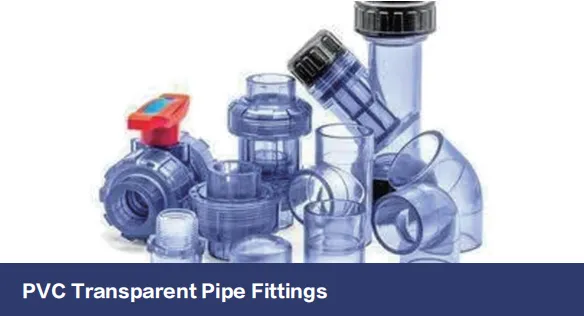
Ever wonder how modern plumbing maintains crystal-clear visibility while staying budget-friendly? PVC transparent pipe fittings are revolutionizing fluid management systems by combining visual monitoring with surprising cost efficiency. This comprehensive analysis reveals how this innovative solution outperforms traditional materials.
Transparent PVC fittings solve a fundamental limitation of traditional plumbing: the inability to visually track flow. Unlike their opaque counterparts, these see-through components provide real-time monitoring of liquids - essential for spotting contamination in food processing, identifying blockages in chemical plants, or observing aquarium ecosystems. The "see-what's-happening" advantage transforms troubleshooting from a guessing game to visual confirmation.
Imagine being able to instantly verify proper fluid movement without dismantling pipes. That's the game-changing benefit transparent PVC brings to maintenance teams. Technicians can visually confirm proper flow rates, identify sedimentation issues early, and spot particulate contamination immediately - all without invasive diagnostic procedures. This visibility isn't just convenient; it's financially smart, preventing costly system failures before they occur.
The technology behind this transparency involves advanced polymer engineering. Manufacturers achieve clarity through precisely controlled cooling processes and specialized additives that maintain optical properties without sacrificing PVC's signature durability. The result? A pipe fitting that performs like industrial-grade PVC but offers lab-grade visibility.
Perfect clarity but fragile and expensive installation. Thermal shock vulnerability makes them impractical for industrial environments.
Superior strength but completely opaque. Requires expensive sensors or invasive checks for flow verification.
Cost-effective and durable but provides zero visibility. Forces reliance on external monitoring equipment.
Good clarity but limited chemical resistance. More expensive than PVC and prone to stress cracking.
Transparent PVC fittings deliver economic advantages throughout their lifecycle, far outweighing their initial price premium. Here's how the cost-efficiency unfolds:
Transparent PVC installs 30-40% faster than metal alternatives. Its lightweight nature means no heavy equipment rentals, and compatibility with standard PVC solvent welding keeps labor costs minimal. Contractors report eliminating specialized tooling expenses entirely when switching from stainless steel systems.
Consider the labor cost difference: A stainless steel industrial installation typically requires 3 skilled workers - one welder, one pipefitter, one quality inspector. The transparent PVC equivalent? Just two general technicians working with ordinary PVC tools. The hourly savings compound dramatically at scale.
Visual inspection capabilities save thousands in diagnostic expenses annually. Food processing plants report eliminating 85% of their previous microbiological testing costs by implementing transparent monitoring sections. The ability to immediately spot flow irregularities prevents expensive shutdowns.
Chemical treatment facilities using transparent fittings reduce maintenance budgets by 40% through predictive rather than reactive approaches. Visible flow confirmation eliminates unnecessary pressure testing and pipe disassembly. Early leak detection at connection points prevents secondary damage to surrounding infrastructure.
Transparent PVC boasts comparable lifespan to Schedule 80 PVC - typically 20+ years in industrial applications. The material's natural corrosion resistance eliminates the replacement cycles endemic to metal systems. Chemical plants report eliminating their former 5-year pipe replacement cycles entirely.
Unlike glass or acrylic alternatives, transparent PVC maintains clarity throughout its lifespan with proper UV stabilization. The chemical resistance profile remains identical to standard PVC, impervious to acidic and alkaline solutions that rapidly degrade metal systems. This longevity delivers dramatic cost-per-year advantages over alternatives.
Transparency proves invaluable for contamination prevention. Production facilities immediately spot particulate matter or biofilm formation. This visual confirmation reduces product recalls and meets strict FDA visual verification requirements without elaborate inspection equipment. One juice processor eliminated 92% of their microtesting budget by implementing strategic transparent sections.
Sanitation validation becomes simplified. Cleaning crews visually confirm chemical sanitizer circulation and rinse completion. This has reduced cleaning cycles by 30% in dairy plants, saving thousands in chemical and labor costs annually while improving food safety standards.
The chemical resistance of transparent PVC provides dual advantages: excellent material compatibility plus visual confirmation. Plants monitor for phase separation, crystallization, or precipitation in real-time. Reactor transfer lines now feature transparent inspection fittings that help technicians avoid catalyst contamination incidents.
Blending operations achieve unprecedented precision. Operators visually confirm laminar flow conditions in multi-stream mixing applications. One specialty chemical manufacturer reduced off-spec batches by 70% after implementing transparent verification fittings throughout their reactor feed systems.
Municipal facilities save significantly through visible flow monitoring. Operators immediately identify filter breakthrough events, sludge accumulation, or air pocket formation. Transparent air-release valves provide instant visual confirmation of proper venting operation without pressure testing.
UV treatment systems utilize transparent PVC throughout, creating a visual feedback loop that confirms proper lamp operation and chamber flushing. Treatment plants report reducing maintenance calls by 60% through these visible diagnostics.
Emerging technologies will further enhance PVC transparent fittings' cost profile. Industry leaders anticipate:
The fusion of digital monitoring with physical transparency creates unprecedented value. Next-generation systems will enable operators to visually verify flows while simultaneously collecting flow rate, temperature, and particulate data through integrated smart fitting technology.
In architectural contexts where design integration matters, such as spaces featuring waterproof flooring, the aesthetic advantages of transparent PVC create additional value. Facilities achieve their functional requirements while maintaining design integrity throughout visible plumbing sections.
While economically advantageous, transparent PVC has constraints worth noting:
Untreated transparent PVC yellows and weakens with prolonged sun exposure. Solution: Specifying UV-stabilized formulations adds only 8-12% to material costs but extends outdoor lifespan by 300%.
Performance degrades above 140°F (60°C). Solution: Install reflective insulation (adds $0.30/ft) to maintain temperature thresholds in process applications.
Certain solvents compromise PVC integrity. Solution: Strategic placement of non-transparent specialty fittings addresses this economically, with transparent sections providing monitoring at critical points.
The economic case for transparent PVC fittings proves compelling across industries. Facility managers report complete ROI within 18-28 months through combined savings in installation labor, maintenance reduction, and operational efficiency gains. The visual verification advantage alone justifies implementation in critical monitoring applications.
When conducting total cost analysis, transparent PVC outperforms alternatives in nearly all moderate-temperature fluid transfer applications. Stainless steel costs 4-6 times more installed and requires ongoing corrosion management. Glass systems carry both fragility risks and higher insurance premiums. Traditional PVC loses on operational efficiency despite material savings.
The future points toward wider adoption as manufacturing efficiencies reduce costs and smart integration adds digital value to physical transparency. Already, chemical plants, food processors, and water treatment facilities consider transparent PVC fittings essential operational technology rather than optional upgrades.
For organizations seeking to optimize fluid systems economically, transparent PVC fittings deliver unprecedented value - making the invisible visible and the expensive affordable. This revolutionary approach to plumbing combines practical benefits with bottom-line results that redefine cost-effectiveness in modern industrial operations.
Recommend Products












