


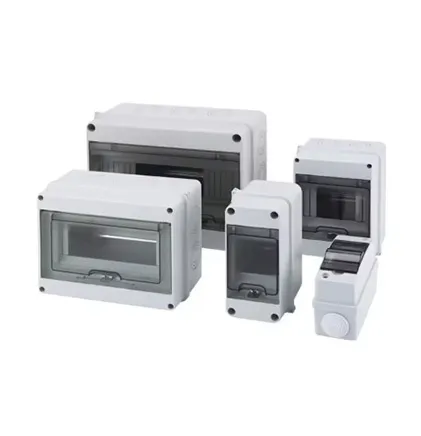
Ever opened a cabinet stuffed with tangled cables and thought: "There must be a better way!" That frustration is exactly why compact distribution boxes are revolutionizing electrical installation. Picture this: instead of maze-like wiring systems swallowing precious square footage, you get neatly organized, space-savvy hubs that deliver power and intelligence exactly where needed.
️ What's the big deal? Modern buildings demand smarter infrastructure. As decentralized systems replace clunky centralized distribution, compact boxes become nerve centers – managing energy flows while disappearing into walls, ceilings, or floors.
The Evolution: From Cluttered Rooms to Sleek Nodes
Traditionally, electrical distribution meant dedicating entire rooms to bulky switchgear. Today, building automation relies on distributed intelligence – and compact boxes are the enablers. Take Wieland's approach: their GESIS® RAN units function like "black boxes" packed with processing power yet occupy less space than a briefcase.
| Traditional Centralized | Modern Decentralized | Space/Function Impact |
|---|---|---|
| Dedicated equipment rooms | Wall/ceiling-integrated boxes | +50% usable space recovery* |
| Meter-long wiring runs | Short point-to-point connections | -70% cabling length* |
| Manual error-prone wiring | Plug-and-play interfaces | -66% installation errors* |
*Wieland field data from commercial installations
The Modern Compact Box Toolkit
These aren't just metal containers. They're modular ecosystems:
- Power Distribution Units (PDUs) like Eaton's BF-U series with 33SU capacity in slim profiles
- Consolidation Points merging power/data signals with failover protection
- Room Automation Units controlling HVAC, lighting, and security from a single tile
Material innovation plays a huge role too. Stainless steel handles moisture-rich bathrooms, aluminum withstands chemical exposure, and UV-stable polymers thrive in rooftop applications.
Installation hack: Unlike traditional gear requiring finished spaces, compact boxes install late-stage. Crews rough-wire buildings first, then drop in pre-configured units – slashing project timelines by up to 46%.
Where Small Size Creates Big Opportunities
You'll find these compact heroes transforming spaces where square footage equals revenue:
- Hotels : Room control boxes behind headboards enabling guest-controlled ambiance
- Retail : Power/data hubs integrated into display fixtures cutting renovation downtime
- Labs : Cleanroom-rated units managing sensitive instrumentation clusters
The pluggability factor changes everything. During a hospital remodel in Munich, technicians swapped outdated Wieland RVG boxes without cutting a single wire. Just unplugged the old unit, snapped in new IP controllers, and patched software – all during night shifts.
The Compromise Equation: Space vs. Function
Yes, downsizing creates challenges:
- Thermal Management : High-density wattage requires ventilated housings
- Upgrade Limitations : Future-proofing requires oversizing boxes from day one
- Accessibility Trade-offs : Flush-mount options complicate maintenance access
Smart designers address these through:
- Strategic perforated sections near heat-intensive components
- Unused capacity zones for mid-life upgrades
- Magnetic tool-release covers for fastener-free access
Selecting Your Compact Partner
When evaluating systems, go beyond catalog specs:
| Feature | Wieland | Eaton | Key Decision Points |
|---|---|---|---|
| Plug System | gesis®/RST® coded connectors | xComfort® interface sets | Existing infrastructure compatibility |
| Build Type | Custom configurable boxes | Fixed kit assemblies | Project uniqueness vs. standardization |
| Mounting | Wall/floor/ceiling w keyholes | Flush recessed mounting | Renovation vs new build needs |
⚠️ Critical Factor: Insist on in-situ thermal imaging during factory tests. A 2023 study found 23% of "compact" boxes exceeded operating temps when loaded at 80% capacity.
Where Compact Tech Is Headed Next
Horizon technologies will dissolve boundaries between distribution and intelligence:
- Predictive maintenance chips : Monitoring load cycles to flag failing relays
- Dynamic Power Reallocators : Stealing unused wattage from meeting rooms to labs
- Multi-layered trace PCBs : Fusing PLC controls onto busbar structures
The next decade's game-changer? Functional integration into architectural elements. Picture decorative columns housing vertical power spines or window mullions containing zone controllers.
Wrapping It Up: Small Footprint, Giant Leaps
The evolution from room-swallowing switchgear to palm-sized power nodes isn't just convenient – it's catalytic. By reclaiming real estate while distributing intelligence, compact boxes unlock architectural freedom. As Robert Gerhäuser from Wieland puts it: "We're not just fitting boxes into buildings – we're fitting buildings into smarter futures."
So next time you flip a switch in a hotel room or adjust office lighting via phone, remember: there's likely a carefully-engineered, space-optimized distribution box hiding nearby – orchestrating comforts quietly from the shadows.










