
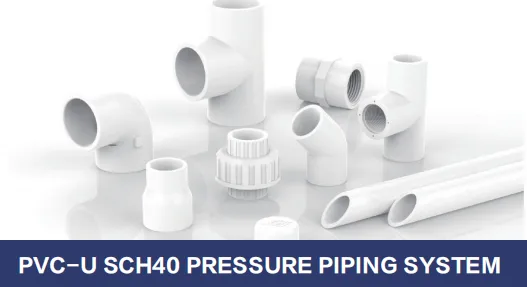
Picture this: You're standing in the middle of a bustling construction site—a new office complex, maybe, or a sprawling shopping mall. The air smells of fresh concrete, and workers dart between scaffolding, each focused on their piece of the puzzle. Among the chaos, one element quietly holds the project together: the plumbing system. Without reliable pipes, water can't flow to restrooms, break rooms, or fire suppression systems. For commercial projects, where efficiency, durability, and cost-effectiveness are non-negotiable, choosing the right piping system isn't just a detail—it's a cornerstone of success. Today, we're diving into one of the most trusted options in commercial plumbing: the PVC-U SCH40 pressure piping system . We'll explore what makes it tick, the key design considerations that can make or break your project, and why partnering with the right PVC-U SCH40 pressure piping system supplier matters just as much as the materials themselves.
First things first: Let's decode the jargon. PVC-U stands for "unplasticized polyvinyl chloride"—a rigid, strong version of PVC that's free of the plasticizers that make flexible PVC bendable. "SCH40" refers to the pipe's schedule, a standard that defines its wall thickness and pressure-bearing capacity. Think of it as the pipe's "strength rating": SCH40 is thicker than SCH20 (used for low-pressure applications) but thinner than SCH80 (reserved for high-pressure, high-temperature scenarios). For most commercial projects—think office buildings, retail spaces, or schools—PVC-U SCH40 hits the sweet spot: tough enough to handle daily water pressure, yet lightweight and affordable enough to keep project costs in check.
But why PVC-U SCH40 specifically? Unlike metal pipes (which rust) or copper (which corrodes in acidic water), PVC-U is inherently resistant to corrosion, chemicals, and scale buildup. It's also surprisingly lightweight—about a third the weight of steel—making it easier to transport, lift, and install. And let's not forget cost: PVC-U pipes and fittings are generally cheaper than copper or CPVC, which is a big win for projects with tight budgets. Little wonder, then, that it's a go-to for everything from cold water supply lines to irrigation systems in commercial settings.
Designing a PVC-U SCH40 system isn't as simple as picking a pipe and gluing it together. Commercial plumbing systems face unique challenges: fluctuating water pressure, high usage peaks (like morning rush in a hotel), and strict building codes. Overlooking even one detail can lead to leaks, pressure drops, or worse—costly rework down the line. Let's break down the critical factors every designer, contractor, and project manager should keep top of mind.
Here's a golden rule: Pipes don't just "hold water"—they hold pressure . In commercial buildings, water pressure can vary dramatically. A high-rise office, for example, might need booster pumps to push water to upper floors, increasing pressure on lower-level pipes. A stadium during a sold-out event could see sudden spikes in demand as thousands of people use restrooms at once. PVC-U SCH40 is rated for specific pressure limits, but here's the catch: those ratings drop as temperatures rise. At 20°C (68°F), a 1-inch SCH40 pipe can handle up to 450 psi (pounds per square inch). But crank the heat to 40°C (104°F), and that number plummets to around 230 psi. For cold water systems (the sweet spot for PVC-U SCH40), this isn't a problem. But if you're tempted to use it for hot water? Think again—PVC-U starts to soften above 60°C (140°F), making it risky for anything beyond lukewarm applications. For hot water lines, you'd need to step up to CPVC SCH80 or PPR pipes, but that's a topic for another day.
The takeaway? Always check the pipe's pressure rating at the maximum temperature your system will see. Your PVC-U SCH40 pressure piping system supplier should provide detailed charts for this—don't hesitate to ask for them. It's better to over-engineer slightly than to watch a pipe burst during peak usage.
Imagine trying to water a garden with a straw: no matter how much pressure you apply, the flow will be weak. The same principle applies to piping systems. Size a pipe too small, and you'll get low water pressure, noisy flow, or even pipe bursts from friction. Size it too large, and you're wasting money on materials and installation. So how do you get it right?
Start with flow rate: How much water does your system need to deliver? For a small café, a ¾-inch line might suffice for the kitchen sink. For a hotel with 200 rooms, each with a shower and toilet, you're looking at 2-inch or larger mains. Then factor in friction loss—the pressure drop that occurs as water rubs against the pipe's interior. PVC-U SCH40 has a smooth inner surface, which minimizes friction (a big advantage over rough cast iron), but longer pipe runs or sharp bends can still slow flow. Most designers use software like Pipe-Flo or hydraulic calculators to balance flow rate, pipe diameter, and pressure, but a good rule of thumb is to consult your local plumbing code—many jurisdictions have minimum size requirements for specific fixtures (e.g., 1.5-inch pipes for commercial restroom sinks).
Pro tip: Don't forget about future expansion. A retail space might start with a small staff, but if it expands into a larger store, that 1-inch pipe could become a bottleneck. Work with your PVC-U SCH40 pressure piping system supplier to plan for growth—they can often provide PVC-U SCH40 pressure piping system solutions that balance current needs with future scalability.
A pipe is only as strong as its weakest link—and that link is often the fittings. Elbows, tees, couplings, and valves must match the pipe's material and pressure rating to avoid leaks. For PVC-U SCH40 systems, this means using PVC-U SCH40 fittings (not SCH20, which are thinner) and ensuring they're compatible with the type of fluid flowing through them. For example, if your system carries treated water with chlorine, check that the fittings are rated for chemical resistance. Most pipes fittings supplier options will stock PVC-U SCH40-compatible parts, but double-checking is critical. A mismatched fitting might save a few dollars today, but it could cost thousands in repairs tomorrow.
Another compatibility consideration: joining methods. PVC-U SCH40 is typically joined with solvent cement (a glue that melts the pipe and fitting surfaces, fusing them into one). But not all cements are created equal—use one specifically formulated for PVC-U (avoid "all-purpose" cements that might not bond as strongly). Your supplier can recommend the right product, and many even offer training for installers to ensure proper application. Remember: A good bond requires clean, dry surfaces and the right curing time (usually 24 hours for full strength). Rushing this step is a recipe for leaks.
Even the best materials fail if installed poorly. PVC-U SCH40 is relatively easy to work with, but that doesn't mean it's foolproof. Here are a few installation pitfalls to avoid:
Many PVC-U SCH40 pressure piping system suppliers offer on-site support or installation guides—take advantage of these resources. A quick call to their technical team can save hours of frustration (and rework) down the line.
Commercial plumbing isn't just about function—it's about following the law. Every jurisdiction has its own codes (e.g., the International Plumbing Code in the U.S., or BS EN standards in Europe) that dictate everything from pipe materials to installation methods. For PVC-U SCH40, the most common standard is ASTM D1785, which sets specifications for dimensions, pressure ratings, and material quality. Look for pipes marked with "ASTM D1785 SCH40" to ensure compliance.
Other certifications matter too. If your system carries potable water, the pipe must be NSF/ANSI 61 certified (meaning it won't leach harmful chemicals into drinking water). For healthcare facilities or schools, additional certifications (like low lead content) may be required. Your supplier should have these certifications on hand—if they can't produce them, it's time to look elsewhere. Non-compliance isn't just a legal risk; it can void insurance claims if a failure occurs.
Curious how PVC-U SCH40 compares to other piping options? Let's break it down with a quick comparison:
| Material | Pressure Rating (20°C) | Max Temperature | Best For | Cost (Relative) |
|---|---|---|---|---|
| PVC-U SCH40 | 450 psi (1-inch pipe) | 60°C (140°F) | Cold water supply, irrigation, non-potable systems | Low |
| CPVC SCH80 | 400 psi (1-inch pipe at 20°C) | 93°C (200°F) | Hot water lines, industrial chemical transport | Medium |
| PPR (Polypropylene Random Copolymer) | 200 psi (1-inch pipe at 20°C) | 82°C (180°F) | Hot/cold water in residential and light commercial | Medium-High |
| Copper | 400 psi (1-inch Type L) | 200°C (392°F) | Premium residential, historic buildings | High |
As you can see, PVC-U SCH40 shines in cold water, low-to-medium pressure applications where cost and ease of installation are priorities. For hot water or high-temperature chemicals, you'll need to step up to CPVC or PPR, but for most commercial projects, PVC-U SCH40 is the workhorse that gets the job done without breaking the bank.
By now, you're probably thinking, "Okay, I get the design stuff—but where do I get the pipes?" Here's the truth: Your PVC-U SCH40 pressure piping system supplier isn't just a place to buy materials—they're a partner in your project's success. A great supplier does more than ship boxes; they provide PVC-U SCH40 pressure piping system solutions that include technical support, custom sizing, and even training for your team. So what should you look for?
And don't forget about pipes fittings supplier partnerships. The best PVC-U suppliers often stock compatible fittings, valves, and cement, making it easy to source everything from one place. This reduces lead times and ensures compatibility—no more guessing if a fitting from Supplier A will work with a pipe from Supplier B.
PVC-U SCH40 is low-maintenance, but it's not "set it and forget it." Here's how to keep your system in top shape:
At the end of the day, commercial plumbing is about reliability. You need a system that works when you need it, lasts for decades, and doesn't drain your budget. PVC-U SCH40 checks all these boxes: it's strong, affordable, easy to install, and resistant to the wear and tear of commercial life. But success depends on more than just picking the right pipe—it requires careful design, proper installation, and a partner who understands your project's unique needs. Whether you're building a small café or a skyscraper, take the time to research, ask questions, and choose a PVC-U SCH40 pressure piping system supplier who offers more than products—they offer peace of mind.
So the next time you walk through that finished office complex or shopping mall, take a moment to appreciate the unsung hero behind the scenes: the PVC-U SCH40 pipes, quietly delivering water where it's needed, day in and day out. With the right design and the right partner, your project can enjoy that same reliability—now and for years to come.
Recommend Products












