
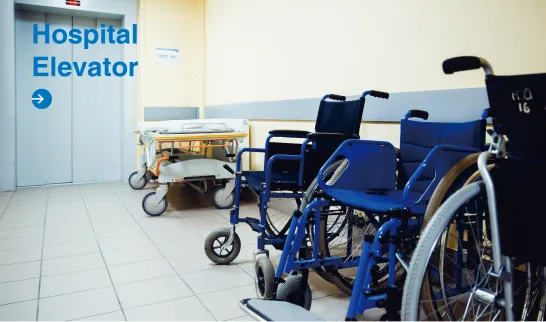
Building lifelines for Saudi Arabia's healthcare future—where reliability, innovation, and care converge
In the heart of Riyadh, Jeddah, and Dammam, a quiet revolution is unfolding. Saudi Arabia's Vision 2030 isn't just reshaping skylines—it's redefining what healthcare looks like for millions. As new hospitals rise and existing facilities expand to meet growing demand, there's an unspoken truth: the buildings themselves must work as hard as the medical teams inside them. Every corridor, every ward, and every connection between floors carries the weight of saving lives. And in that intricate web of care, elevators aren't just machinery—they're the silent partners ensuring that patients reach treatment faster, nurses deliver supplies without delay, and critical equipment moves seamlessly where it's needed most.
For Saudi healthcare contractors tasked with bringing these vital projects to life, choosing the right partners isn't just a business decision—it's a commitment to the communities they serve. That's where Coloria steps in. More than a building material supplier , we're a one-stop architectural solution provider deeply rooted in Saudi Arabia's vision. With decades of experience navigating the unique needs of the Middle East market, we understand that hospital elevators require more than standard specs. They demand precision, empathy, and a design philosophy centered on the people who rely on them daily.
Walk into any hospital, and you'll quickly realize: elevators here operate in a world of their own. A maternity ward's elevator might carry a newborn and their family, while steps away, another transports a patient on a stretcher, surrounded by medical monitors. Down the hall, a third shuttles heavy MRI machines or stacks of sterile supplies. Each scenario demands something different, but all share a common need: uncompromising reliability .
At Coloria, we don't just build elevators—we engineer solutions tailored to the chaos and urgency of healthcare. Our hospital elevators are designed with the people at their core: the exhausted parent rushing to NICU, the surgeon racing to an emergency, the technician wheeling life-saving equipment. Let's break down what makes them different:
Saudi Arabia's climate and landscape present unique challenges. Dust storms in the desert, scorching summer temperatures, and the need for equipment to withstand years of heavy use—these aren't afterthoughts for us. Our hospital elevators are built to thrive here, not just function.
| Model | Capacity | Speed | Saudi-Centric Features |
|---|---|---|---|
| MedLift 1600 | 1600 kg (21 passengers) | 1.0 m/s | Dust-resistant door mechanisms, high-temp lubricants, backup battery for power fluctuations |
| MedLift 2000 | 2000 kg (26 passengers) | 1.3 m/s | Antimicrobial stainless steel interiors, emergency intercom with Arabic/English support |
| MedLift 2500 | 2500 kg (33 passengers) | 1.6 m/s | Reinforced flooring for heavy equipment, smart load sensors, remote monitoring via cloud |
Take, for example, our dust-resistant door systems . In regions like Riyadh, where sandstorms can reduce visibility to meters, traditional elevator doors often jam or wear down prematurely. We've redesigned the seals and tracks to repel fine particles, ensuring doors open and close smoothly even during the harshest weather. Similarly, our lubricants are formulated to withstand temperatures up to 50°C (122°F)—critical for elevators installed in unconditioned machine rooms or exposed shafts.
But it's not just about surviving the elements. It's about fitting seamlessly into Saudi Arabia's healthcare ecosystem. Our elevators comply with both international standards (ISO 18738 for healthcare elevators) and local regulations set by the Saudi Standards, Metrology and Quality Organization (SASO). For contractors, that means one less headache—no last-minute adjustments to meet compliance gaps.
Here's a reality healthcare contractors know all too well: managing multiple suppliers for a single project is a logistical nightmare. Imagine coordinating delivery timelines for elevators from one company, wall panels from another, and electrical systems from a third—all while ensuring they work together flawlessly. Delays, miscommunications, and compatibility issues become inevitable.
At Coloria, we built our reputation on solving this exact problem. As a one-stop architectural solution provider , we don't just deliver elevators—we deliver cohesion . When you partner with us for a hospital project, you gain access to our full suite of products, all designed to work in harmony:
For a recent hospital expansion in Jeddah, this integration proved transformative. The contractor needed elevators, fire-resistant walls, and electrical systems delivered within a tight 12-month timeline. By choosing Coloria, they eliminated the need for three separate contracts, three sets of inspections, and three teams to coordinate. Our project managers oversaw the entire process, ensuring elevators arrived when the shaft was ready, walls were installed to precise dimensions, and wiring integrated seamlessly with elevator controls. The result? The project finished two months early—saving time, money, and countless headaches.
There's a difference between doing business in Saudi Arabia and being of Saudi Arabia. For decades, Coloria has called this region home. Our Riyadh-based team isn't just a sales office—it's a hub of local expertise, with engineers, technicians, and project managers who understand the nuances of Saudi construction. They know the rhythms of the market, the priorities of local contractors, and the unique needs of healthcare projects in cities from Al Khobar to Mecca.
This local presence translates to more than just convenience. It means faster response times when a maintenance issue arises. It means training programs for Saudi technicians, so hospitals have in-house experts to keep elevators running smoothly. It means aligning our goals with Saudi Vision 2030—whether that's creating local jobs, investing in sustainable technologies, or supporting the kingdom's push for self-reliance in healthcare infrastructure.
Take our partnership with a government-led hospital project in Dammam. As part of the initiative to boost (localization), we trained 15 Saudi engineers in elevator maintenance and safety protocols. Today, those engineers lead the facility's maintenance team, ensuring minimal downtime and keeping the elevators operational 24/7. It's not just about selling products—it's about building capacity for the long term.
Hospitals are energy-intensive by nature, but that doesn't mean they can't be part of Saudi Arabia's sustainability journey. Coloria's hospital elevators are designed with the planet in mind, turning every ride into an opportunity to conserve resources. Our regenerative drive systems, for example, capture energy during descent and braking, feeding it back into the building's electrical grid. In a busy hospital with elevators running 18 hours a day, that can reduce energy consumption by up to 30% annually.
But sustainability goes beyond energy savings. We source materials locally where possible, reducing carbon footprints from transportation. Our elevator cabins use recycled steel and low-VOC (volatile organic compound) paints, improving indoor air quality for patients and staff. Even the packaging for our components is recyclable—a small step, but one that adds up when multiplied across hundreds of projects.
For contractors aiming to secure LEED or Estidama certifications for their healthcare facilities, these details matter. Coloria doesn't just help you build a hospital—we help you build a sustainable one, aligned with both global best practices and Saudi Arabia's commitment to a greener future.
At the end of the day, healthcare construction is about more than concrete and steel. It's about creating spaces where people feel safe, cared for, and hopeful. For Saudi contractors, that means choosing partners who share that vision—partners who see beyond deadlines and budgets to the human impact of the work.
Coloria's hospital elevators are more than a product. They're a promise: that when you build with us, you're building with reliability, innovation, and a deep understanding of what Saudi healthcare needs. From the first design meeting to the final inspection—and every maintenance check in between—we're with you, ensuring that the elevators in your hospitals don't just move people, but move mountains for the patients and teams who depend on them.
Saudi Arabia's healthcare future is bright. Let's build it together—one lift, one project, one life at a time.
Recommend Products












