
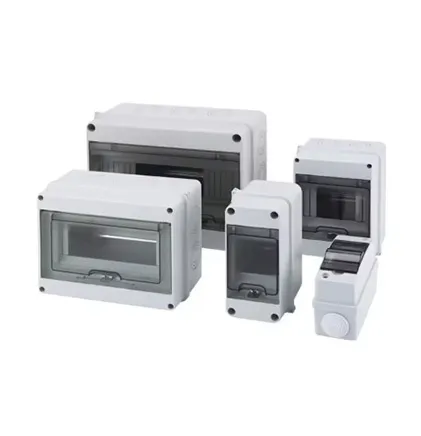
Imagine walking into a newly built hospital in Riyadh, where every light, medical device, and air conditioning unit works flawlessly. Or picture a luxury residential tower in Dubai, where families feel safe knowing their home's electrical system won't fail during a summer heatwave. Behind these scenes of reliability and safety lies a critical component that often goes unnoticed but never unappreciated: the power distribution box. As the "control center" of a building's electrical system, its role in ensuring safe, efficient energy flow can't be overstated—especially when construction projects span borders and must adhere to global safety standards.
For international contractors and developers, one question looms large: How do you ensure the electrical components you source meet the strictest safety regulations, no matter where the project is located? This is where compliance with the International Electrotechnical Commission (IEC) standards becomes non-negotiable. And for those seeking a partner who understands both global standards and regional needs, Coloria— a leading one-stop architectural solution provider—stands out as a trusted name in delivering power distribution boxes that bridge technical excellence with real-world application.
In the rush to finalize a construction project, it's easy to focus on visible elements like flooring, fixtures, or facades. But seasoned architects and contractors know better: the true backbone of any building is its electrical infrastructure. And at the heart of that infrastructure is the power distribution box—responsible for dividing incoming electrical power into subsidiary circuits while providing protective fuses or circuit breakers for each circuit.
"A substandard distribution box isn't just a technical issue—it's a safety hazard. In commercial spaces like hotels or hospitals, electrical failures can disrupt operations and endanger lives. In residential buildings, it can lead to fires or equipment damage. That's why cutting corners here is never an option." — A senior electrical engineer with 20+ years in Middle Eastern construction projects
Whether you're building a 500-unit apartment complex or a sprawling shopping mall, the distribution box must be tailored to the project's specific demands. Residential buildings, for example, require systems that handle diverse household appliances—from refrigerators to smart home devices—while commercial spaces often need higher load capacities for heavy-duty equipment like elevators or industrial-grade HVAC systems. As both a residential building materials supplier and commercial building materials supplier, Coloria understands these nuances, offering distribution boxes designed to scale with project requirements without compromising on safety.
When it comes to electrical safety, the IEC isn't just another acronym—it's the most widely recognized international standard-setting body for electrotechnology. Established in 1906, the IEC develops standards that ensure electrical equipment works safely, efficiently, and interoperably across borders. For power distribution boxes, compliance with IEC standards means meeting rigorous criteria for design, performance, and durability.
| IEC Standard | Key Requirements | Real-World Impact |
|---|---|---|
| IEC 61439-1 | Low-voltage switchgear and controlgear assemblies – General rules for design and testing | Ensures the box can withstand electrical stress, temperature fluctuations, and mechanical impact during installation and use. |
| IEC 60529 | Degrees of protection provided by enclosures (IP Codes) | Guarantees protection against dust, water, and foreign objects—critical for harsh environments like construction sites or coastal areas. |
| IEC 60898-1 | Circuit breakers for overcurrent protection for household and similar installations | Prevents electrical fires by ensuring circuit breakers trip at the right current levels, protecting both people and equipment. |
For global contractors, these standards aren't just checkboxes—they're peace of mind. When a project in Saudi Arabia specifies IEC compliance, it means the same rigorous safety measures apply as in a project in Europe or Asia. This harmonization saves time, reduces risks, and ensures that buildings meet the highest safety benchmarks, regardless of location.
At Coloria, compliance with IEC standards isn't an afterthought—it's built into every step of the manufacturing process. As a one-stop architectural solution provider with decades of experience in the Middle Eastern market, the company knows that meeting international standards is table stakes for earning trust in regions like Saudi Arabia, where construction projects are booming under the Vision 2030 initiative.
It starts with material selection. Coloria sources high-grade insulation materials and flame-retardant plastics that meet IEC 60695 flammability standards, ensuring the box itself won't contribute to fire spread. Conductive components are made from electrolytic copper with 99.9% purity, minimizing resistance and heat buildup—a critical factor in preventing overheating failures.
The production line then takes over, with automated assembly processes that reduce human error. Each box undergoes multiple tests: dielectric strength testing to ensure insulation integrity, temperature rise tests to verify performance under load, and short-circuit withstand tests to simulate worst-case scenarios. Only after passing these internal checks does the product move to third-party certification, where independent labs confirm compliance with IEC 61439-1 and other relevant standards.
While IEC standards provide a global framework, regional climates and regulations demand flexibility. In Saudi Arabia, for example, extreme temperatures (reaching 50°C in summer) and high humidity levels can stress electrical equipment. Coloria's distribution boxes for the Middle East market include enhanced ventilation systems and heat-resistant gaskets, all while maintaining IEC's strict IP54 protection rating (dust-tight and protected against splashing water).
This ability to blend global standards with local expertise is why Coloria has become a trusted saudi arabia building materials supplier. By working closely with local engineers and understanding the unique challenges of the region—from sandstorms to voltage fluctuations—the company delivers solutions that feel tailored, not generic.
In construction, time is money. Coordinating with multiple suppliers for electrical components—distribution boxes, cables, switches, and fixtures—can lead to delays, compatibility issues, and increased costs. This is where Coloria's strength as a one-stop architectural solution provider shines brightest.
Imagine a hotel project in Jeddah. The electrical contractor needs not just distribution boxes, but also electrical fixtures & cables, lighting systems, and even smart controls. Instead of juggling orders from five different suppliers, they can source everything from Coloria. This integration ensures that all components work seamlessly together—no more mismatched cable sizes or incompatible switchgear. It also simplifies logistics: one delivery schedule, one point of contact, and one unified quality standard across the entire electrical system.
Saudi Arabia's Vision 2030 isn't just about economic diversification—it's about building a sustainable future with locally driven growth. As a saudi arabia building materials supplier, Coloria aligns with this vision by maintaining a local office in Riyadh, staffed with bilingual engineers who understand both international standards and local construction practices. This presence means faster response times for technical support, on-site inspections, and after-sales service—critical for keeping projects on track in a fast-paced market.
The company also invests in training programs for local electricians, teaching best practices for installing IEC-compliant electrical systems. By empowering the local workforce, Coloria isn't just supplying products; it's contributing to the long-term development of Saudi Arabia's construction industry—one skilled technician at a time.
In today's construction landscape, "sustainable" isn't just a buzzword—it's a requirement. With global efforts to meet carbon neutrality goals, even components like distribution boxes are being reimagined with eco-friendliness in mind. Coloria's commitment to sustainability aligns with both international "net-zero" trends and Saudi Arabia's own green building initiatives under Vision 2030.
How does this translate to distribution boxes? For starters, the company uses recycled aluminum for enclosure frames, reducing the carbon footprint of raw material extraction. Low-energy circuit breakers minimize standby power loss, and modular designs make it easy to upgrade components without replacing the entire box—extending product lifespan and reducing waste. These features not only meet IEC's emerging sustainability guidelines but also help project developers earn LEED or Estidama certifications, which are increasingly important in competitive markets.
"Sustainability in construction isn't about choosing between safety and the environment—it's about integrating both. A distribution box that's energy-efficient and recyclable doesn't just help the planet; it lowers long-term operating costs for building owners. It's a win-win that IEC standards are starting to emphasize more strongly." — Sustainability consultant specializing in Middle Eastern construction
While Coloria has deep roots in the Middle East, its reach extends far beyond. With a global service network that spans Asia, Africa, and Europe, the company prides itself on "global customer satisfaction"—a promise backed by 24/7 technical support, multilingual documentation, and a supply chain that can deliver to even remote construction sites.
Take, for example, a luxury resort project in the Maldives. The contractor needed distribution boxes that could withstand saltwater corrosion and frequent power fluctuations. Coloria's team in Dubai collaborated with the local engineering firm to modify standard designs, adding marine-grade coatings and surge protection features. The boxes were shipped within three weeks, and a technician was on-site to supervise installation—all part of the company's commitment to being more than just a supplier, but a partner in project success.
In the end, a power distribution box is more than just a metal box with switches. It's a promise—of safety for occupants, reliability for operators, and compliance for contractors. For Coloria, that promise is upheld through rigorous adherence to IEC standards, a deep understanding of regional needs, and a commitment to making construction easier through one-stop solutions.
As Saudi Arabia continues to grow under Vision 2030, and as global construction demands higher safety and sustainability standards, the role of trusted partners becomes clearer. Whether you're building a hospital, a residential complex, or a commercial tower, the right distribution box isn't just a component—it's the foundation of a building that stands the test of time. And in that foundation, compliance with IEC standards isn't optional—it's essential.
Recommend Products












