
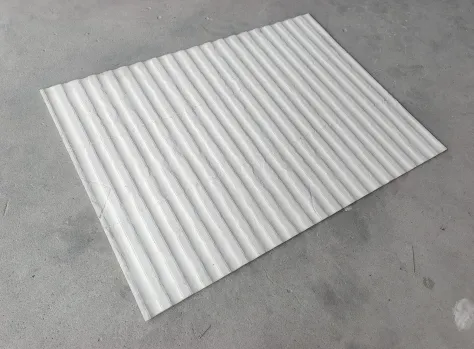
Natural stone brings timeless beauty to buildings but demands special engineering considerations. Unlike manufactured materials, stone has unique geological characteristics that affect its structural performance. The anchoring system acts as the crucial interface between the stone facade and building structure, responsible for transferring all loads while accommodating natural material behaviors.
Modern architectural trends toward larger stone panels and complex geometries make anchoring systems more critical than ever. The 2018 Burj Al Arab retrofit demonstrated how proper anchor selection can extend a building's lifespan by decades.
Understanding how different forces interact with stone panels is the foundation of safe installation. There are three primary loads anchoring systems must manage:
The weight of the stone itself creates constant downward force. Granite typically weighs 165-172 lb/ft³ compared to limestone's 150-160 lb/ft³ - these differences significantly impact anchor capacity requirements.
Wind patterns create pressure differentials that push and pull on stone panels. The Chicago Willis Tower experiences wind forces up to 100 mph at its peak, requiring anchors to resist over 45 psf suction forces.
In earthquake-prone regions, anchors must accommodate movement through designed slip planes while maintaining structural integrity. The 2010 Chile earthquake proved the effectiveness of seismic-rated anchors when dozens of stone-clad buildings survived major tremors without facade failure.
Choosing the right anchor depends on stone type, panel dimensions, structural backing, and environmental conditions:
These feature blade inserts that slide into grooves cut into the stone edge. Best for standard granite/marble panels up to 2" thickness in low-to-mid rise applications.
Specialized drill bits create dovetail voids where anchors mechanically lock into position. Ideal for brittle stones like sandstone where edge conditions are problematic.
Epoxy-bonded systems distribute stresses evenly across stone surfaces. Perfect for renovation work where minimal visual impact is required.
Combinations of mechanical and adhesive components provide redundancy. The Sydney Opera House restoration used titanium hybrid anchors to preserve the building's iconic shell design.
The conversation between stone and metal matters:
Moisture creates electrochemical reactions between dissimilar metals. Always match anchor material to fastener grade - using 304 stainless anchors with 316 fasteners invites trouble.
Stone and structural framing expand at different rates. Aluminum framing expands nearly twice as much as granite for the same temperature change - anchors must accommodate differential movement.
Insufficient distance from anchor to stone edge creates fracture planes. As a rule of thumb, maintain minimum edge distance equal to twice the anchor diameter plus 1/4" tolerance.
Transform theoretical calculations into physical security:
Anchors aren't created equal in a panel. Corner anchors bear disproportionate loads - typically designed for 1.5x higher capacity than mid-panel anchors.
Standard safety factors of 4:1 provide protection against hidden stone flaws. The table below illustrates how safety requirements change with stone variability:
Static anchors cause stone fractures. Modern systems incorporate:
- Slotted connection holes (horizontal movement)
- Compression gaskets (vertical movement)
- Rotation plates (differential movement)
Anchor performance degrades differently across climate zones:
Salt aerosols penetrate microscopic gaps. Along Florida's coast, standard 304 stainless shows pitting corrosion within 7 years - Type 316 is the absolute minimum.
Water absorption below 0.5% is critical for freeze zones. Use anchors designed with freeze expansion chambers to prevent cracking during ice formation.
Even perfect engineering fails with poor execution:
Masonry backup walls require more anchor adjustability than steel frames. For CMU walls, include ±3/8" vertical adjustment and ±1/4" horizontal flexibility.
The "Rule of Thirds" governs placement: Divide panel height into thirds, place anchors at each division point. For 8' tall panels, install rows at 32" and 64" from base.
Over-tightening crushes stone cells. For marble, apply maximum 35 in-lb torque; granite can handle up to 70 in-lb. Always use calibrated torque wrenches and document each setting.
Stone anchoring systems require periodic evaluation:
Infrared thermography identifies moisture intrusion behind stone panels before visible damage occurs. The Empire State Building facade inspection program saved $2.5 million in preventive repairs last decade.
Annual tension testing with calibrated pull-testers can identify anchor degradation before failures occur. Target at least 5% of anchors per elevation for sampling.
Modern codes reflect decades of field experience:
ASTM C1354 demands proof load testing to twice the design load without deformation. Crucial for high-rise applications where access for repair is costly.
Insist on mill certifications for metal components. Counterfeit stainless steel enters the supply chain frequently - batch testing caught 14% substandard anchors in the 2019 Miami audit.
The Los Angeles City Hall project illustrates modern seismic anchoring:
Original 1928 stone facade anchors lacked seismic accommodation. Engineers installed 15,000 custom shock-absorbing anchors that:
The system successfully weathered three moderate earthquakes during installation alone.
Design for climate resilience through:
With increasing storm intensity, design for 120 mph baseline instead of historical 90 mph standards in hurricane zones.
Shape-memory alloy anchors now entering market - can absorb energy through phase transformation rather than permanent deformation.
Address common installation problems:
Patterned fractures radiating from anchors indicate overtightening or insufficient edge distance. Document fracture patterns to diagnose root cause.
Brown discoloration below anchors reveals galvanic corrosion. Requires immediate isolation of dissimilar metals with dielectric gaskets.
A systematic approach ensures compatibility:
Is the project in coastal environment?
→ YES: Use Type 316 stainless or higher
→ NO: Proceed to next question
Does stone have high water absorption?
→ YES: select stainless anchors with drainage pathways
→ NO: Standard kerf anchors may be suitable
Proper stone anchoring balances engineering precision with material empathy. By understanding stone's geological personality and designing anchors as adaptive interfaces rather than rigid constraints, we create facades that weather centuries. Remember the three pillars: calculations rooted in physics, materials chosen for compatibility, and installation performed with craftsman's attention. When these align, stone transforms from mere cladding into architecture that speaks across generations.
Recommend Products












