
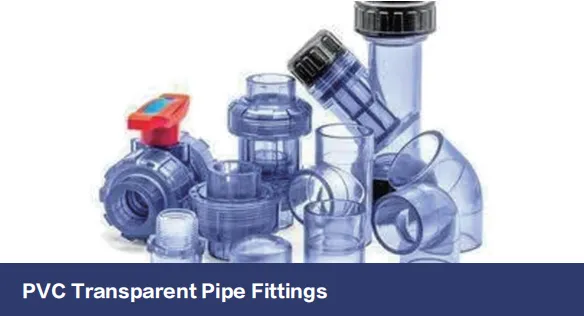
Imagine walking through a modern industrial plant and actually seeing fluids flowing through the pipes - that's the reality transparent PVC pipe fittings create. This innovation has transformed plumbing from a hidden infrastructure component into a visible system where flow monitoring happens in real-time. The traditional materials like copper, galvanized steel, and opaque PVC dominated the industry for decades, but their inherent limitations - corrosion, high costs, and lack of visibility - created persistent challenges for maintenance and safety.
Transparent PVC solves these fundamental problems through its unique combination of clarity, durability, and cost-effectiveness. Maintenance crews can instantly spot blockages without disassembly, factory supervisors can monitor chemical flows visually, and homeowners can appreciate the modern aesthetic of exposed plumbing systems. This innovation couldn't have come at a better time, as global infrastructure demands grow exponentially and efficiency becomes critical.
The PVC pipes and fittings market is experiencing explosive growth, projected to reach $110.47 billion by 2034 according to recent industry analysis. Three powerful megatrends fuel this expansion:
As cities expand globally, the demand for efficient water management systems intensifies. Developing economies in Asia and Africa require massive plumbing infrastructure, while established markets need replacements for aging systems.
With freshwater becoming increasingly scarce, technologies that enable efficient distribution and leak detection have moved from desirable to essential. Transparent fittings help conserve resources by providing immediate visual confirmation of system integrity.
Modern manufacturing demands precision fluid handling across pharmaceutical production, chemical processing, and food manufacturing. Industrial CPVC high pressure pipes with transparent monitoring capabilities ensure both quality control and safety compliance.
Despite this growth potential, many PVC fitting manufacturers struggle with international market penetration due to inconsistent quality standards and varying certification requirements across regions.
In an increasingly competitive global marketplace, certifications have transformed from optional credentials to fundamental business requirements. Authoritative third-party validation serves multiple critical functions:
Certifications reduce liability exposure by demonstrating adherence to safety protocols. When systems fail, documented compliance provides legal protection.
Certifications function as universal passports. European CE marking, North American NSF/ANSI 61, and Middle Eastern SASO certifications open doors that remain closed to uncertified products.
Rigorous testing protocols verify product durability under extreme conditions, ensuring transparent PVC maintains clarity after years of UV exposure or chemical contact.
The transparency that defines these fittings extends metaphorically to business practices through certification. When specifiers see certification badges on technical documentation, they immediately understand that manufacturers have nothing to hide about their production standards.
A leading transparent PVC fitting manufacturer transformed its export performance through a strategic certification investment:
This transformation underscores how certifications create tangible financial benefits beyond simply meeting regulatory requirements. The documented compliance journey becomes a powerful marketing narrative of quality commitment.
The certification landscape will evolve significantly as PVC fittings integrate with digital technologies:
Future certifications will validate sensor compatibility and data security for fittings incorporating flow monitoring sensors and IoT connectivity.
Standards will emerge for closed-loop recycling systems, validating both recycled content percentages and recyclability at end-of-life.
Certificates will quantify manufacturing emissions as carbon pricing mechanisms expand globally, creating competitive advantages for efficient producers.
These emerging standards represent both a challenge and opportunity. Forward-looking manufacturers are already implementing quality management systems with these future requirements in mind, building the infrastructure for seamless certification when standards formalize.
Transitioning to a certification-focused operation requires strategic commitment:
Identify required certifications for priority export regions. Government trade offices provide updated certification requirement databases.
Conduct thorough comparisons between current practices and certification requirements. Most certification bodies offer pre-audit consultation services.
Revise production workflows to incorporate quality verification checkpoints rather than adding inspection layers as an afterthought.
Promote certification achievements through technical documentation, website verification badges, and industry event participation.
The investment timeline typically spans 9-18 months from initial commitment to first certifications. Smart manufacturers view this period as an operational enhancement journey rather than simple compliance, fundamentally improving production quality during the process.
The true power of transparent PVC pipe fittings extends beyond their physical characteristics. These products represent a larger shift toward visibility throughout plumbing systems—from physical flow observation to transparent manufacturing practices validated through authoritative certification.
As global markets become increasingly sophisticated and regulatory requirements more demanding, certification has transitioned from an expense to a strategic investment with measurable returns. Manufacturers embracing this certification-first approach don't just qualify for international markets—they position themselves as premium providers worthy of specification preference.
The future belongs to manufacturers who pair material innovation with compliance leadership. As transparent PVC fittings become standard in chemical plants, pharmaceutical facilities, and modern architectural designs, certified products will flow through increasingly complex global supply chains—visibly demonstrating their quality every step of the way.
Recommend Products












