
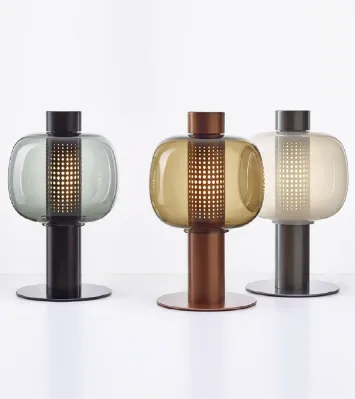
Picture this: you've just settled into your favorite armchair after a long day, ready to dive into that novel you've been neglecting. But as you reach for the light, something feels off – that generic store-bought lamp just doesn't create the warm, inviting glow you crave. That's where China's master crafters of illumination come in, transforming ordinary spaces into sanctuaries of light.
Having spent years exploring the nooks and crannies of China's lighting industry, I've seen how the right table lamp can whisper personality into a room. Unlike those mass-produced bulbs-in-a-base you'll find everywhere, the artisans we're about to explore treat lighting like brushstrokes on a canvas.
You know that feeling when you walk into a room and instantly feel at ease? Nine times out of ten, it's not the furniture or wall color – it's the lighting fixtures doing the heavy lifting. China's top manufacturers get this intuitively. They've moved beyond simply making things bright to crafting experiences:
| Consumer Pain Point | Standard Solution | Innovative Chinese Approach |
|---|---|---|
| Glare headaches | Basic diffuser | Multi-layer light filters that soften without dimming |
| Assembly frustration | 15-step instructions | Tool-free magnetic assembly (snaps in 10 seconds) |
| Cold industrial look | Metallic finishes | Hand-textured ceramics & natural stone bases |
Walking through their Shanghai showroom felt like entering a light sculpture gallery. Founder Mei Lin abandoned her architecture career after realizing "buildings are just containers for light." Their signature move? Using optical-grade crystal to bend light into rainbow patterns on ceilings – perfect when you want to pair wall art decoration with atmospheric accents.
Why decorators love them: Their lamps don't scream for attention but make everything around them look curated. The Harmony Collection remains my top pick for gallery walls – it casts the perfect museum-grade glow.
Tucked away in bamboo forests, this family-run operation sources materials from their own groves. Watching 70-year-old Master Chen split bamboo strands thinner than spaghetti to weave lampshades changed how I see craftsmanship. Each piece weathers like fine leather – developing a unique patina over time.
The sustainability edge: Their "Grow-a-Lamp" program lets customers plant bamboo shoots that'll eventually become their next lamp. A conversation starter that actually backs up eco-claims.
The "porcelain capital" meets Edison bulbs in unexpectedly gorgeous ways. Their artisans throw clay bases on traditional wheels, then carve intricate patterns that cast dancing shadows. Protip: Place one of their lotus-shaped lamps beside a decorative mirror to double the delicate light patterns.
Cultural connection: Each collection revives historical techniques – like celadon glazes from the Song Dynasty adapted for modern wiring systems.
China's lighting pioneers treat LED lights like artists treat paint – as raw material for creation. Forget the cold blue glare of early LEDs; we're talking about:
The magic happens in Shenzhen's tech workshops, where engineers collaborate with ceramicists and glassblowers. As lead developer Zhang Wei told me: "We don't ask 'can we add tech?' but 'will this make someone smile at 10 PM?'"
What stays with me after countless factory visits isn't the tech specs, but moments like watching an artisan in Hangzhou adjust a lampshade by millimeters – "so the light kisses the page like sunset," as he explained. That's the difference between commodity manufacturers and true craftspeople.
Whether you're accenting a favorite wall art decoration or creating a cozy reading nook, these creators prove lighting belongs alongside paintings and sculptures as deliberate expressions of beauty. As one Jingdezhen master potter mused while shaping a clay base: "We're not selling lamps – we're selling moonlit walks through bamboo groves. The lamp just carries the memory home."
Recommend Products












