


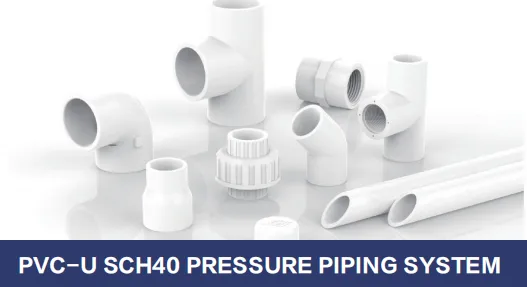
Everything you need to know about this versatile plumbing solution for modern infrastructure
Why PVC-U SCH40 is Your Go-To Piping Solution
Hey there! If you're involved in plumbing, industrial installations, or DIY projects, you've probably encountered PVC-U SCH40 piping. But what makes this material so special? Let's talk honestly - metal pipes rust, copper corrodes, but PVC-U SCH40 pressure pipe stands strong.
Imagine a piping solution that doesn't fight you during installation. No heavy lifting, no welding sparks, no worries about chemical corrosion eating away at your investment. That's what SCH40 offers - a truly low-maintenance partner for your water systems that handles pressures up to 450 PSI depending on pipe size. Unlike metal alternatives, this plastic piping won't develop pin-hole leaks or scale buildup over time.
The secret sauce? Polyvinyl Chloride Unplasticized (PVC-U). The "unplasticized" part means no softening additives, giving it incredible rigidity and strength. When you add the SCH40 dimensional specifications from ASTM standards, you get predictable, reliable performance you can literally bet your building on.
Features That Will Make You Choose SCH40
- Bulletproof Durability - Pound for pound, PVC-U has better impact strength than cast iron or even ductile iron. We're talking serious resilience that won't crack if someone accidentally bumps it with a ladder.
- No More Scale Wars - Remember scraping mineral deposits out of metal pipes? SCH40's smooth interior actually maintains flow rates over time, unlike corroded metal pipes that lose capacity.
- Chemistry Class Hero - Works beautifully with acids, bases, alcohols, and most chemicals. While metal pipes disintegrate, SCH40 just shrugs it off - perfect for industrial applications like laboratories and manufacturing facilities.
- Silent Operator - PVC absorbs sound vibrations better than metal pipes. You know that annoying "water hammer" noise? Drastically reduced, especially when combined with proper support spacing.
- Thermal Insulation - Better R-value than metal means less condensation in humid environments and better temperature retention for hot water lines.
One contractor friend told me: "Installing SCH40 feels like cheating compared to threading steel pipe." Solvent welding creates joints stronger than the pipe itself in minutes - no flame permits, no specialty tools needed. It's like the difference between hand-writing a letter and sending an email.
Your Guide to Proper Installation
Alright, let's get practical. Installing PVC-U SCH40 isn't rocket science, but there's an art to doing it right. I've seen too many failed installations from skipped steps:
Cutting : Use a PVC cutter or fine-tooth saw. Don't even think about that coarse wood blade - it'll leave micro-fractures. Deburr the inside and outside religiously.
Priming : Yeah, I know - it's tempting to skip that purple step. Don't. The primer softens the surface for maximum bonding. Without it, you're gambling with joint integrity.
Cementing : Apply cement to both the socket and the pipe end within 30 seconds of priming. Twist the pipe a quarter turn as you insert it to distribute cement evenly. Hold for 30 seconds - no cheating!
Support Spacing : Here's where pros differ from DIYers. Follow this simple rule: Every 3 feet for pipes 1" and smaller, every 4 feet for 1.25"-2", and every 6 feet for 3" and up.
Pressure & Temperature Ratings Made Simple
| Pipe Size | Max Operating Pressure | Max Temperature | Recommended Applications |
|---|---|---|---|
| 1/2" | 450 PSI | 140°F (60°C) | Residential water supply, condensation lines |
| 1" | 330 PSI | 140°F (60°C) | Irrigation systems, pool plumbing |
| 2" | 280 PSI | 140°F (60°C) | Industrial process lines, agricultural systems |
| 4" | 220 PSI | 140°F (60°C) | Cooling tower lines, drainage mains |
Important reminder: Those pressure ratings assume room temperature. For every 20°F above 73°F, derate by 20%. Hot water circulating at 140°F? Your max working pressure drops by about 50% compared to cold water ratings. Don't get caught by this temperature-pressure relationship!
Applications That Just Make Sense
Let me share where PVC-U SCH40 truly shines based on real-world projects:
Municipal Water Systems : Cities love it because it doesn't need cathodic protection like metal pipes. Installation moves faster too - cutting days off project timelines. Plus, the hydraulic smoothness means pumping savings over decades.
Industrial Chemical Lines : That epoxy coating on steel pipes? Forget it. SCH40 handles acids, alkalis, and solvents natively. I've seen it in plating shops and battery factories where metal pipes lasted mere months.
Aquaculture : Seawater won't phase PVC-U. Unlike stainless steel that pits over time, SCH40 maintains integrity in saltwater applications at a fraction of the cost.
HVAC Condensate Drainage : Condensate is slightly acidic - death to metal but harmless to PVC. Sloped correctly, these systems run maintenance-free for decades.
DIY Innovations : Home crafters have built hydroponic gardens, home brewery setups, and even rainwater harvesting systems with surprising effectiveness.
The water supply and drainage system versatility is remarkable - from carrying ultrapure water in pharmaceutical plants to handling fertilizer solutions in greenhouses. That's why specifying SCH40 creates better and longer-lasting infrastructure.
Fitting Selection Demystified
Choosing the right fittings is where many installations go wrong. Let's decode fitting types:
Solvent-Weld Fittings - The go-to for permanent installations. Make sure you're using schedule-rated fittings, not DWV versions. Pro tip: Use clear cement so you can see your coverage during assembly.
Threaded Adaptors - Essential for connecting to existing metal systems. Always use both Teflon tape and pipe dope on male threads. Install a union nearby so you can service valves without cutting pipe.
Mechanical Joints - Great for temporary systems or where solvent welding isn't practical. Transition fittings require special attention - use quality stainless steel clamps that won't corrode.
For industrial setups, industrial PVC pressure pipes paired with corrosion-resistant brass fittings deliver best results. Avoid galvanized steel fittings - their shorter lifespan defeats the purpose of using PVC.
The SCH40 Sustainability Edge
Here's something we should talk about more: SCH40 systems are eco-friendly warriors. The manufacturing energy is less than half of copper pipe production. Plus, PVC pipe has a remarkable recycling story.
Did you know? Approximately 30% of all new PVC pipe contains recycled material. Old pipes get ground and reformed into everything from park benches to new fittings. With a service life exceeding 70 years, the "cradle-to-cradle" sustainability makes it a top choice for green building projects.
For facilities managers, the smooth interior surface translates directly to pumping energy savings. Less friction means smaller pumps, lower electricity costs, and reduced carbon footprint over decades of operation. It's not glamorous, but it's real sustainability through physics.
Maintenance That's Almost Too Easy
Compared to other systems, SCH40 requires surprisingly little care. But don't neglect these essentials:
- Annually inspect exposed piping for UV damage. If exposed to sunlight, paint it with light-colored latex paint to prevent degradation
- Check support hangers every 5 years - metal components (like straps) age faster than the pipe itself
- Listen for water hammer - if present, install air chambers or arrestors to prevent stress damage
- Winterize properly - despite its strength, frozen water will split SCH40 pipe like any other material
For industrial chemical applications, flush systems thoroughly during chemical changes. While resistant, SCH40 doesn't appreciate sudden radical pH swings without transition flushing.
Why SCH40 Beats SCH80 in Most Scenarios
The SCH80 vs SCH40 debate confuses many installers. Let me simplify: SCH80 has thicker walls meaning higher pressure rating, but:
It's overkill for most applications - that extra thickness comes with a 50-100% price premium for pressure capacity most systems won't need
Flow rates suffer - the reduced inner diameter means higher friction losses. You'll need bigger pumps to move the same volume
Installation headaches - heavier material is harder to handle, cut, and requires longer solvent welding hold times
One exception : Use SCH80 for exposed piping at risk of physical impact or temperatures above 140°F. Otherwise, SCH40 delivers the best balance of performance, cost, and install experience.
Secrets From Industry Veterans
After interviewing dozens of installers with combined centuries of experience, here are their golden tips:
- Dry Fit First : Assemble with clean, dry fittings first to ensure proper insertion depth before cementing
- Use Quality Cement : Don't economize on cement - different formulations exist for different pipe diameters and temperatures
- Cold Weather Tricks : In temperatures below 40°F, warm pipes before cutting and cementing to prevent brittle fractures
- Marking Matters : After alignment marks disappear under primer, use painter's tape to preserve orientation
- Support Cleverly : Near valve connections, leave a little slack for maintenance without requiring pipe cutting
One pro shared: "I spend more time planning my supports than cutting pipe. Properly supported SCH40 looks professional and performs flawlessly for decades." This experience matters more than any specification sheet.
Standards You Can Trust
When selecting SCH40 products, look for these critical certifications:
ASTM D1785 - The governing standard for pipe dimensions and pressure ratings. This ensures dimensional consistency so fittings work correctly
NSF 61 - Certifies material safety for potable water contact. Never install non-NSF61 pipe for drinking water systems
ASTM D2665 - The DWV (drain-waste-vent) spec. Don't confuse DWV fittings with pressure-rated ones - they aren't interchangeable!
CSA B137.3 - The Canadian counterpart to ASTM standards. Important for North American projects
Never accept pipe without clear printing of size, schedule, ASTM standard, NSF mark, and manufacturer info. Unmarked "mystery pipe" has no place in quality installations.
Future-Proofing Your Pipe System
What comes next? Industry trends point to even smarter PVC solutions:
Hybrid Materials : Fiberglass-reinforced SCH40 variants for extreme applications with enhanced stiffness and heat deflection
IoT Integration : Smart couplings with embedded sensors to monitor flow, pressure, and water quality in real-time
Bio-Based PVC : Companies are developing renewable-source vinyl chloride monomers to reduce dependence on fossil fuels
Ultraviolet Resistance : New stabilizing packages that extend outdoor service life by 25-50% without painting
What remains constant? The fundamental value proposition - affordable reliability that installation teams appreciate. Whether you're retrofitting a century-old facility or plumbing a new lab, PVC-U SCH40 delivers performance you feel confident about.










