
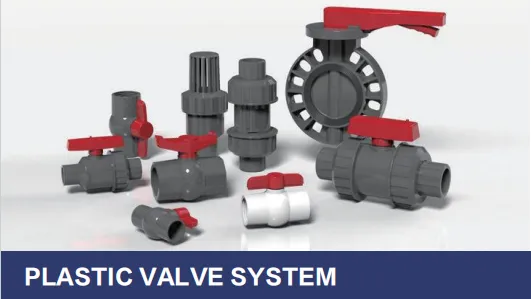
A comprehensive guide to navigating the evolving landscape of industrial flow control solutions
Picture this: you're designing a state-of-the-art water supply and drainage system for a coastal community. The salty air alone would corrode traditional metal valves within months. But plastic valves? They'll outlast your infrastructure plans. That's the reality modern engineers face as plastic valves evolve from simple alternatives to sophisticated solutions in corrosive, high-purity, and temperature-sensitive environments.
Unlike their metallic counterparts, plastic valves bring an almost magical blend of corrosion resistance, lightweight design, and cost efficiency to projects ranging from municipal water plants to pharmaceutical manufacturing. Their DNA resists chemical attacks that destroy metal valves, creating new possibilities in places we couldn't dream of installing valves just a decade ago.
Consider these 2025 projections:
The polymer kitchen is cooking up incredible new recipes. Modified CPVC blends now withstand temperatures that used to be exclusive to stainless steel. PVDF formulations offer unbelievable chemical resistance to solvents and acids that would dissolve lesser materials. These hybrids work like specialized tools rather than generic solutions – imagine valves engineered specifically for sulfuric acid transfer systems or pharmaceutical-grade distilled water.
Your valves are talking - are you listening? We've moved beyond basic sensors. Today's intelligent valves monitor particulate levels, anticipate seal failure months in advance, and self-calibrate to maintain precise flow rates. They form ecosystems where a smart ball valve communicates with a diaphragm valve upstream to optimize system performance automatically. For engineers, it's like upgrading from a flip phone to a quantum computer.
Recycled PVDF material now matches virgin polymer performance at 60% lower carbon footprint. But the innovation goes deeper - we're seeing fully circular systems where end-of-life valves become raw material for new installations. It's not just eco-friendly window dressing; plants actually see 15-20% material cost savings across the lifecycle while meeting aggressive sustainability targets.
Advanced injection molding achieves tolerances of ±0.001 inch – unthinkable a decade ago. What does that mean practically? Bubble-tight seals in vacuum applications. Zero-leak shutoff in hazardous material systems. And at the same time, additive manufacturing allows on-demand valve modifications that would require custom tooling before. It's mass production meeting artisan craftsmanship.
Plastic valves are storming the last bastions of metal valves. In semiconductor manufacturing, they prevent ionic contamination better than electropolished steel. In desalination plants, they laugh at brine that corrodes stainless steel. Even in high-purity biopharma applications, advanced polymers leach fewer contaminants than metal surfaces. The perception that plastic means "cheap substitute" has officially expired.
The affordable workhorse perfect for chilled water systems, agricultural irrigation, and pool chemistry management. New UV-stabilized formulas solve outdoor durability issues.
Exceptional chemical resistance at low cost
Lowest purchase price of all valve materials
Limited temperature range below 140°F (60°C)
Think of it as PVC's sophisticated sibling with a PhD in thermal resistance. Critical for industrial hot water applications where metal valves suffer from mineral buildup and scaling.
Stable up to 200°F (93°C) in continuous service
Resistant to chlorine-based disinfection systems
Becomes brittle at extremely low temperatures
The chemical warfare specialist. Performs miracles in sulfuric acid, hydrogen peroxide, and bleach transfer systems where metal valves disintegrate rapidly.
Champion chemical resistance at molecular level
Outstanding fatigue resistance for automated systems
Limited high-temperature performance ceiling
Where engineering meets extreme environments. Handles concentrated acids, solvents, and high-purity applications that demand single-digit PPB contamination levels.
Highest thermal capability among plastics
Semiconductor-grade purity certifications
Premium price point reflects performance
CPVC ball valves reign supreme for main distribution lines with their perfect balance of corrosion resistance, pressure rating, and cost. The secret innovation? Fusion-bonded seats that eliminate typical leakage paths after thousands of cycles.
Reinforced PP diaphragm valves dominate acid transfer systems. Their leak-free shutoff outperforms traditional ball and gate valves, while completely eliminating stem leakage points. Bonus: diaphragm replacements take under 10 minutes with new quick-change designs.
Ultra-pure PVDF check valves ensure zero contamination in sterile filling lines. The new generation features polished internals with surface roughness measured in nanometers. CIP/SIP compatible designs clean faster while using less sterilizing fluid.
Special-grade PFA angle valves protect billion-dollar processes. Their radical purity certifications guarantee ionic contamination below 1 part per billion - critical when a single speck destroys semiconductor wafers.
The smartest engineers I know approach plastic valve selection like composing a symphony – each material has its tonal quality, each design approach brings unique rhythm to the flow path. In 2025, we've moved beyond "plastic vs metal" debates into a sophisticated material science landscape where purpose-engineered polymers solve problems metals cannot.
Remember that coastal water system? They ultimately selected PVDF ball valves with titanium-reinforced stems. Three years later, zero maintenance interventions versus quarterly overhauls with the former stainless steel valves. That's the transformation happening right now. Your valves shouldn't be the weakest link in your operation – they should be the most resilient component. That future has arrived.
Recommend Products












