
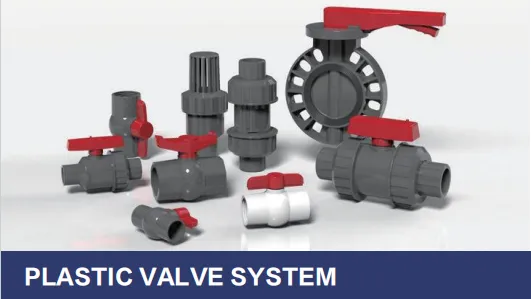
Walk through any modern industrial plant today, and you'll notice a quiet revolution: the gleaming stainless steel valves our dads worked with are being replaced by colorful polymer systems. Why this shift? Plastic valves don't just resist corrosion; they redefine reliability in harsh chemical environments while cutting installation time in half. Unlike their metal predecessors, these lightweight champions flow liquids like whispering mountain streams rather than clunky pipes. By 2025, the market will see polymer valves capture 35% of global industrial applications – that's no niche trend.
Picture this: A pharmaceutical plant switches to PFA-lined valves. Suddenly, batch contamination rates drop to near-zero. Why? No metallic ions leaching into sensitive compounds. Or consider municipal water systems where pipe connectors using CPVC withstand decades of chlorine exposure that would cripple bronze valves. The magic isn't just in the material – it's in how brands engineer flow paths to minimize turbulence, design stem seals that outperform Teflon, and reinvent actuator compatibility.
Starting as a garage operation in Dortmund, ChemGuard now commands 18% of the European chemical sector. Their secret? "Living hinges" – ultra-thin polymer sections that flex millions of cycles without failure. Installations in sulfuric acid transfer lines show zero degradation after 7 years – outperforming alloy valves costing 4x more.
Remember when bio-pharma plants avoided plastics? AquaPlex shattered that myth with their ultra-smooth PVDF ball valves. When Genentech upgraded, their CIP (Clean-in-Place) cycles reduced by 40% – all because microbial colonies couldn't grab onto AquaPlex's laser-polished surfaces. Their secret sauce? Adding trace nano-ceramics during injection molding.
While PVC fails above 140°F, Asahi's PPSU valves handle 380°F steam sterilization cycles. Critical for food processing plants rotating between sanitation and production.
GF Piping's 316 PSI rating seems modest until you realize it's triple the working pressure – that hidden safety net prevents catastrophic failures during pressure spikes.
We're moving beyond static materials into responsive systems. See that valve from Polystream Tech? Its smart polymer changes viscosity when detecting pH shifts – automatically restricting flow if acids exceed concentration thresholds. It's like creating valves with "chemical immune systems".
The real disruption? Additive manufacturing. Siemens recently 3D-printed an entire chlorine dosing station as one continuous flow component with zero joints. Installation time: 90 minutes versus 3 days for traditional assemblies.
Even the best valve fails with poor fitting. Veteran installers know this trick: When joining dissimilar plastics, always use transition sleeves from brands like Simona. Their multilayer adapters prevent galvanic corrosion between say, PP pipes and CPVC valves – a silent killer in processing plants.
Pro tip: Notice bubbles during pressure testing? Unlike metals, polymers expand slightly. Experienced engineers deliberately oversize ports by 0.25mm to create perfect cold-seals as temperatures normalize.
Final Thought: Valve selection isn't just technical specs – it's about understanding how each material breathes under pressure, flexes during thermal cycling, and ages against chemicals. The brands winning in 2025 mastered this molecular tango.
Recommend Products












