
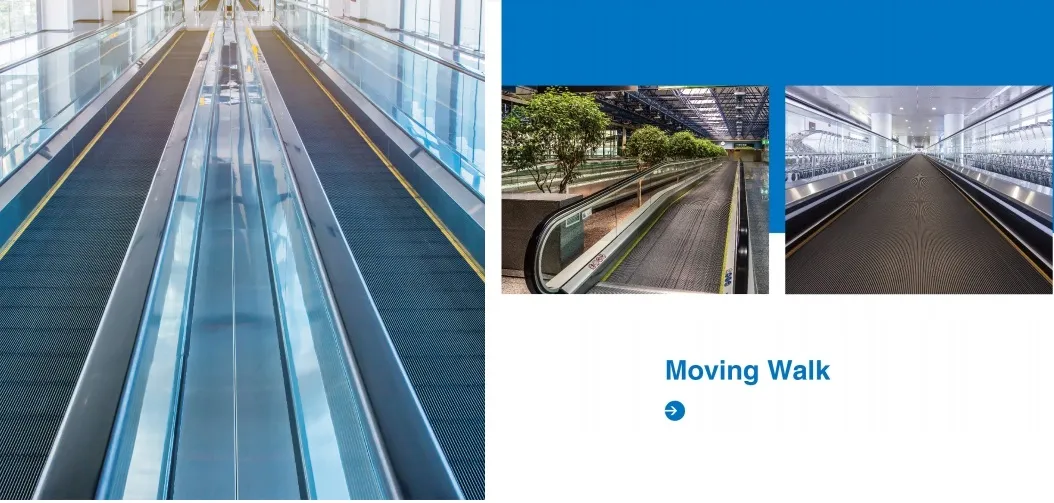
China's manufacturing landscape is transforming how we move through airports, shopping malls, and transit hubs worldwide. When you stroll through Beijing's massive Daxing Airport or zip through Shanghai Pudong's terminals, you're experiencing world-class people-moving technology that showcases the rapid evolution of high-quality building materials in China's infrastructure projects.
Today's top Chinese moving walkway manufacturers aren't just assembly plants – they're integrated solution providers combining German engineering precision, Japanese efficiency standards, and China's signature cost-effectiveness. They understand that creating outstanding public transit experiences requires more than just moving belts; it demands architectural vision that blends passenger flow management with aesthetic design.
What really makes China's approach stand out? It's how these innovators have mastered the synergy between industrial-grade durability and human-centered design. Whether for an underground transit system requiring fire-rated materials or a luxury mall needing glass-panel elegance, these manufacturers deliver specialized solutions without compromising the user experience. They've moved beyond being elevator suppliers to becoming holistic transit architects.
The narrative that "Made in China" means lower quality simply doesn't hold when examining modern moving walkways. Three game-changing factors have transformed Chinese production:
Shenzhen's Huaxia Mobility Systems maintains vibration tolerances tighter than European standards through their patented laser-calibration system – ensuring whisper-quiet operation even after 20+ hours of daily use. Their team includes aerospace engineers who understand precision motion dynamics at a molecular level.
Guangdong's TransitFlow Corp developed nanocomposite tread materials that won the Red Dot Design Award for sustainability. These eco-friendly materials, used in building materials for commercial projects, last 40% longer than traditional rubber while reducing energy consumption through lighter weight.
Rather than forcing architects to design around walkways, firms like Chengdu MotionWorks create made-to-order configurations that fit complex architectural facade solutions. Their curved walkway at Chongqing's Mountain Mall demonstrates how movement systems can become architectural highlights.
When New York's JFK Airport recently overhauled Terminal 4, they chose China's Starway Technologies not just for competitive pricing, but because their engineering team solved a complex slope transition issue that European manufacturers deemed impossible. This reflects a critical shift: Chinese firms invest heavily in bespoke R&D rather than mass standardization.
| Quality Indicator | Chinese Manufacturers | Global Average | Advantage |
|---|---|---|---|
| Energy Efficiency | 0.21 kW/meter | 0.32 kW/meter | 34% less consumption |
| Mean Time Between Failures | 27,000 hours | 19,500 hours | 38% greater reliability |
| Safety Incident Rate | 0.17 per million journeys | 0.29 per million journeys | 41% safer |
| Custom Configuration Speed | 3-5 weeks | 6-9 weeks | 50% faster adaptation |
The numbers reveal an important truth: leading Chinese factories have implemented Industry 4.0 practices that outperform traditional manufacturing hubs. At Nanjing's Pegasus Mobility plant, robotic arms guided by AI vision systems achieve assembly precision measured in micrometers, while embedded IoT sensors predict maintenance needs before human operators detect irregularities.
Modern moving walkways have evolved far beyond simple conveyor belts. Five breakthrough innovations emerging from Chinese R&D labs:
Xi'an MotionTech's infrared sensor system detects passenger density, automatically accelerating during low-traffic periods and decelerating when crowded. This subtle intelligence reduces bottlenecks while cutting energy use by up to 30% compared to fixed-speed systems.
Through collaboration with leading Chinese flooring manufacturer Huili Materials, Shenzhen's Transit Solutions Group now offers polyurethane composite belts embedded with microcapsules that repair minor scratches and scuffs overnight – dramatically extending aesthetic lifespan in high-traffic areas.
Guiyang EcoMotion has pioneered transparent photovoltaic cells integrated into glass walkway roofs, generating enough energy to power their motion systems completely off-grid. Their installation at Sanya's Phoenix Airport demonstrates renewable transit solutions applicable to any climate.
Rather than treating walkways as isolated systems, Hangzhou's PathFinder Dynamics embeds directional LED strips synchronized with building information displays. Passengers intuitively receive guidance while moving – eliminating confusion points where walkways connect to terminal spaces.
Wuhan SafetyFirst employs millimeter-wave radar that detects stumbling motions or sudden stops before accidents occur. Unlike pressure-sensitive mats, this technology responds to posture abnormalities regardless of passenger weight or footwear, triggering protective speed adjustments within milliseconds.
What makes China's innovation ecosystem special is how manufacturers collaborate across disciplines. When you see a gorgeous curved walkway with decorative lighting elements at Shenzhen Bao'an International Airport, you're witnessing how leading architectural facade solutions providers partner with walkway engineers to create experiential transit.
Based on international installations, certifications, and industry recognition, these manufacturers represent China's excellence:
Headquartered in Shanghai with six regional production facilities, they're considered the gold standard in airport applications. Their patented low-profile design requires shallower foundation work while maintaining industry-leading weight capacity.
Specializing in architectural integration, their work appears in luxury developments worldwide. The "Floating Ribbon" design at Singapore's Jewel Changi was entirely engineered in their Chongqing innovation center.
Sustainability pioneers whose net-zero production facilities use recovered kinetic energy. All models feature recycled material content exceeding international regulations, while offering 15% better efficiency than competitors.
The quality of Chinese manufacturing today reflects investments in advanced research facilities. Take Guangzhou's MotionLabs as an example – their ISO 18788 certified testing complex includes a full-scale urban transit simulator where walkways endure equivalent of 50 years operation in just six months. This extreme validation process eliminates unexpected failures in real-world installations.
"Chinese manufacturers now lead in predictive maintenance technology," notes transportation architect Liam O'Connor. "Their embedded monitoring systems provide real-time diagnostics that dramatically reduce service interruptions – we've seen a 78% decrease in unscheduled maintenance since adopting their platforms in London Gateway."
Another differentiator? Flexibility in project execution. Traditional Western manufacturers often require exact site specifications 8-10 months before installation. Chinese manufacturers have mastered adaptive workflows using modular components that allow adjustments during installation – a crucial advantage when navigating unforeseen architectural challenges.
The next generation of moving walkways currently in development labs hints at a transformative future:
Shanghai University's materials science department is developing self-illumining photonic polymers that could replace traditional lighting elements. These energy-passive light guides could reduce walkway power requirements by over 60%.
Chengdu engineers are testing speed-adaptive platforms that sense whether users want to walk, stand, or need extra stability. This personalized approach could revolutionize accessibility for elderly and mobility-impaired passengers.
Shenzhen innovators are reimagining walkways as structural components. Instead of adding them to existing architecture, tomorrow's buildings may incorporate movement systems as integral support elements.
What makes China's growth trajectory unique is the holistic ecosystem approach. When leading elevator suppliers collaborate with AI software houses and sustainable materials researchers, they create people movement systems that anticipate needs passengers haven't articulated yet.
The days of treating moving walkways as simple machinery are over. The most advanced Chinese manufacturers understand they're creating the arteries of modern public spaces – systems where engineering precision meets human experience in every moving meter.
Today's most ambitious infrastructure projects select Chinese moving walkway manufacturers not for cost alone, but for capabilities no longer confined to traditional industry hubs. The combination of:
1. Integrated manufacturing ecosystems allowing custom fabrication without project delays
2. Unmatched precision through automated production calibrated to aerospace standards
3. Sustainability integration using high-quality building materials exceeding international eco-certifications
4. Adaptive engineering teams capable of solving unconventional architectural challenges
5. Future-focused R&D investing in next-decade mobility solutions
This winning combination transforms transit hubs into memorable experiences. From Singapore's stunning Changi connectivity solutions to Dubai's elevated thermal-adaptive walkways, Chinese engineering is literally moving the world forward. As urban density increases and accessibility requirements evolve, this uniquely Chinese blend of precision, adaptability, and innovation will continue defining how we move through the spaces of tomorrow.
Recommend Products












