
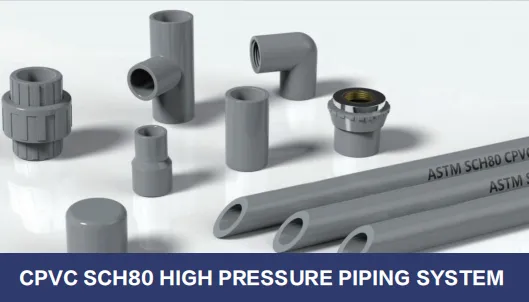
In the backbone of industrial operations—whether it's a chemical processing plant, a water treatment facility, or a manufacturing hub—piping systems play a role far more critical than just "moving fluids." They are the circulatory system, ensuring that everything from raw materials to finished products, from coolants to high-pressure gases, flows reliably, safely, and efficiently. Yet, for all their importance, industrial piping systems face a relentless onslaught of challenges: extreme pressure, corrosive chemicals, fluctuating temperatures, and the ever-looming threat of downtime from leaks or failures. For decades, plant managers and engineers have grappled with balancing durability, cost, and maintenance—often settling for materials that excel in one area but fall short in others. Enter CPVC SCH80 high pressure piping systems: a solution that's quietly revolutionizing how industries approach their piping needs. In this article, we'll dive into why CPVC SCH80 has become a go-to choice for industrial applications, exploring its unique benefits, real-world impact, and how it stacks up against traditional and alternative materials.
Before we unpack CPVC SCH80, let's first ground ourselves in the realities of industrial piping. Imagine a chemical plant where acids and solvents are transported at high pressures, or a food processing facility where hot water and cleaning agents flow through pipes 24/7. In these environments, a single pinhole leak can lead to product contamination, equipment damage, or even safety hazards. Traditional materials like steel or iron, once the default, come with their own set of headaches: they corrode, rust, and require constant monitoring for pitting or scaling. Even newer plastic alternatives, such as the widely used PVC-U SCH40 (a staple from many a pvc-u sch40 pressure piping system supplier ), often struggle with high pressure or temperature extremes. Meanwhile, options like PPR (Polypropylene Random Copolymer) or PEX (Cross-Linked Polyethylene), popular in residential and light commercial settings (and readily available from ppr pipe and fitting supplier or pex pipe and fitting supplier ), may lack the robustness needed for heavy industrial use. The result? Industries have long needed a material that can handle pressure, resist chemicals, tolerate heat, and keep maintenance costs in check. CPVC SCH80 emerges as that material.
CPVC, or Chlorinated Polyvinyl Chloride, is a thermoplastic polymer derived from PVC (Polyvinyl Chloride) through a chlorination process. This extra step—adding chlorine molecules to the PVC structure—enhances its chemical resistance, temperature tolerance, and mechanical strength, making it far more versatile than standard PVC. The "SCH80" designation refers to the pipe's schedule, a standardized rating that indicates wall thickness and, consequently, its pressure-bearing capacity. In simple terms, SCH80 pipes are thicker than their SCH40 counterparts, allowing them to withstand significantly higher pressures. For context, a 2-inch SCH40 PVC pipe might handle around 450 psi at room temperature, while a SCH80 pipe of the same diameter can push that to over 600 psi—numbers that matter when you're dealing with industrial-scale pressure.
Manufactured through extrusion, CPVC SCH80 pipes are designed with precision, ensuring uniform wall thickness and consistent performance. Unlike metal pipes, which require welding or threading (and the associated labor and equipment costs), CPVC SCH80 uses solvent cement or mechanical fittings, simplifying installation. But what truly sets it apart is how it marries the best of plastic's flexibility with the durability needed for industrial rigor. Let's break down its key benefits.
At the heart of SCH80's appeal is its ability to handle high pressure—and not just "high" by residential standards, but industrial-grade high. The SCH80 designation means the pipe walls are thicker, which directly translates to higher burst pressure and working pressure ratings. For example, a 1-inch CPVC SCH80 pipe can typically handle up to 1,000 psi at 73°F, while larger diameters (like 4 inches) still clock in at around 300 psi—more than enough for most industrial processes, from hydraulic systems to high-pressure water jetting. Compare that to standard SCH40 PVC, which, as any pvc-u sch40 pressure piping system supplier will confirm, maxes out at lower pressures (e.g., 450 psi for 1-inch pipes at 73°F). For operations where pressure spikes are common—say, during startup or process changes—this extra margin of safety is invaluable. It's not just about avoiding leaks; it's about peace of mind that the system can handle the unexpected.
Industrial fluids are rarely "gentle." From sulfuric acid in battery manufacturing to sodium hydroxide in paper production, pipes are bombarded with substances that eat away at metals and even some plastics. CPVC SCH80, however, is a chemical-resistant champion. Its chlorinated structure creates a barrier that resists most acids, alkalis, salts, and organic solvents—even at elevated temperatures. Unlike steel, which rusts and pits when exposed to moisture and chemicals, or copper, which can corrode in acidic environments, CPVC remains inert. This resistance isn't just about longevity; it's about maintaining purity. In pharmaceutical or food processing, for instance, a corroded metal pipe could leach contaminants into the product. With CPVC, that risk is eliminated. Even compared to alternatives like PPR or PEX (common offerings from ppr pipe and fitting supplier and pex pipe and fitting supplier ), CPVC SCH80 holds an edge: PPR can struggle with strong oxidizing agents, while PEX is less resistant to oils and certain solvents. For industries where chemical compatibility is non-negotiable, CPVC SCH80 is a game-changer.
Industrial processes rarely stick to room temperature. Whether it's hot water for cleaning, heated oils for machinery, or steam condensates, pipes must withstand elevated temperatures without warping, weakening, or deforming. CPVC SCH80 excels here, with a maximum continuous use temperature of around 200°F (93°C)—far higher than standard PVC (which tops out at ~140°F) and even exceeding some metal alloys in specific applications. This makes it ideal for processes involving hot liquids, such as in chemical reactors, industrial boilers, or food sterilization lines. What's more, CPVC's temperature resistance is consistent across its lifespan; unlike some plastics that become brittle over time when exposed to heat, CPVC maintains its structural integrity, ensuring long-term reliability.
Anyone who's worked with steel pipes knows the hassle: heavy lifting equipment, specialized tools for cutting and welding, and teams of workers to maneuver even small sections. CPVC SCH80, by contrast, is remarkably lightweight—about 1/7th the weight of steel. This isn't just a convenience; it's a cost-saver. Lighter pipes mean easier transportation, simpler on-site handling, and faster installation. A single worker can carry a 20-foot length of 2-inch CPVC SCH80 pipe without breaking a sweat, whereas steel would require a forklift. Installation is equally straightforward: no welding, no threading, just solvent cement (which bonds in minutes) or mechanical fittings. This reduces labor hours, minimizes downtime during retrofits, and lowers the risk of installation errors. For projects where time is money, CPVC SCH80's installation efficiency is a major plus.
Corrosion isn't just a maintenance issue—it's a financial drain. A study by the American Water Works Association estimated that corrosion costs U.S. industries over $137 billion annually, from pipe replacements to lost productivity. CPVC SCH80 sidesteps this problem entirely. Unlike metal, it doesn't rust, corrode, or develop scale. Its smooth inner surface resists the buildup of deposits, ensuring consistent flow rates over time. This means fewer clogs, less pressure drop, and reduced energy costs (since pumps don't have to work as hard to push fluid through narrowed pipes). In coastal or high-humidity environments, where salt air accelerates metal corrosion, CPVC's resistance becomes even more critical. Over a 20-year lifespan, a CPVC SCH80 system can save tens of thousands of dollars in maintenance, repairs, and replacements compared to steel or even concrete pipes.
Let's talk numbers. At first glance, CPVC SCH80 might cost more upfront than standard PVC or even some metals (though it's often cheaper than stainless steel). But "cost" isn't just about the initial invoice—it's about the total cost of ownership (TCO). Consider: steel pipes require coatings or liners to prevent corrosion, adding to upfront costs. They also need regular inspections, cleaning, and eventual replacement. PPR or PEX, while cheaper upfront, may need to be replaced sooner in industrial settings due to chemical or pressure limitations. CPVC SCH80, with its 50+ year lifespan (in ideal conditions), minimal maintenance, and energy efficiency (thanks to smooth flow), often ends up being the most cost-effective choice over time. A cpvc sch80 high pressure piping system supplier can provide detailed TCO analyses, but anecdotal evidence from industries that have made the switch tells the story: lower labor costs, fewer repairs, and longer service life add up to significant savings.
To truly appreciate CPVC SCH80's value, it helps to see how it stacks up against common alternatives. Let's compare it to five widely used materials in industrial applications:
| Material | Max Working Pressure (1" pipe, 73°F) | Max Temp Resistance | Chemical Resistance | Installation Complexity | Maintenance Needs | Typical Lifespan |
|---|---|---|---|---|---|---|
| CPVC SCH80 | ~1,000 psi | 200°F (93°C) | Excellent (resists acids, alkalis, solvents) | Low (solvent cement/mechanical fittings) | Minimal (no corrosion, smooth interior) | 50+ years |
| PVC-U SCH40 (from pvc-u sch40 pressure piping system supplier ) | ~450 psi | 140°F (60°C) | Good (limited chemical and temp resistance) | Low | Minimal (but shorter lifespan in harsh conditions) | 20-30 years |
| Steel | ~1,500 psi (varies by grade) | 1,000°F+ (high) | Poor (corrodes in chemicals, saltwater) | High (welding, threading, heavy equipment) | High (inspections, corrosion treatment, repairs) | 20-30 years (with maintenance) |
| PPR (from ppr pipe and fitting supplier ) | ~400 psi (at 73°F) | 180°F (82°C) | Fair (susceptible to oxidizing agents) | Medium (heat fusion needed) | Moderate (prone to scaling in hard water) | 25-35 years |
| PEX (from pex pipe and fitting supplier ) | ~400 psi (at 73°F) | 200°F (93°C) (PEX-A) | Fair (oils and solvents can cause degradation) | Low (crimp or push fittings) | Low (but not ideal for high-pressure industrial use) | 40-50 years (residential/commercial) |
The table tells a clear story: CPVC SCH80 outperforms most alternatives in pressure resistance, chemical tolerance, and lifespan, while matching or exceeding them in ease of installation and maintenance. It's a balanced solution that doesn't force tradeoffs between durability and practicality.
CPVC SCH80 isn't just a theoretical improvement—it's making a difference in industries worldwide. Let's explore a few key applications where cpvc sch80 high pressure piping system solutions are proving indispensable:
In facilities that produce fertilizers, dyes, or pharmaceuticals, CPVC SCH80 transports everything from hydrochloric acid to methanol. Its chemical resistance ensures that pipes don't degrade, even with constant exposure to harsh substances. A leading chemical manufacturer in the Gulf region recently replaced its steel acid-transport lines with CPVC SCH80, reducing maintenance costs by 65% and eliminating downtime from corrosion-related leaks.
Municipal and industrial water treatment plants rely on CPVC SCH80 for high-pressure backwash systems, chemical dosing lines, and brine transport. Its resistance to chlorine and other disinfectants, combined with its pressure handling, makes it ideal for these critical operations.
From cleaning-in-place (CIP) systems to hot water lines, CPVC SCH80 meets FDA standards for food contact, ensuring product safety. Its smooth interior prevents bacterial buildup, a key concern in food processing.
In power plants, CPVC SCH80 is used for cooling water systems, chemical injection lines, and ash handling. Its temperature tolerance and corrosion resistance make it suitable for the high-heat, high-moisture environments of boilers and turbines.
Of course, even the best material is only as good as the supplier behind it. When selecting a cpvc sch80 high pressure piping system supplier , look for partners who prioritize quality: certifications like ASTM D2846 (the standard for CPVC pipe and fittings), rigorous testing protocols, and a track record of serving industrial clients. A good supplier should also offer technical support—helping with system design, pressure calculations, and installation best practices. After all, industrial piping is a long-term investment, and you want a partner who's committed to your success, not just selling a product.
In the fast-paced world of industrial operations, reliability isn't a luxury—it's a necessity. CPVC SCH80 high pressure piping systems deliver that reliability, combining high pressure resistance, chemical tolerance, temperature stability, and cost-effectiveness in a single package. By eliminating the headaches of corrosion, reducing maintenance burdens, and simplifying installation, they free up resources to focus on what truly matters: growing your business. Whether you're retrofitting an aging plant or building a new facility, CPVC SCH80 isn't just a piping material—it's a long-term investment in efficiency, safety, and peace of mind. As more industries discover its benefits, one thing is clear: the future of industrial piping is looking a lot more durable, and a lot less stressful.
Recommend Products












