
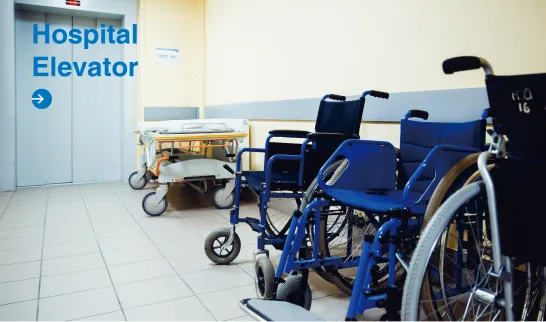
When every second counts and patient safety is paramount, hospital elevators become vital lifelines – let's explore what separates adequate lifts from truly exceptional ones.
Hospital elevators aren't just people-movers – they're specialized medical equipment requiring more precision than a surgeon's scalpel. Picture this: an ICU nurse racing against time with a critical patient, an orderly wrestling with heavy imaging equipment, and visitors navigating unfamiliar corridors. All while maintaining a sanctuary-like environment for recovery. That's the daily reality hospital elevators must handle seamlessly.
Unlike commercial lifts, these vertical transporters must balance competing priorities: medical urgency with gentle operation, germ-resistant surfaces with constant accessibility, massive weight capacity with energy efficiency. It's no exaggeration to say lives depend on their performance.
Ever tried squeezing a hospital bed into a standard elevator? It's like fitting a giraffe into a Mini Cooper. High-quality hospital elevators understand space isn't just about dimensions – it's about movement freedom. We're talking about cab designs allowing 180-degree bed rotation during transport, wide enough for two crash carts to pass without jostling, with ceiling heights accommodating upright traction equipment.
But it's not just about physical measurements. Smart designs include recessed handrails, fold-down seats that vanish when needed, and corner-mounted control panels leaving clear pathways. Building materials matter too – non-porous surfaces not only prevent bacterial growth but withstand regular dousing with powerful disinfectants without degrading. Speaking of building materials , they must be exceptionally durable to withstand continuous use in healthcare settings.
Here's where engineering becomes artistry. Picture transporting a trauma patient with spinal injuries – that elevator ride needs smoother than a Rolls Royce on fresh asphalt. Top-tier hospital lifts incorporate:
The quietness factor matters enormously too. Imagine trying to hear a beeping IV pump over elevator gear noise! Premium systems operate below 45 decibels – quieter than a quiet conversation.
In hospitals, elevators can be germ superhighways. Quality designs turn them into sterile transport bubbles through:
The difference shows in infection rate studies – hospitals with advanced elevator hygiene protocols report 22% fewer HAIs according to recent healthcare design journals.
True safety isn't about meeting codes – it's anticipating failures. Premium hospital elevators feature:
The heavy-lift champions designed around ICU equipment dimensions. You'll recognize these by oversized door arches and reinforced flooring capable of handling three fully-equipped beds simultaneously. Critical features include bed-wheel locking grids and oxygen tank restraints.
The workhorses handling everything from laundry carts to meal trolleys. Look for scuff-resistant stainless walls, drainage channels for spills, and industrial-grade bumpers. Many feature separate "clean" and "soiled" zones.
Emergency department favorites designed for rapid movement. Their trademark? Split-second door operations and interior layouts accommodating ECG monitors while staff perform CPR. Often have integrated power outlets.
Not glorified passenger lifts! These include privacy screens for confidential discussions, encrypted access controls, and fatigue-reducing padded rails where surgeons can lean during 18-hour shifts.
The Swiss Army knives – convertible spaces with modular walls that transform from standard passenger cabs to critical care transports in seconds via button press.
Investing in quality hospital elevators pays compounding dividends:
The true value becomes apparent during emergencies – when properly designed elevators become extensions of the ER rather than obstacles to it.
Choosing hospital elevators involves more than comparing spec sheets. Facilities must consider:
The quiet heroes – elevator technicians – deserve special attention too. Ensure provider training includes infection control protocols so maintenance doesn't introduce pathogens. And remember: that warranty should cover not just parts, but downtime costs – because when hospital elevators fail, patient care gets stranded.
For hospitals, selecting elevators carries weight no commercial decision should bear – they're literal life-support systems in vertical form. The difference between mediocre and magnificent doesn't just show in operational flow or budget sheets; it echoes in the quiet sigh of relief from a surgeon reaching the OR with seconds to spare, in the peaceful transfer of a fragile newborn between floors, in the absence of infections traced to transportation pathways.
This hidden infrastructure deserves scrutiny matching its impact. Because truly, in healthcare environments, what moves us upward should elevate care standards in every possible dimension.
Recommend Products












