
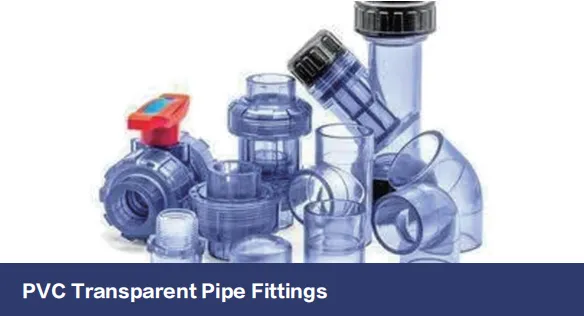
When it comes to building reliable fluid transport systems, the devil’s in the details – and those details often revolve around transparent PVC pipe fittings. These crystal-clear connectors and tubes aren’t just for show; they’re engineered workhorses that offer unparalleled utility in dozens of industries. From letting lab technicians monitor chemical reactions in real-time to helping brewers maintain quality control in fermentation tanks, transparent fittings transform opaque industrial processes into observable, controllable systems.
High-quality PVC transparent pipe fittings combine strength with clarity – chemical-resistant enough to handle corrosive materials, yet transparent enough to see when maintenance is needed. They’re the unsung heroes keeping everything from pharmaceutical production lines to craft breweries running smoothly.
That glass-like transparency isn’t accidental. Premium PVC fittings achieve optical clarity through meticulous polymer formulation and processing techniques. Manufacturers carefully balance plasticizers, stabilizers, and UV inhibitors to maintain transparency without sacrificing durability. Unlike cheaper alternatives that turn cloudy over time, high-quality PVC retains over 92% light transmission even after years of use and chemical exposure.
You’d be amazed how many systems benefit from this simple visibility. In biotech labs, technicians watch for air bubbles in vaccine production lines. Aquarium operators track fish health through visible water flow. Food processing plants verify cleanliness without disassembling pipes. The transparency provides constant quality assurance that colored pipes simply can’t match.
Top-tier PVC transparent fittings handle everything from mild acids and alkalis to aggressive solvents like acetone and methanol. Their non-reactive nature makes them ideal for pharmaceutical manufacturing, chemical processing, and laboratory environments where stainless steel would corrode or contaminate solutions.
Don’t let the see-through design fool you. Schedule 80 PVC fittings withstand up to 630 PSI at room temperature – enough for most industrial applications. The molecular alignment from extrusion creates impressive hoop strength without compromising clarity. Even at higher temperatures up to 140°F, quality fittings maintain 50-75% of their pressure rating.
While PVC has limitations compared to specialized plastics, high-grade transparent fittings operate reliably from 33°F to 140°F. Advanced formulations with impact modifiers retain flexibility at colder temperatures where cheaper PVC becomes brittle. For brewers transferring chilled wort or labs handling cryogenic fluids, this thermal stability prevents catastrophic failures.
Visual flow monitoring helps technicians spot connection issues, sediment buildup, or flow disruptions long before they cause major leaks or system failure.
In food/pharma applications, visible interiors enable verification of cleaning protocols – you can literally see when sanitation is incomplete.
Air bubbles, contamination discolorations, crystallization – all become immediately apparent for rapid troubleshooting without disassembly.
Precisely measured additives and fillers minimize waste while maintaining optical properties. Quality fittings use 100% recyclable PVC with manufacturing scrap rates below 2%.
Every material has tradeoffs. Transparent PVC fittings’ limitations are manageable but worth noting:
| Limitation | Real-World Impact | Proven Solutions |
|---|---|---|
| UV Degradation | Extended sunlight exposure causes yellowing/reduced clarity | UV-stabilized formulations; protective coatings; indoor use |
| Temperature Sensitivity | Performance drops above 140°F; brittleness below freezing | Insulation; thermal monitoring; CPVC alternatives for hot fluids |
| Chemical Compatibility | Aromatic hydrocarbons and ketones can cause swelling | Compatibility charts; small-scale testing; fluoropolymer liners |
Pro Tip: For applications needing extreme temperature resistance above 200°F, consider glass-lined systems or fluoropolymer alternatives. But for 90% of use cases, quality PVC offers the best balance of clarity, cost and performance.
Getting that perfect seal requires technique. For solvent welding:
Maintain that crystal-clear appearance with simple care:
Beyond standard couplings and elbows, transparent systems use specialized fittings for unique applications:
| Fitting Type | Unique Advantage | Ideal Applications |
|---|---|---|
| Clear Unions | Quick-disconnect without cutting pipes | Lab equipment cleaning; sampler ports |
| Sight Glasses | Reinforced thick-walled observation zones | Pump suction monitoring; particle detection |
| Transparent Valves | Visual confirmation of flow status | Critical isolation points; sterile systems |
| O-Ring Seal Fittings | Resealing capability after disassembly | Maintenance-intensive systems; prototypes |
Modern PVC formulations address environmental concerns effectively:
Safety-wise, transparent fittings provide unique advantages like visible gas bubble detection in hydrogen systems and confirmation of hazardous material purges before maintenance. Their non-conductive nature prevents galvanic corrosion when transitioning between metals.
The next generation of transparent fittings is already emerging:
In sectors like biopharma where every micron matters, transparent fittings are evolving from passive conduits to active monitoring platforms with integrated sensors for pH, turbidity and flow velocity.
While basic PVC fittings might seem interchangeable, the premium invested in quality transparent versions pays dividends in system reliability, maintenance reduction, and operational insight. They transform plumbing from a "set it and forget it" installation into an interactive diagnostic tool. By specifying fittings with certified material composition, controlled manufacturing processes, and robust physical properties, engineers design systems that offer both functionality and invaluable transparency.
Whether you're maintaining an aquarium filtration system or designing a semiconductor fabrication line, don't underestimate how much visual access enhances operational intelligence. That clear view into your process flow isn't just nice to have – it's the foundation of predictive maintenance, quality assurance and efficient troubleshooting.
Recommend Products












