
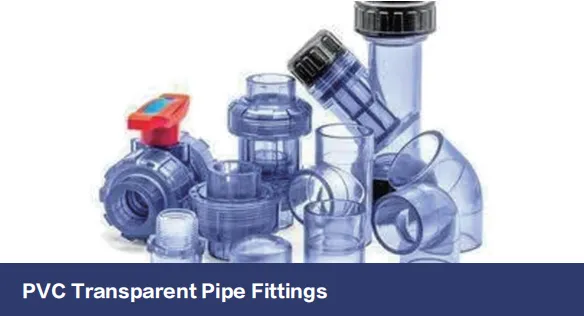
Picture a tool that lets engineers dream wilder, manufacturers work smarter, and end-users get precisely what they need – not just "close enough." That's what 3D printing is doing for PVC transparent pipe fittings today. While plastic pipes might seem like humble components, they're vital arteries in everything from breweries to biotech labs. Getting them customized quickly used to mean eye-watering costs and months-long waits. But thanks to 3D printing, we're seeing a seismic shift where bespoke designs and rapid prototyping are now within reach for everyone.
This isn't just about making things differently – it's about unshackling creativity. Engineers no longer need to compromise on designs because mold costs are prohibitive. Need a fitting with unusual angles for a cramped installation? A custom connector for specialty equipment? With 3D printing, these move from "impossible" to "print it by Thursday."
Traditional manufacturing methods treat PVC pipe fittings like mass-produced commodities. Injection molding requires steel molds costing thousands of dollars and weeks of lead time – sensible for million-unit runs but crippling for specialized needs. CNC machining carves away precious material (up to 90% waste!) and struggles with complex internal geometries.
3D printing sidesteps these bottlenecks entirely. Imagine:
Modern printing processes like Multi Jet Fusion handle transparent PVC materials beautifully, creating crystal-clear fittings with structural integrity matching traditionally manufactured parts.
Clear PVC pipes aren't just aesthetic choices – they're functional necessities in countless industries:
Seeing bubble formation, fluid levels, or contamination can prevent costly errors. Printed transparent fittings enable custom observation ports right where needed.
Monitoring flow without disrupting processes? Critical. Printed connectors with built-in inspection windows keep production lines moving.
Testing flow dynamics? Debugging complex assemblies? Physical > simulation every time. Printing enables iteration where seeing is understanding.
One game-changing application lies in sanitary installations using specialized pipe fittings . Pharmaceutical labs increasingly deploy printed transparent connectors that can be steam-sterilized while providing visible confirmation of sterile fluid paths – something impossible with opaque metal alternatives.
A microbrewery struggled with foaming issues in their unique fermentation setup. Rather than ordering expensive custom brass fittings (8-week lead time), they printed transparent PVC connectors overnight. Seeing where bubble nucleation occurred led to a redesigned fitting that solved the problem. Total cost? Under $100 and 36 hours.
An Alaskan fish processing plant suffered a critical fitting failure. With replacement parts weeks away by barge, they printed a durable transparent PVC connector using onsite equipment. Production resumed in 6 hours.
Mass production has its place, but for niche applications, 3D printing offers compelling advantages:
| Factor | Traditional Manufacturing | 3D Printing |
|---|---|---|
| Minimum Order Quantity | 1000+ units | 1 unit |
| Customization Cost | High setup fees | Negligible |
| Iteration Speed | Weeks/months | Hours/days |
| Design Constraints | Significant | Minimal |
This flexibility is transformative for:
The technology isn't standing still. Emerging trends will further revolutionize PVC pipe fittings:
Imagine printed PVC connectors with embedded sensors monitoring flow rate, pressure, or chemical composition. 3D printing enables this electronics integration during fabrication.
Using recycled PVC feedstock in printers significantly reduces environmental impact versus traditional manufacturing waste streams. Some facilities already achieve near-zero PVC waste.
Why ship fittings globally when local 3D print hubs can produce certified parts on demand? This slashes logistics costs and carbon footprints dramatically.
As manufacturing gets more connected and automated, components must keep pace. 3D printed PVC fittings naturally integrate into this ecosystem:
Digital inventories replace costly physical warehouses - just hit print when needed. Mass customization becomes routine rather than exceptional. Maintenance cycles get transformed through on-demand replacement parts with enhanced design life.
The future factory floor will see AI-designed fittings optimized for specific performance metrics, printed locally, installed by robots, and monitored in real-time – and transparent PVC components will be central to visible process verification.
The humble pipe fitting has entered a revolutionary era. 3D printing transforms PVC transparent fittings from commodities to custom-designed solutions that enhance safety, efficiency, and functionality across countless industries. The barriers to innovation have crumbled – what once required deep pockets and endless patience now demands only imagination and a printer.
As material science advances and printing technology becomes even more accessible, we're not just looking at incremental improvements, but a fundamental reimagining of how we design, produce, and deploy these critical components. The pipes may stay transparent, but the future of their fittings has never been clearer.
Recommend Products












