
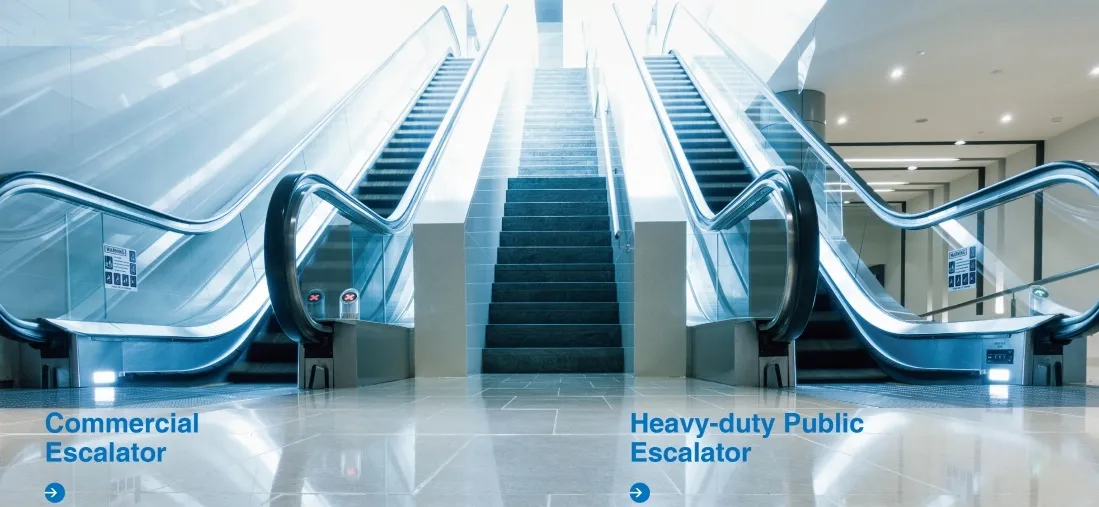
Picture this: You're walking through a shopping mall at 10 AM on a Tuesday. The place is nearly empty except for a few early shoppers and staff. Yet the escalators are running full tilt, grinding away at maximum speed with no passengers in sight. It feels wasteful because it is wasteful. These energy-guzzling workhorses consume electricity regardless of whether they're transporting passengers or just moving air.
Variable Frequency Drive (VFD) technology is like giving escalators a smart brain - suddenly they understand when to sprint and when to nap. Instead of operating at constant high speeds 24/7, they adapt to real-time demand, slowing down when empty and accelerating only when passengers approach.
Across office buildings, airports, and transit stations worldwide, escalators account for up to 10% of a building's total energy consumption. That's a staggering number when you consider they're essentially moving stairs. What makes this statistic more concerning is that traditional units operate at full capacity approximately 85% of the time while actually transporting people only 15% of that time. That energy mismatch is where variable frequency technology comes to the rescue.
The heart of an escalator is a three-phase induction motor. In conventional setups, these motors get a constant voltage and frequency, spinning at near-full speed regardless of need. Here's where it gets interesting: VFDs adjust both voltage and frequency to match the motor's speed to the actual requirement.
Imagine driving your car with only two options - full throttle or completely stopped. That's how traditional escalators operate. VFDs introduce an intelligent accelerator that smoothly controls speed. When sensors detect no passengers for a preset time, the system gently slows the escalator to about 20% of normal speed - what engineers call "sleep mode." When motion sensors detect approaching passengers, the system smoothly ramps back up to full speed before their first foot touches the step.
Typical energy savings in commercial installations
Average ROI period for retrofitting existing systems
Reduction in mechanical wear and tear
The physics behind these savings is surprisingly elegant. Motor power consumption relates to the cube of rotational speed. Reduce speed by 20%, and energy use drops by nearly 50%. Slow down by 50%, and you're using only 12.5% of the original energy. This isn't linear savings - it's exponential magic! Plus, the gradual ramp-up dramatically reduces mechanical stress on gears, chains, and bearings compared to the jarring starts and stops of conventional systems.
When Heathrow upgraded its massive Terminal 5 complex, engineers faced a dilemma: 78 escalators moving air more than people. After implementing variable frequency technology:
The technology proved particularly valuable during overnight hours when passenger traffic dropped to near zero but maintenance crews needed occasional access. Now escalators remain in low-power standby mode until motion triggers activation.
The world's largest shopping destination faced astronomical electricity bills from its 150+ escalators. After a comprehensive VFD retrofit:
Intriguingly, the system demonstrated unexpected benefits during the 2020 pandemic closures. While the mall operated at limited capacity for months, escalators automatically adjusted to match the sparse foot traffic patterns, saving thousands in operational costs weekly.
While energy savings grab headlines, variable frequency technology delivers a cascade of secondary benefits that collectively transform building operations:
"The most surprising benefit was how the variable systems changed our maintenance scheduling. Before, we reacted to breakdowns. Now we predict component wear using the system's data outputs."
- Javier Rodriguez, Chief Engineer at Barcelona Metro
Retrofitting existing escalators requires careful planning but isn't as disruptive as many facility managers fear:
Retrofit Reality Check: Modern systems install directly into existing motor control cabinets without changing drive mechanisms. Most projects complete during off-hours in 8-12 hour increments per unit. The modular nature minimizes building disruption - a crucial consideration for hotels and hospitals.
Smart Sensor Synergy: Advanced installations integrate with other building systems. Motion detectors, security cameras, and even Wi-Fi tracking collaborate to predict traffic patterns. Some airports now sync escalator behavior with flight arrival screens, automatically adjusting to passenger surges.
Financial Wisdom: While initial investment ranges $8,000-$20,000 per unit (depending on complexity and length), the payback period typically falls between 2-4 years through energy savings alone. Factor in reduced maintenance costs and longer asset life, and the ROI becomes compelling.
Variable frequency technology is just the starting point. The future lies in truly intelligent vertical transport:
Forward-thinking manufacturers are exploring frictionless magnetic levitation concepts that would eliminate mechanical wear entirely. Others develop photovoltaic steps that generate energy with each footfall - the ultimate closed-loop system.
Variable frequency technology transforms escalators from dumb machines into responsive, efficient building partners. The benefits cascade through every aspect of operations - slashing energy bills 30-60%, dramatically reducing maintenance needs, extending equipment lifespan, and creating smoother experiences for passengers.
With commercial buildings facing increasing pressure to reduce environmental footprints and operational costs, smart escalator technology delivers measurable ROI while aligning with global sustainability goals. As one facilities director at a major New York office tower shared: "The savings exceeded our projections by 22% in year one. But honestly? The quiet operation and passenger compliments were the unexpected wins that made me wish we'd done it sooner."
For building managers evaluating smart upgrades, VFDs represent low-hanging fruit with high returns. The technology has matured beyond experimentation to become a standard best practice in modern building design. As energy costs continue rising and environmental standards tighten, the question isn't whether to adopt variable frequency technology - it's how soon you can start saving.
Recommend Products












