


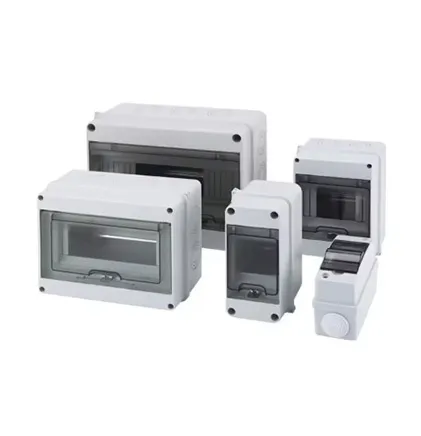
You know that feeling when you're setting up a temporary power station outdoors, and the weather forecast turns from promising to problematic? Or when you're installing electrical equipment in a corrosive factory environment, wondering if it'll hold up? We've all been there. The truth is, picking the right protection level for distribution boxes isn't just about compliance paperwork—it's about real-world reliability when it matters most.
Distribution boxes protect our electrical systems like bodyguards shield VIPs. When they fail, everything goes dark. Today, we'll explore how international standards translate into practical protection through rigorous testing methodologies that simulate the harshest conditions on earth.
Decoding the IP Rating Language
That "IP67" or "IP65" rating stamped on distribution boxes? It's not just random numbers—it's a universal language telling us exactly what environmental stresses an enclosure can handle. Let's break down this coding system that separates resilient equipment from vulnerable setups.
First Digit: Solid Object Defense
Imagine construction sites where cement dust hangs thick in the air or factories filled with metal shavings. The first digit is our shield against these invaders:
- IP5X (Level 5): Dust-resistant—keeps out most particles but not completely dust-tight. Perfect for urban events or lightly dusty areas.
- IP6X (Level 6): Dust-tight—absolute protection against fine powders and particles. Essential for quarries or heavy industrial zones where dust concentration hits 50mg/m³ or higher.
Testing Insight: During IP5X/6X testing, enclosures are placed in a dust chamber for 8 hours with talcum powder circulating. To pass IP6X, you shouldn't even find a speck of dust inside—truly airtight.
Second Digit: Liquid Warfare
When rainstorms hit or high-pressure washdowns begin, this rating becomes your best friend:
- IPX4: Handles splashes from any direction—ideal for light drizzles up to 50mm/h
- IPX5: Withstands water jets (6.3mm nozzle @ 30 kPa)—designed for heavy rainfall over 100mm/h
- IPX6: Resists powerful jets (12.5mm nozzle @ 100 kPa)—essential for environments needing frequent washdowns
- IPX7: Survives temporary submersion up to 1m depth for 30 minutes
- IPX8: Endures continuous underwater operation at specified depths
The testing for water resistance isn't gentle either. For IPX7 certification, technicians literally dunk distribution boxes into water tanks and watch the clock for a full half-hour while monitoring for leaks—no mercy shown.
Environmental Challenges & Custom Solutions
Real-world environments mix multiple threats simultaneously. Coastal ports battle salt corrosion while construction sites juggle dust and downpours. Here's how smart engineering tackles these combinations:
Material Warfare Against Elements
The enclosure material makes all the difference in hostile environments:
| Environment | Threats | Material Solution | IP Rating |
|---|---|---|---|
| Coastal Areas | Salt spray (150mg/m²·d), High humidity | 316 Stainless Steel + EPDM gaskets | IP66 |
| Battery Plants | Acid/alkaline exposure (pH 2-12) | UV-stabilized polycarbonate | IP67 |
| Arctic Zones | -40°C temperatures, icing | Fluorosilicone rubber gaskets | IP67 |
| Desert Sites | +50°C heat, UV degradation | Aluminum with ceramic coating | IP65 |
Implementation Tip:
Port of Singapore case study: Using 316 stainless steel boxes with special nano-coating reduced maintenance costs by 60% over 3 years despite constant salt exposure—proof that smart material selection pays off.
Industry-Specific Mandates
Different sectors demand specialized protection profiles:
- Construction Sites: GB 7000.212-2008 mandates IP65+ for all temporary distribution boxes
- Food Processing: Requires IP69K (high-pressure, high-temperature steam cleaning) with FDA-approved gaskets
- EU Installations: EN 60529 certification needed for CE compliance
- Hazardous Locations: Additional certifications like ATEX for explosive environments
Test Standards Dissection (IEC/EN Focus)
What happens behind laboratory doors to verify those IP ratings? IEC and EN standards create exhaustive testing protocols that leave no vulnerability unexposed.
Mechanical Torture Testing
Distribution boxes undergo physical abuse simulations:
- IK Impact Rating: Steel pendulum hammers deliver calibrated impacts (IK08 = 5 Joule impact)
- Non-removable Parts Test: Applying 30N force perpendicular to surfaces for 1 minute
- Durability Cycling: 10,000 open/close cycles on doors and access points
During impact testing, technicians use specialized equipment to precisely deliver hammer blows at specific energies to simulate forklift collisions or dropped tools—the distribution box equivalent of a crash test.
Extreme Temperature Validation
How equipment survives thermal extremes:
- Heat Resistance: Steel balls pressed on surfaces at 125°C for an hour followed by rapid water cooling
- Glow Wire Test: 960°C filament contact for 30 seconds to verify fire resistance
- Thermal Cycling: Repeatedly moving between -40°C and +85°C environments
The glow wire test particularly separates durable plastics from flammable materials—if any part ignites or continues burning after test completion, the entire enclosure fails certification.
Electrical Safety Gates
The electrical testing that ensures user safety:
- Insulation Resistance: Applying 500V DC between live parts and enclosure
- Electric Strength: High voltage tests from 1kV to 3.75kV depending on rated voltage
- Earth Continuity: ≤0.1Ω resistance verified with 10A test current
Electric strength testing brings drama—technicians gradually ramp voltage while listening for arcing sounds and watching for insulation breakdown. It's a high-stakes performance review where failure means sparks literally fly.
From Paper Standard to Field Reality
Certificates gather dust in filing cabinets unless backed by smart implementation. Here's what separates theoretical compliance from real-world resilience:
Five-Step Implementation Framework
- Environmental Assessment: Collect dust concentration (Grimm 1.109 meter), rainfall patterns (Testo 635), and corrosion parameters
- Compliance Mapping: Match conditions to local standards (GB, CE, UL 1640)
- Supplier Validation: Verify test reports from SGS/Intertek and material certifications
- Field Trials: Install sample boxes for 2-week monitoring period
- Customization: Add UV coatings or specialty gaskets as needed
A German automaker recently avoided $700k in downtime costs by implementing these steps. Their mistake? Installing standard IP65 boxes in a paint shop where chemical vapors required IP66 with acid-resistant gaskets—a detail caught during field trials.
Innovations Changing the Game
The future of distribution protection features exciting developments:
- Self-healing Gaskets: Silicone compounds that re-seal after compression
- Smart Monitoring: Built-in sensors detecting moisture intrusion before damage occurs
- Nano-Coatings: Molecular-level protective layers repelling water and corrosion
- Modular Designs: Swappable seals for changing environmental requirements
Forward-thinking manufacturers now offer "environmental adaptation kits" letting users upgrade gaskets or seals when moving equipment from construction sites to coastal installations—acknowledging that protection needs evolve.
Beyond Ratings - The Human Factor
While we obsess over test standards, the human element remains critical:
- Installation errors account for 38% of protection failures according to IEC studies
- Cable entry points prove the weakest link in 60% of water intrusion cases
- Overtightening seals reduces effectiveness by compressing gaskets unevenly
Recently, a solar farm avoided costly downtime by training technicians on proper cable gland installation—a small investment that protected $4M worth of equipment during monsoon season. This underscores that even IP68-rated boxes fail with poor implementation.
Closing Thoughts
Distribution box protection isn't about chasing the highest IP rating like some tech spec trophy. It's a thoughtful balancing act between environmental realities, operational requirements, and smart engineering. The difference between "certified on paper" and "functional in practice" comes down to understanding the why behind each test standard.
When selecting your next distribution box, look beyond the flashy specs. Ask for validation documents from reputable labs, verify material certifications, and most importantly—understand your specific environmental villains. After all, no box gets awards for over-engineering in calm offices or under-protecting in chemical plants.
So next time you see an IP rating, remember the stories behind those numbers—the salt spray chambers, the dust torture rooms, the high-voltage torture tests. That's the unseen engineering drama ensuring lights stay on when storms rage, waves crash, or dust storms engulf worksites. And that reliability is always worth the investment.










