
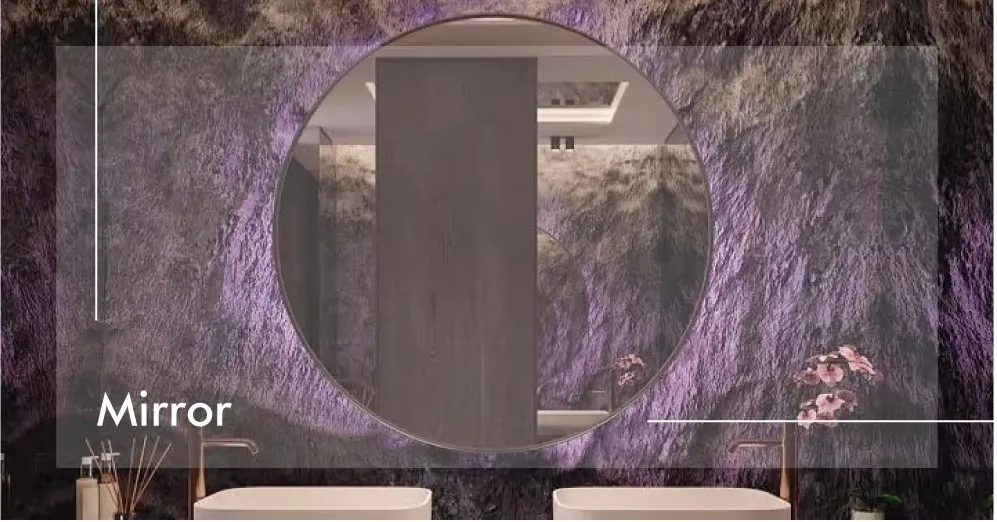
Discover how curved elegance transforms functional spaces into personal sanctuaries
There's something quietly magical about walking into a bathroom where a round mirror greets you like an old friend. Unlike harsh geometric alternatives, these circular wonders seem to whisper rather than shout, wrapping spaces in a soft embrace that says "you belong here." In the past five years, round bathroom mirrors have seen a staggering 78% increase in installations according to interior design analytics, outpacing traditional rectangular options. But this isn't just a passing trend—it's a design awakening. We're rediscovering that personal spaces like bathrooms crave gentle forms that nurture our spirits.
The human brain processes circular shapes differently than angles—it's coded into our biology. Studies in neuroaesthetics reveal we associate round forms with safety, completeness, and softness. When Japanese neuroscientists monitored brain responses to different shapes, circles consistently triggered the superior temporal cortex—the region associated with emotional warmth and social connection.
"Rectangular mirrors give information; round mirrors give emotion. They reflect not just our faces, but our humanity."Dr. Elena Rossi, Spatial Psychologist
Consider your morning routine: rushing to prepare, wrestling with responsibilities. The sharp edges of typical bathroom fixtures subtly add micro-stresses. Now picture the same space softened by a round mirror that mimics celestial bodies, curved windows, and organic forms found in nature. Suddenly that frantic reflection transforms. The curve invites you to lean in, not recoil.
The story begins in 15th century Venice, where glassblowers perfected mercury-backed circular mirrors for physicians examining patients. Functional, not beautiful. When mass production democratized mirrors centuries later, rectangles dominated simply because they were easier to cut from large sheets of glass.
Standard square mirrors installed by contractors purely for utility
Ovals emerge as high-end hotel "luxury" alternatives
Round mirrors dominate Pinterest bathroom boards with 2.3M+ saves
Today's artisan glassmakers have reclaimed the circle through innovative design , precisely controlling liquid glass flow to achieve perfect rounded edges. The result? Mirrors without harsh endpoints that echo the continuous flow of water itself—the element that defines the bathroom's essence.
Frameless thin-profile glass floats like a full moon against stone walls. Paired with concrete basins, it creates a spa sanctuary effect beloved in Scandinavian countries.
Reclaimed wood frames with radiating wood slats bring farmhouse warmth. Ideal for softening modern industrial spaces when centered above freestanding tubs.
Brushed brass frames with concentric circular patterns create jewel-like focal points. Excellent for powder rooms needing personality explosions.
"I was afraid our small master bath would feel cluttered," shares Marisol Chen, who installed a circular mirror above her floating vanity. "Instead, the rounded shape visually expanded the walls upward somehow. It became the room's gentle anchor."
Beyond their psychological magic, circular mirrors offer surprising practical advantages:
Hanging too high creates disconnected floating orb effect
Center between vanity top and ceiling with 45-50" ideal
Lighting integration separates good from magical:
What happens when we encounter our reflection in a gentle circle? Something deeper than vanity. Without sharp corners establishing boundaries between "me" and "the world," the experience becomes more unified. That brief morning moment transforms from critical self-assessment to peaceful self-acknowledgement.
"After installing our round bathroom mirror," shares Elijah Thompson, who renovated after his divorce, "the room stopped feeling like a sterile pitstop. When I see myself framed in that curve now, it's softer. Kinder somehow. Like the space decided to hold me gently."
Perhaps that's the ultimate magic: these curved reflections teach us to be as generous with ourselves as they are with light.
The circular renaissance extends beyond mirrors—rounded islands dominate kitchen remodels, arched doorways replace rigid entries, and curved sectional sofas embrace living rooms. This represents a cultural pivot toward spaces that nurture rather than simply contain. After decades worshipping harsh modernist lines, we're welcoming back softness.
Bathrooms lead this revolution because they're intensely personal spaces where form affects emotion most directly. The round mirror isn't decoration—it's homeopathic architecture, subtly administering therapeutic curves when we're most vulnerable each morning.
As daylight streams across your bathroom tomorrow, notice how your reflection lands. If harsh corners impose rigid boundaries between you and the world, perhaps it's time to soften the edges. After all, the way we meet ourselves each morning inevitably shapes how we meet the world.
Recommend Products












