
Understanding how PVC pipe fittings age isn't just lab science—it's about the pipes in your home, the infrastructure in your city, and the water systems we all rely on. Let's explore why this invisible process matters more than you think.
Imagine installing shiny new PVC pipes in a building, only to find them brittle and cracked after a decade. That’s what happens when we underestimate aging. Researchers like Bennis et al. subjected CPVC and PVC pipes to accelerated hydrothermal aging —essentially speeding up time by exposing materials to extreme heat and moisture. Their findings weren't optimistic: tensile strength dropped like a rock in water, proving that environmental exposure silently degrades pipe integrity over years.
Real-world impact: Hydrothermal aging mimics decades of service life in months. At 63°C—close to PVC’s glass transition temperature—creep performance becomes unpredictable. Like an old bridge groaning under weight, aged PVC deforms under pressure in ways new material wouldn’t.
The Springer research uncovered a brutal truth: both CPVC and PVC lose flexibility over time. Picture a rubber band left in the sun—it turns brittle and snaps. Similarly, PVC’s molecular chains break down during thermal cycling, causing irreversible damage. Researchers tracked this using something called static damage law , a predictive model that quantifies material decay like an expiration date for plastics.
In ResearchGate’s study, PVC creep wasn’t gradual—it was an erratic dance. At elevated temperatures (63°C), physical aging disrupted predictable patterns. The Struik-Kohlrausch formula, normally reliable, struggled to describe compliance curves during aging. Why? Because PVC near its glass transition temperature undergoes nonlinear molecular restructuring. It’s like trying to predict how ice melts in lukewarm water—traditional rules break down.
Both studies converged on a solution: multi-mechanism modeling. Zhou et al.’s phenomenological framework showed creep compliance evolves in two distinct phases—a chaotic early stage where decay accelerates, followed by stabilized degradation. This explains why traditional master curve techniques failed. Practical translation? Service life predictions must account for this nonlinearity—your pipe won’t whisper warnings before failing.
Industry insight: Incorporating these models into standards could prevent catastrophic failures. Imagine design protocols that treat thermal aging like earthquake resilience—built into structures from day one.
Combining Springer's damage quantification with ResearchGate’s creep analytics creates a powerful predictive toolkit:
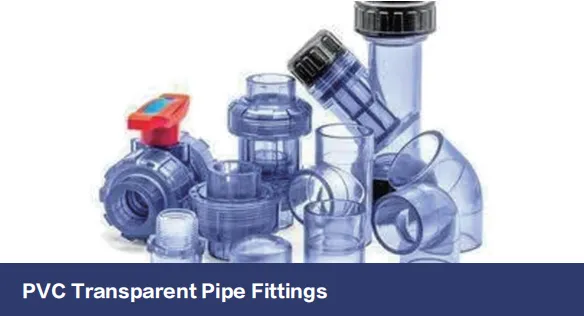
So how might this affect your home’s pipes? Transparent PVC fittings often hide in walls and under sinks. Their deterioration isn’t visible until leaks erupt. Using the research, we could develop pipe fittings with bamboo charcoal additives—a material noted in the architectural industry for moisture regulation. Such innovations could delay aging by absorbing environmental stressors.
Ultimately, these studies shout a clear message: predict performance by simulating time. Manufacturers are already exploring integrated pipe monitoring systems that track material fatigue. Think of it as a "check engine" light for plumbing, where early warnings prevent floods.
Recommend Products












